Oracle Stock: Wall Street Sees Massive Upside. Here’s My Price Target
Oracle just staged a dramatic comeback after cratering more than 50% from its highs, and Wall Street is divided on whether the $638 billion backlog signals a generational opportunity or a capital spending trap waiting to spring.


Oracle (NYSE:ORCL | ORCL Price Prediction) has become one of the most talked-about names in the AI infrastructure trade, and after a violent round trip from north of $341 to the low $130s and back, investors want a number to anchor to.
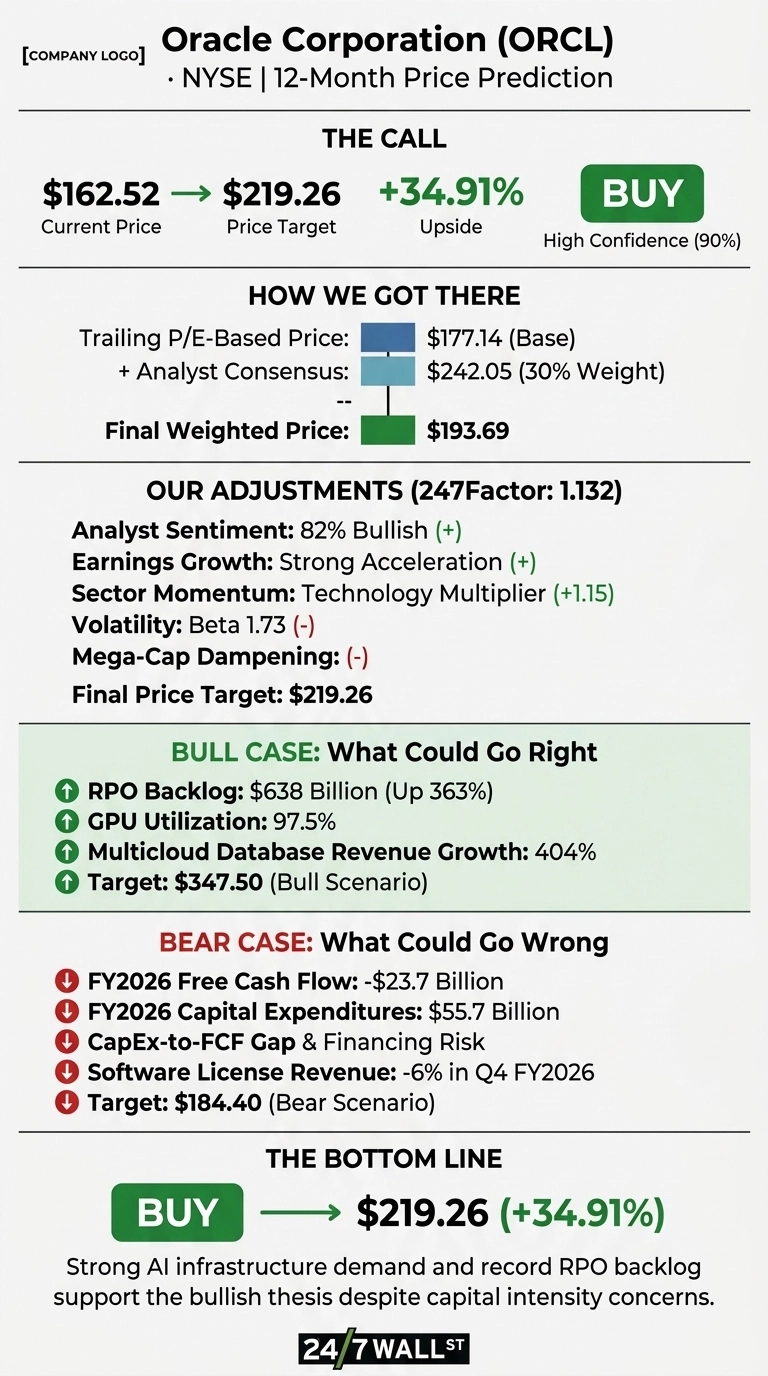
Our 24/7 Wall St. price target for Oracle is $219.26, which implies 34.91% upside from the last close of $162.52. Our recommendation is buy, with high conviction at a 90% confidence level.
24/7 Wall St. Price Target Summary
| Metric | Value |
|---|---|
| Current Price | $162.52 |
| 24/7 Wall St. Price Target | $219.26 |
| Upside | 34.91% |
| Recommendation | BUY |
| Confidence Level | 90% |

A Violent Reset, Then a Bounce Into the Earnings Report
Oracle shares are down 31.07% over the past year and 15.81% year to date, but the stock has flipped decisively in recent weeks: up 10.54% over the past month and 15% in the past week alone as the OpenAI ecosystem returned to favor per MarketWatch coverage on September 8.
That move sets up the Q1 FY2027 report expected September 10, 2026. In Q4 FY2026, Oracle delivered EPS of $2.11 on revenue of $19.18 billion, with Cloud Infrastructure revenue up 93% and Remaining Performance Obligations reaching a staggering $638 billion, up 363% year over year. Polymarket traders are pricing an 83.5% probability that Oracle beats expectations.
Why Bulls See a Breakout Above $300
The bull case is the RPO. Oracle now sits on a $638 billion backlog, with $67 billion in new AI infrastructure signed in Q4 alone and a global GPU utilization rate of 97.5%.
Multicloud database revenue grew 404%, and Safra Catz has walked investors through an OCI ramp reaching $144 billion by FY2030. Management reconfirmed a 31% revenue CAGR and 28% EPS CAGR through FY2030. If Oracle hits FY2028 consensus EPS of $10.97 and the market awards even a 30x multiple, our bull scenario reaches $347.50.

What Could Go Wrong
The bear case is capital intensity. Free cash flow ran to negative $23.7 billion in FY2026 on CapEx of $55.7 billion, and FY2027 CapEx is guided near $70 billion, funded partly through a $20 billion at-the-market equity issuance and additional debt. Software license revenue also fell 6% in Q4.
That said, bulls would counter that a chunk of the RPO, roughly $75 billion, involves customer-supplied GPUs that reduce Oracle’s own capital burden, and Hilary Maxson has flagged steady-state ROIC in the high 20s. Our bear scenario prices in multiple compression and lands at $184.40.

How Oracle Stacks Up Against Microsoft and Amazon
Microsoft (NASDAQ:MSFT) is the natural enterprise-cloud comp, trading at a P/E of 27 with Azure growth of 43% and a commercial RPO of $678 billion. Oracle’s implied forward P/E of 21 looks cheap next to Microsoft given Oracle’s faster OCI growth of 93%.
Amazon (NASDAQ:AMZN) is the pure hyperscaler benchmark. AWS grew 37% in Q2 2026 at a 39.4% operating margin, and Amazon trades at a P/E of 36. Oracle grows OCI faster than AWS, yet trades at a meaningful discount to Amazon on earnings. Against this peer set, the 24/7 Wall St. price target of $219.26 looks conservative relative to peers.
Oracle Price Prediction 2026 to 2030
Oracle looks attractive at $162.52 if you believe the RPO backlog converts to revenue on the schedule management has outlined and OCI capacity keeps clearing at 97.5% utilization. I’d stay on the sidelines if the CapEx-to-FCF gap keeps widening into FY2028 or if a major hyperscaler contract renegotiates lower.
On balance, the 24/7 Wall St. price target of $219.26 and the analyst consensus at $242.05 both point higher. The model’s output skews bullish, with high confidence.
| Year | 24/7 Wall St. Price Target |
|---|---|
| 2026 | $178.89 |
| 2027 | $221.66 |
| 2028 | $269.73 |
| 2029 | $319.01 |
| 2030 | $351.18 |
These projections assume Oracle executes on its FY2030 OCI ramp and preserves cloud margins in the 30% to 40% range. Significant upside or downside could result from AI-contract renewal patterns or the cost of the FY2027 debt and equity raise.
Contact [email protected] for any questions or corrections.
Vandita Jadeja is a financial publisher with over a decade of experience writing about financial topics, including investment, savings, retirement, insurance and banking. Vandita is a Chartered Accountant who loves to debunk financial concepts for readers.
Her work has appeared on sites that include The Motley Fool, InvestorPlace, and Benzinga. She covers investing and focuses on stock picks and price prediction for 24/7 Wall St.
When not looking for the next stock investment opportunity, she can be found traveling, reading, chasing sunsets and enjoying her iced latte.