Oracle Price Prediction: Can Its $638 Billion Backlog Send The Stock Back Toward $250?
Oracle just reported a backlog so massive it rivals Microsoft's entire commercial pipeline, yet the stock sits 40% below where it traded a year ago. Something has to give, and figuring out which way raises billions of dollars worth of…


Oracle’s (NYSE:ORCL | ORCL Price Prediction) remaining performance obligations vaulted to $638 billion in Q4 FY2026, an unprecedented backlog that reframes the investment case. Yet the stock trades nowhere near its prior highs, creating a sharp divergence between fundamentals and price.
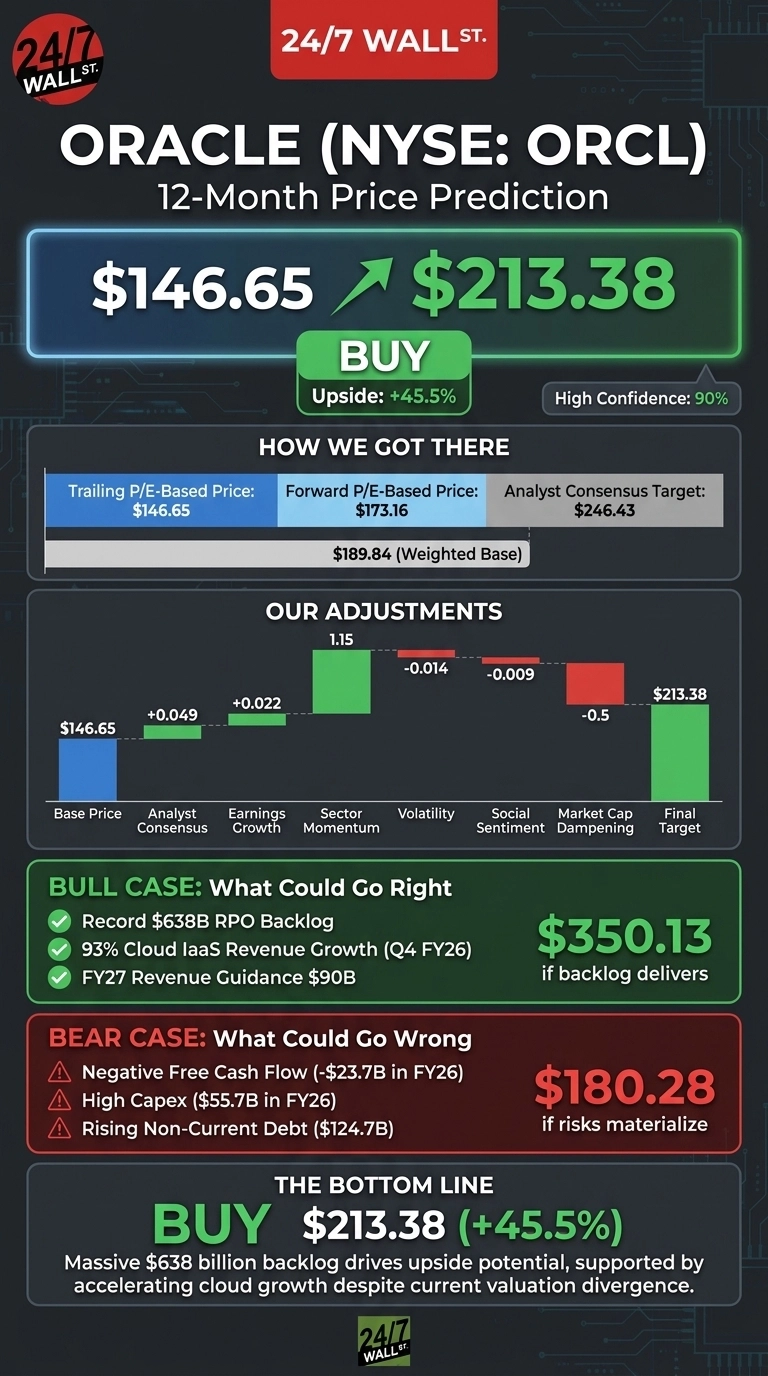
Oracle closed at $146.65 on August 17, 2026. Our 24/7 Wall St. price target for Oracle is $213.38, implying 45.5% upside over the next 12 months. Our model output favors accumulation, with a confidence level of 90%.
The $250 level referenced in bull commentary sits close to the Wall Street consensus target of $246.43, a reach case rather than our base case.
| Metric | Value |
|---|---|
| Current Price | $146.65 |
| 24/7 Wall St. Price Target | $213.38 |
| Upside | 45.5% |
| Recommendation | BUY |
| Confidence Level | 90% |
A Painful Year That Set Up the Opportunity
Oracle has fallen 40.26% over the past year and 24.03% year to date, though shares are up 16.01% over the past month as the backlog narrative gains traction. The stock sits 28% below the 52-week high of $341.82.
Q4 FY2026 delivered EPS of $2.11 on revenue of $19.18 billion, with cloud infrastructure jumping 93% to $5.79 billion. Management signed $67 billion in AI infrastructure contracts in a single quarter, with global GPU utilization at 97.5%.

Why Bulls See a Path to $350
The bull case rests on the backlog. Of the $638 billion in RPO, 12% converts to revenue in the next 12 months and 34% in the following 24. CFO Hilary Maxson called it “exceptional visibility into our future revenue growth.” FY2027 revenue is guided to $90 billion with non-GAAP EPS of $8.05, and Safra Catz previously projected OCI reaching $144 billion by FY2030.
Our bull scenario points to $350.13 within 12 months if capacity delivery keeps pace with demand, aligned with the 37 buy or strong buy ratings anchoring consensus.

What Could Go Wrong
The bear case starts with cash. Oracle burned $23.69 billion in free cash flow in FY2026 against capex of $55.66 billion, with roughly $40 billion of new debt and equity planned in FY2027. Non-current debt has climbed to $124.7 billion, and insider activity has been net selling across 36 recent transactions.
Bulls counter that $75 billion of the backlog uses customer-prepaid or bring-your-own-hardware structures with no margin degradation, and Maxson expects steady-state ROIC “in the high 20s.” Our bear scenario still points to $180.28, above today’s price.

How Oracle Compares to Microsoft and IBM
Microsoft (NASDAQ:MSFT) is the direct hyperscaler contrast. Its commercial RPO reached $678 billion, only slightly larger than Oracle’s despite Microsoft’s $3.57 trillion market cap versus Oracle’s $434 billion. Microsoft trades at a P/E of 27, roughly in line with Oracle’s trailing 26, but Oracle’s forward multiple of 19 is markedly cheaper on projected earnings, making our $213 target look conservative on a relative basis.
IBM (NYSE:IBM) is the legacy enterprise software comparison. IBM grew Q2 FY2026 revenue just 1.1% with an AI book of business near $12.5 billion, orders of magnitude smaller than Oracle’s backlog. That growth gap justifies Oracle commanding a higher multiple than IBM and reinforces the case that $213 remains a measured target.
Oracle Price Prediction 2026-2030
Our 24/7 Wall St. price target of $213.38 carries a bullish model bias at 90% confidence. The tipping factor is the RPO trajectory: from $455 billion in Q1 to $638 billion in Q4 with no margin degradation on the newest contracts.
The bullish thesis strengthens if capacity delivery in Q1 FY2027 approaches the 1 gigawatt target management flagged. It weakens if free cash flow remains deeply negative through FY2028 without visible RPO conversion.
Here is where our model projects Oracle could trade in the coming years, assuming current growth trajectories and market conditions hold.
| Year | 24/7 Wall St. Price Target |
|---|---|
| 2026 | $165 |
| 2027 | $213 |
| 2028 | $275 |
| 2029 | $340 |
| 2030 | $414 |
These projections assume Oracle continues converting RPO to revenue at forecast margins. Significant upside or downside could come from AI capex cycle timing and interest expense on the FY2027 debt raise. Oracle is one of several names riding the data-center buildout, and we profiled seven suppliers powering that wave, from power to cooling, in a free report you can grab here.
Contact [email protected] for any questions or corrections.
Vandita Jadeja is a financial publisher with over a decade of experience writing about financial topics, including investment, savings, retirement, insurance and banking. Vandita is a Chartered Accountant who loves to debunk financial concepts for readers.
Her work has appeared on sites that include The Motley Fool, InvestorPlace, and Benzinga. She covers investing and focuses on stock picks and price prediction for 24/7 Wall St.
When not looking for the next stock investment opportunity, she can be found traveling, reading, chasing sunsets and enjoying her iced latte.