The $1.7 Trillion Job Apocalypse: Why Investors Can’t Ignore Humanoid Robots
AI has already gutted white-collar tech jobs by the hundreds of thousands, but the next wave targets something far bigger: the physical economy and the wages of workers who never touched a keyboard.


The U.S. labor market is sending mixed signals. The July employment report from the Bureau of Labor Statistics showed payrolls actually declined by 23,000 while unemployment held at 4.1%. More troubling, May and June payroll gains were revised down by a combined 103,000 jobs.
Yet there are still pockets of strength: health-care employment continues to rise, and median weekly earnings increased 4.6% year over year in the second quarter, ahead of the 3.9% increase in consumer prices. The economy isn’t collapsing. But beneath the headline numbers, technology is changing what it means to have a job.
AI Has Already Started The Labor Shakeout
The first wave is hitting white-collar workers. U.S. technology companies have eliminated nearly 140,000 jobs in 2026, according to Financial Times analysis. Amazon (NASDAQ:AMZN | AMZN Price Prediction), Microsoft (NASDAQ:MSFT), Meta Platforms (NASDAQ:META), and Oracle (NYSE:ORCL) account for roughly 50,000 of those cuts.
AI isn’t necessarily responsible for every layoff. Pandemic-era overhiring and cost cutting also matter. But companies increasingly describe AI as a reason to build leaner organizations.
That matters because AI can compress work that once required entire teams. A process that previously needed dozens of employees can, in some cases, be handled by software with one person overseeing the output. Monday.com (NASDAQ:MNDY), for example, announced plans in July to eliminate about 20% of its workforce, or roughly 630 positions, while redirecting resources toward its AI platform.
SaaS companies face an even more uncomfortable question: If customers can use AI to build software, automate workflows, analyze data, and generate content themselves, how much software do they need to buy?
The old epithet hurled at unskilled workers to “learn to code” suddenly looks less reassuring when the machines are learning to code, too.
Now Robots Are Coming For Physical Jobs
Humanoid robots extend the same economic logic into the physical world.
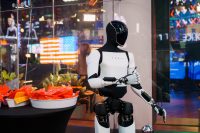
Citizens Bank estimates that Tesla‘s (NASDAQ:TSLA) Optimus could eventually target roughly $1.7 trillion of U.S. wages, with about $300 billion of work already serviceable in areas including factories, warehouses, and back-of-house operations. Its model assumes a humanoid could cost about $5 per hour to operate versus roughly $35 per hour for a human worker, producing a potential payback period of less than 18 months.
Those are only estimates, as Optimus still has to prove reliability, safety, maintenance costs, uptime, and mass-production economics. But the incentive is clear.
Tesla plans to begin Optimus production before the end of 2026 and ultimately targets annual capacity of 1 million robots. That gives Tesla something competitors don’t have: a giant factory network where it can deploy robots internally, lower labor costs, collect operating data, and refine the technology before selling it elsewhere.
Citizens Bank says pressure could emerge first in $75 billion of logistics and material-moving wages, $60 billion in manufacturing, $40 billion in food service, and $35 billion in health and elder care that are classified as near- or mid-term serviceable.
The Hardest Problem Isn’t Technology
For investors, the bigger issue isn’t whether robots eventually work. It’s what happens to workers when they do.
The initial targets are disproportionately lower-skilled, repetitive jobs. Those workers may have fewer opportunities to move into the higher-paying positions created by automation. A warehouse worker cannot necessarily become an AI engineer after taking a six-week course.
AI enthusiasts often describe a future where people no longer need to work. The missing part of that vision is how households pay for housing, food, health care, and everything else once wages disappear.
That is the uncomfortable investment thesis: AI and robotics can increase corporate productivity while simultaneously weakening the purchasing power of the consumers those companies depend upon.
Key Takeaway
In short, investors shouldn’t dismiss humanoid robots as science fiction. Citizens Bank’s $1.7 trillion estimate is a long-term scenario, not a forecast, but even a fraction of that opportunity would reshape labor-intensive industries.
The winners could be companies selling robots, chips, software, power, and automation infrastructure. The risk is that the productivity boom arrives faster than the economy creates new ways for displaced workers to earn a living.
The AI revolution started by attacking digital jobs. Humanoid robots could take the fight into the physical economy next.
Contact [email protected] for any questions or corrections.
After two decades of patrolling the dark corners of suburbia as a police officer, Rich Duprey hung up his badge and gun to begin writing full time about stocks and investing. For the past 20 years, he’s been cruising the markets looking for companies to lock up as long-term holdings in a portfolio while writing extensively on the broad sectors of consumer goods, technology, and industrials. Because his experience isn’t from the typical financial analyst track, Rich is able to break down complex topics into understandable and useful action points for the average investor. His writings have appeared on The Motley Fool, InvestorPlace, Yahoo! Finance, Money Morning, and, of course, 24/7 Wall St. He has been featured in both U.S. and international publications, including MarketWatch, Financial Times, Forbes, Fast Company, and USA Today.