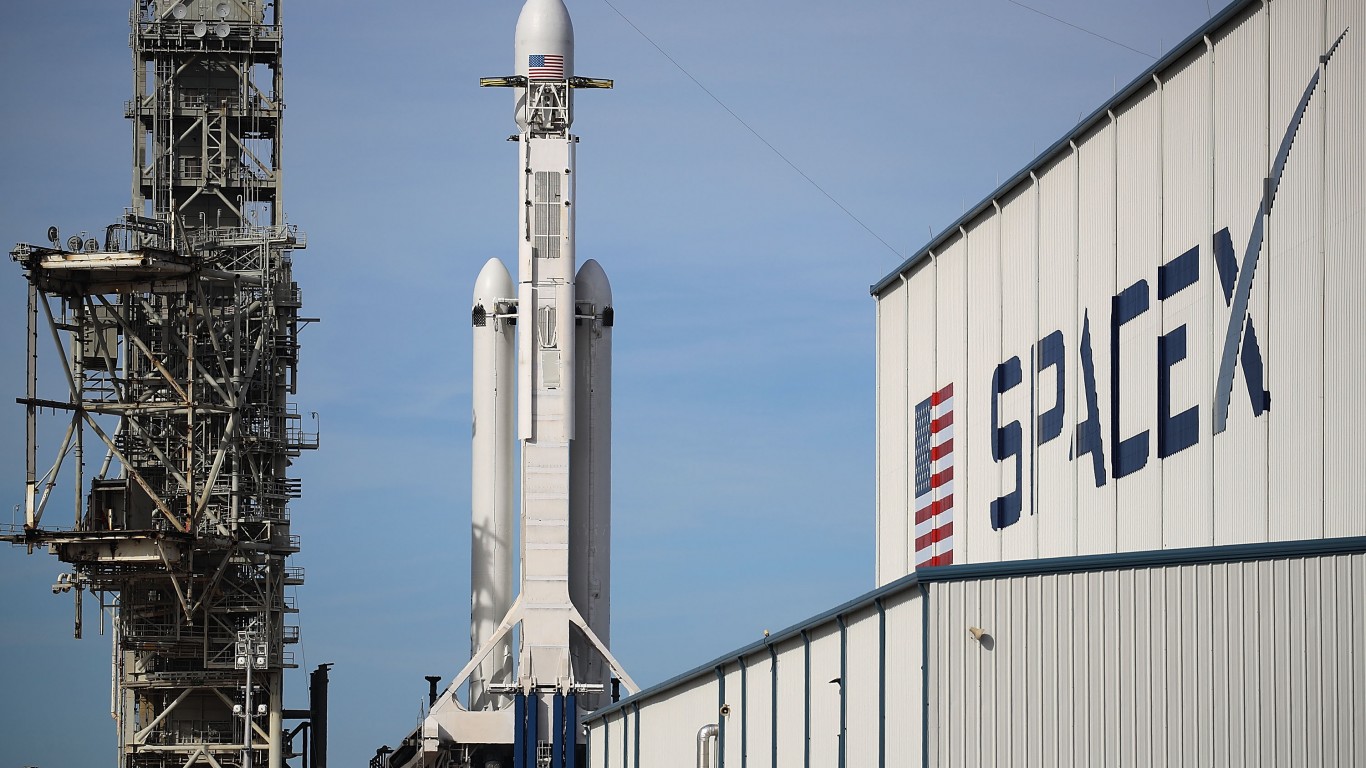
Think AI Is Expensive? SpaceX Is Spending $100 Billion to Build a New Starbase
Hyperscalers are already burning through capital at a pace that shocks Wall Street, but SpaceX just announced a project that makes trillion-dollar AI budgets look cautious. The question is whether one profitable satellite business can carry a bet this size.

The AI infrastructure boom is rewriting the definition of capital-intensive growth. UBS estimates hyperscalers will spend $4.1 trillion on AI infrastructure from 2026 through 2028, more than triple the $1.3 trillion deployed during the previous six years. That spending reaches $1.009 trillion this year, $1.447 trillion in 2027, and $1.619 trillion in 2028.
The remarkable part isn’t just the size of the numbers. It’s how quickly companies are committing capital before the revenue arrives. SpaceX (NASDAQ:SPCX | SPCX Price Prediction) is now taking that same logic into space.
SpaceX Takes the Spending Race to Louisiana
SpaceX announced yesterday that it plans to invest at least $100 billion in Starbase Louisiana, a 125,000-acre launch complex in Vermilion Parish. Construction is scheduled to begin in 2027, with the first launch targeted for 2029. The Louisiana Economic Development agency says the facility is designed to support thousands of launches annually.
That is a staggering number for a company whose trailing-12-month capital expenditures already total about $42.4 billion. SpaceX generated roughly $23 billion of revenue over that period, meaning the new Starbase investment alone would equal more than four times annual revenue.
The comparison gets even more striking when you isolate the company’s traditional space business. About 19% of SpaceX’s revenue comes from space operations, or roughly $4.35 billion. At $100 billion, Starbase Louisiana represents about 23 times that annual revenue.
AI Spending Shows Why This Matters
In the context of the broader infrastructure race, UBS estimates Amazon (NASDAQ:AMZN), Alphabet (NASDAQ:GOOG), and Microsoft (NASDAQ:MSFT) will collectively spend capital equivalent to 102% of their cloud revenue in 2026. UBS expects that ratio to ease to 99% in 2027 and 94% in 2028 — but dollar spending keeps rising.
That tells investors that companies aren’t waiting for today’s revenue to justify tomorrow’s infrastructure. They’re spending ahead of demand because whoever owns the capacity may capture the next wave of growth.
SpaceX is doing the same thing, only with rockets, satellites, and launch pads instead of GPUs and data centers.
Starlink Is Funding the Moonshot
Granted, SpaceX doesn’t have the diversified cash engine of a hyperscaler. That’s where Starlink becomes critical.
SpaceX’s Connectivity segment — primarily Starlink — generated $11.4 billion of revenue and $4.4 billion of operating income in 2025. In the second quarter of 2026 alone, Starlink produced $4.29 billion of revenue and $1.66 billion of operating income.
Meanwhile, SpaceX is building another revenue engine. Contracts with Anthropic, Google, and Reflection AI are expected to generate more than $28 billion annually from its Colossus computing infrastructure, although those agreements contain termination provisions.
That combination — profitable Starlink funding today’s ambitions while AI contracts build tomorrow’s cash flow — gives SpaceX a plausible path to financing Starbase.
Key Takeaway
In short, SpaceX’s $100 billion Louisiana project looks extravagant until viewed alongside the $4.1 trillion AI infrastructure boom. The risk is obvious: SpaceX is committing capital at a pace that vastly exceeds its current space revenue.
But that’s also the investment thesis. SpaceX isn’t building Starbase Louisiana for today’s business. It’s building infrastructure for a much larger future involving Starlink, Starship, AI satellites, and potentially thousands of annual launches. For investors, the key question isn’t whether $100 billion is expensive. It is whether SpaceX can turn that enormous infrastructure bet into enough recurring revenue to justify it.
Contact [email protected] for any questions or corrections.
After two decades of patrolling the dark corners of suburbia as a police officer, Rich Duprey hung up his badge and gun to begin writing full time about stocks and investing. For the past 20 years, he’s been cruising the markets looking for companies to lock up as long-term holdings in a portfolio while writing extensively on the broad sectors of consumer goods, technology, and industrials. Because his experience isn’t from the typical financial analyst track, Rich is able to break down complex topics into understandable and useful action points for the average investor. His writings have appeared on The Motley Fool, InvestorPlace, Yahoo! Finance, Money Morning, and, of course, 24/7 Wall St. He has been featured in both U.S. and international publications, including MarketWatch, Financial Times, Forbes, Fast Company, and USA Today.