Micron Is Down 30% From Its High and Just Lost Its $1 Trillion Status
Micron's revenue surged nearly 380% in a year, analysts expect even tighter memory supply through 2028, and more than 75% of next year's output is already committed. So why are investors selling as if the cycle has already peaked?


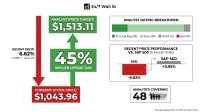
Micron Technology (NASDAQ:MU | MU Price Prediction) closed at $878.84, and Wall Street’s average price target stands at $1,560.57. That leaves a gap of about 77.6% between the share price and where analysts think it belongs.
Friday’s 5.63% drop, or $52.40 a share, left the memory maker worth $994.34 billion. That puts Micron back below the trillion-dollar mark it once crossed.
Micron makes the DRAM and NAND flash chips that AI data centers use. Its latest quarter brought revenue of $54.23 billion, up 379.3% from a year earlier, and management guided for $61.5 billion next quarter.
Yet the stock now trades nearly 30% below its 52-week intraday high of $1,255.00. Analysts argue AI will keep memory scarce for years, while sellers are pricing in a peak that hasn’t shown up in the numbers.
Six Losses in Seven Sessions Knocked Micron Below $1 Trillion
Micron closed at $1,088.00 on October 7 and has fallen in six of the seven sessions since, losing 19.2%. The worst days were October 8, 12, 13 and 14, with drops of 4.79%, 3.88%, 3.62% and 4.08%.
Memory peers fell with it, as SK Hynix dropped 6.58% Friday and SanDisk (NASDAQ:SNDK) lost 6.85%. The chip index posted its eighth straight losing day, its longest streak since 2008.
The selling had macro and sector roots. Tech stocks shed more than a trillion dollars in value as oil hit a five-month high, and investors grew worried about rates and about memory pricing nearing a cyclical peak.
Wall Street Is Still Counting on Years of Tight Supply

Of 49 analysts covering Micron, 9 say Strong Buy and 36 Buy. Only 3 say Hold and 1 Strong Sell.
Their case rests on high-bandwidth memory, the stacked DRAM that AI accelerators need in bulk. Management expects supply and demand to be “much tighter” in 2027 and 2028 than in 2026 and says more than 75% of 2027 output is already committed.
Micron has 26 strategic customer agreements expected to cover more than 35% of revenue through 2030. Chief Executive Sanjay Mehrotra said on the earnings call, “We do not have line of sight to when supply and demand will return to balance.”
Targets are forecasts rather than guarantees. The stock’s forward multiple of about 7 shows how little the market trusts them.

Low Earnings Multiples Have Misled Memory Investors Before
Memory runs in cycles. High prices draw new capacity, supply overshoots, and prices fall, so memory stocks often look cheapest on earnings right before profits peak.
Watch for softer contract pricing, rising customer inventory, and bigger capacity budgets. Micron itself expects about $25 billion in capital spending during the opening six months of fiscal 2027, with more in the second half.
CXMT reported a preliminary nine-month net profit of 131 billion to 132.5 billion yuan, roughly $19.6 billion to $19.8 billion, versus a loss a year ago. That confirms tight DRAM pricing but also funds a Chinese rival’s expansion.
Micron’s 52-week range runs from $192.40 to $1,255.00. That shows how volatile the stock has been.
SanDisk and Seagate Fell Faster Than Micron This Week
The storage group sold off together, and Micron’s 14.58% weekly drop was the softest of the three. Its 208.16% year-to-date gain is still well above the S&P 500’s 11.93%.
SanDisk fell 17.86% in a week to $1,299.30. Its $2,173 average target implies 67.2% upside, with 4 Strong Buys and 17 Buys against 3 Holds and 1 Strong Sell.
Seagate Technology (NASDAQ:STX) lost 18.39% to $639.01, and its $1,138.33 target implies 78.1% upside, barely the group’s largest. It carries 4 Strong Buys, 18 Buys, 2 Holds and 1 Strong Sell, but trades near 26 times forward earnings.
What Could Close Micron’s Gap to Analyst Targets
Micron’s case likely improves if contract pricing holds into its next earnings report, expected around December 15, and hyperscalers keep raising capital spending guidance. Delivering the guided $38.15 in non-GAAP EPS would start closing the gap to $1,560.57.
But the outlook weakens if contract prices flatten, inventories build, or memory makers keep raising capacity budgets, a risk that CXMT’s new profits make more likely.
On balance, the fundamentals look stronger than the share price suggests, although volatility remains high. The selloff came from macro and sector fear, and most of Micron’s 2027 output is already under contract.
Within the group, Micron looks cheaper than Seagate. Seagate offers similar implied upside at a far higher forward multiple, while Micron offers exposure to the same AI storage demand for about 7 times forward earnings.
Contact [email protected] for any questions or corrections.
Omor Ibne Ehsan is a writer at 24/7 Wall St. He is a self-taught investor with a focus on growth, cyclical, and dividend equities that have strong fundamentals, value, and long-term potential. He also has an interest in high-risk, high-reward investments such as penny stocks.