How High Should Inflation Be? Economists Are Split and the Fed Has to Pick a Side
The Fed locked in a 2% inflation promise, and now some economists want to quietly move the goalposts. Whether it accepts that shift or fights for the original target will reprice your mortgage, your bonds, and your retirement timeline.

This post may contain links from our sponsors and affiliates, and Flywheel Publishing may receive compensation for actions taken through them.
The Federal Reserve has a stated inflation target of 2%. The July PCE report showed headline inflation running at 3.7% year over year and core PCE at 3.34%.
On CNBC from Jackson Hole, economists split over whether the Fed should accept 2.5% or press toward the target. Jason Furman argued the labor-market pressure that drove earlier inflation has faded. Allison Schrager acknowledged the composition looks manageable but flagged the credibility gap. Steve Liesman noted committee members who consider 2.5% unacceptable, as well as the daily tariff headlines that make any “one-off” framing hard to defend.
The stakes reach into every retiree’s bond ladder, every mortgage quote, and every equity valuation model. The Fed funds upper bound sits at 3.75% and has held there since December. 10-year Treasury yields 4.70%.
If the Fed accepts a higher inflation floor, long rates likely stay elevated, which is a mixed blessing for savers and a headwind for stocks. If it presses toward 2%, growth pays the bill. The debate is really about which cost the Fed is willing to bear.
What the July Data Actually Shows
PCE, the Fed’s preferred inflation gauge, tracks what households actually spend across goods and services. In July, it rose 0.16% month over month for the headline reading, cooler than May’s 0.48% pace. Core PCE, which strips food and energy, rose 0.25%. Services prices are the sticky part, up 3.69% year over year.
Goods actually fell 0.11% on the month, and WTI crude sits at $83.9 per barrel, down 8.5% from a month ago. That energy relief is real but partial. You can read the underlying series directly at the Federal Reserve.
Trimmed mean PCE, which cuts the extreme movers each month, tends to give a cleaner read on the underlying trend. Real average hourly earnings were $11.30 in July, preliminary, barely different from a year earlier.
Why 2% Is a Promise Not a Formula
The 2% target is a promise the Fed made to households and markets so they would stop assuming inflation would drift, rather than a mathematical optimum derived from a model. Once that anchor slips, wage negotiations, price-setting, and bond pricing all move together. Rebuilding an anchor costs far more than defending one, because expectations are cheap to lose and expensive to earn back.
Furman’s dovish read is grounded in real data. “I’m a little bit less worried about inflation right now. We had really hot labor markets and really fast wage growth. We don’t have either of those right now.” 2026Q2 savings rate fell to 2.8% from 3.9% in Q1, showing households leaning harder on income to keep consumption up.
Schrager’s counterpoint carries more weight. “Inflation might not be too bad. The problem is it’s above target.” The Fed has spent three years telling everyone the target is 2%, and backing away rhetorically is the costly move even if the underlying economics look manageable.
Tariff Hinge That Changes Everything
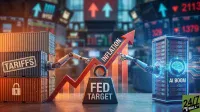
The single most important question is whether tariffs are a one-time price-level shift or a recurring input into future inflation prints. A one-off shock the Fed can look through, because monetary policy cannot undo a supply-side reset. A policy that raises prices every quarter becomes the new normal, baked into expectations.
“It’s very hard, given what’s going on with tariffs right now, to say that the tariffs are one off. The tariffs seem to be daily right now. We have a new tariff on this, a new tariff on that.”
That is why the Fed cannot credibly accept 2.5% as the new floor. If tariffs keep arriving, tolerating the current print effectively imports a permanently higher price level, and once households believe that, the anchor is gone.
What This Means for Your Portfolio
The 10-year Treasury at 4.70% sits near the top of its one-year range. 2s10s spread has steepened to 0.47%. Long rates are pricing sticky inflation.
If the Fed holds the line, rate cuts come slowly, and mortgage costs stay elevated. Bond ladders roll into decent yields, which helps near-retirees, although equity multiples stay pressured by the discount rate.
If the Fed capitulates to 2.5%, the front end drops faster, but the long end could actually back up as the inflation risk premium widens. That is the counterintuitive risk for retirees holding long-duration bonds, because a dovish pivot is not automatically friendly to their statements.
2027 Social Security COLA is tracking toward 3.1%, so benefits adjust, although retirees on fixed, non-indexed income lose ground every month the reading stays above 2%. The Fed should defend the target now rather than try to rebuild it later.
Contact [email protected] for any questions or corrections.
Omor Ibne Ehsan is a writer at 24/7 Wall St. He is a self-taught investor with a focus on growth, cyclical, and dividend equities that have strong fundamentals, value, and long-term potential. He also has an interest in high-risk, high-reward investments such as penny stocks.