Wall Street Strategists Say Tariffs and AI Are Tag-Teaming to Keep Inflation Stuck
Two top Wall Street strategists are pointing at the same unlikely pair of culprits keeping prices stubbornly elevated, and their shared diagnosis carries uncomfortable implications for anyone waiting on the Federal Reserve to cut rates.

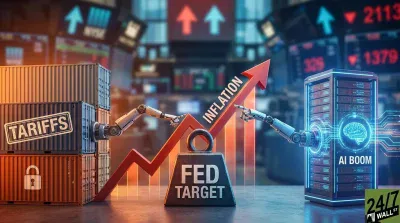
Two prominent Wall Street strategists landed on the same conclusion this week: the trade war and the AI capital spending boom are pushing on the same lever. Both are keeping U.S. inflation stuck well above the Federal Reserve’s target, and neither looks likely to fade soon.
The backdrop is a set of price readings that refuse to cooperate. Headline personal consumption expenditures (PCE) inflation ran at 3.7% year over year in July 2026, with core PCE at 3.3%. Services inflation held at 3.7%, and energy prices were 15.3% higher than a year earlier. The Federal Reserve has been sitting on its hands in response. The upper bound of the federal funds target rate has been 3.75% since December 10, 2025.
Sonders: A Three Handle That Will Not Budge
Liz Ann Sonders, chief investment strategist at Charles Schwab, made the case on the August 28 episode of the On Investing podcast, titled “The Bond Market Strikes Back.” Reacting to the July PCE report, she said, “We still have very comfortably a three handle, both at the headline and the core level. And I just don’t really see what the forces would be to bring that down sustainably.”
“We’re not in a wage price spiral. So I don’t really worry about that traditional driver of inflation. But there are many other sources of inflation that I don’t think are easing anytime soon.” In her framework, two of the biggest sources are tariffs and the AI capital expenditure surge.
On tariffs, Sonders repeated a point that headline coverage routinely obscures. That is, tariffs are taxes paid by U.S. importing companies bringing goods across the border. When Washington raises a duty on steel or autos, the check is written by an American firm bringing the goods across the border. That firm then decides how much of the cost to absorb and how much to push into shelf prices. The result is a direct hit to inflation and a drag on growth. The trade data confirms this. The U.S. ran a $73.3 billion goods and services trade deficit in June 2026, so the tariff base remains large.
Her AI point is subtler. Consensus treats artificial intelligence as a long-run disinflationary and productivity-enhancing force. Sonders describes a near-term counterweight: much of the AI buildout, equipment and otherwise, is import-heavy, which shows up as a negative in the net exports line of the GDP equation while also pushing import prices higher. The same spending wave that is supposed to boost productivity eventually is, in the meantime, adding to measured inflation. (We profiled seven of the non-chip suppliers powering that buildout, from power to cooling. Grab the free report here.)
Swonk: Sticky Services, Plus Consumer Electronics on a Hockey Stick
Diane Swonk arrived at the same AI channel from a different direction on the August 27 Marketplace Morning Report episode “Why inflation in this country is so sticky.” Her framing is that the initial tariff shock has largely played out and simply raised the level of prices, so the Fed’s problem now is underlying service-sector inflation.
She pointed to out-of-pocket healthcare and insurance costs, including co-pays and monthly premiums, as well as accelerating elder care and childcare costs. Then came the AI overlap: “We’re seeing the effects of AI as well. And that is in consumer electronics, which went up at their fastest pace on record. They look like a hockey stick in terms of their acceleration.” Chip demand tied to AI infrastructure is bleeding into finished-goods prices that households pay.
One PCE Print, Both Forces
A separate Marketplace segment captured the convergence. The July core PCE reading of 3.3% year over year was driven by AI-related chip demand pushing up consumer electronics prices and by tariff bleed-through on steel and aluminum products. One inflation print, two supposedly unrelated stories, same direction.
The bond market has taken notice. The 10-year Treasury yield closed at 4.67% on August 27, 2026, with the 30-year at 5.19%. Households are feeling it too. The University of Michigan consumer sentiment index registered 49.5 in June 2026, well below the 60 threshold the survey describes as recessionary. Investors watching for the Fed to declare victory should keep an eye on whether the tariff pass-through fades before the AI capex cycle peaks. On the current trajectory laid out by Sonders and Swonk, the answer is not yet.
Contact [email protected] for any questions or corrections.
Trey has been an editor and author at 24/7 Wall St. for more than a decade, where he has published thousands of articles analyzing corporate earnings, dividend stocks, short interest, insider buying, private equity, and market trends. His comprehensive coverage spans the full spectrum of financial markets, from blue-chip stalwarts to emerging growth companies.
Beyond 24/7 Wall St., Trey has created and edited financial content for Benzinga and AOL's BloggingStocks, contributing additional hundreds of articles to the investment community.
Trey's editorial expertise extends across multiple publishing environments. He served as production editor at Dearborn Financial Publishing and development editor at Kaplan, where he helped shape financial education materials. Earlier in his career, he worked as a writer-producer at SVE. His freelance editing portfolio includes work for prestigious clients such as Sage Publications, Rand McNally, the Institute for Supply Management, the American Library Association, Eggplant Literary Productions, and Spiegel.
Outside of financial journalism, Trey writes fiction and has been an active member of the writing community for years, moderating workshop sessions at regional conventions.