JPMorgan Strategist: The AI Rally Is Expanding Far Beyond the Magnificent Seven
The Magnificent Seven barely budged this year, yet markets keep hitting new highs. A JPMorgan strategist points to a quieter group of companies now driving the AI rally, and their order backlogs suggest the real gains may just be getting…

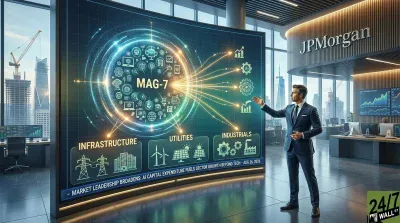
Speaking on CNBC, JPMorgan Private Bank’s Stephen Parker pushed back against the idea that this year’s rally is being carried entirely by the largest Magnificent-7 companies: “I think we are seeing a broadening in market leadership. For a long time it was all about the Mag-7. This year the Mag-7 is barely up. And yet markets are continuing to push to new highs. And while tech continues to be a leader, we’re seeing other sectors like industrials and utilities taking the lead as well.”
Parker framed the rotation towards infrastructure providers: “You’ve seen a transition in market leadership around this AI story. For a number of years it was all about the hyperscalers. This year it’s transitioned to more about the infrastructure providers.”
Infrastructure Companies Are Crushing the Market
Quanta Services (NYSE:PWR | PWR Price Prediction) embodies Parker’s infrastructure thesis. Q2 adjusted EPS of $4.24 beat the $3.03 consensus by 39.93%, revenue reached $9.56 billion, up 41.1% year-over-year, and backlog hit a record $53.44 billion. CEO Duke Austin said Quanta is compounding “as our customers accelerate investment in the electric grid, power generation and mission-critical infrastructure that underpin the economy.” Shares are up 43.14% year to date.
GE Vernova (NYSE:GEV) posted Q2 orders of $24.2 billion, up 88% organically, with total backlog at $176 billion and data-center orders exceeding $5 billion year-to-date, more than double full-year 2025. CEO Scott Strazik called the electric power industry “in the early stages of a multi-decade growth opportunity” and expects at least 125 gigawatts of gas equipment under contract by year-end 2026. GEV is up 42.06% YTD.
Eaton (NYSE:ETN) grew Q2 revenue 21.4% to $8.53 billion, with data-center sales up about 65%. Management sized US data-center backlog at 307 gigawatts, or 15 years of backlog at 2025 build rates. CEO Paulo Ruiz said “data centers remain a key growth driver” across broad end markets. Eaton shares have gained 29.53% YTD.
Networking players like Cisco Systems (NYSE:CSCO) show the opportunity on the connectivity side. CEO Chuck Robbins described a “multi-year, multi-billion dollar networking super cycle“ and booked $4 billion in AI infrastructure orders in Q4 and $9.3 billion for FY2026. Cisco guided FY2027 AI infrastructure revenue to $7.5 billion. Shares are up 46.33% YTD.
AI Is Driving Profitability Outside the Tech Sector
Parker noted how AI is driving legitimate business results across the market: “It’s not just about AI as the driver from a capital spending perspective, but it’s AI as a driver for growth and efficiency in companies and other industries.”
Walmart (NYSE:WMT) exemplifies this. Q2 FY27 adjusted EPS of $0.81 beat the $0.74 consensus, gross profit rate expanded 96 basis points to 25.4%, and global advertising grew 38%. CEO John Furner said Walmart believes “AI will improve nearly every part of our business by making shopping better and our associates work easier.” Walmart also flagged competitive pressures from AI technologies as a risk.
Consumer Spending Driving Broad Strength
Parker also drew a line between consumer sentiment and behavior: “When you actually look at what the consumers are doing rather than what they’re saying, spending continues to be robust. The banks are talking about continued loan demand.”
JPMorgan’s (NYSE:JPM) Q2 backed him up, with CCB revenue at $20.3 billion, up 8% year-on-year, average loans up 10%, and net new checking growth above 500,000 accounts.
Key Takeaways
The strongest evidence for Parker’s broadening thesis is the record backlogs building across power, grid, and networking companies. If those orders continue converting into revenue while consumer spending remains resilient, the next stage of the AI rally could extend into the broader market.
Contact [email protected] for any questions or corrections.
Thomas Richmond is a financial writer and content strategist with 5+ years of experience covering stocks and financial markets. He has published over 500 articles focused on individual stock analysis, helping investors better understand business fundamentals, stock valuations, and long-term opportunities.
Thomas previously served as a Content Lead at TIKR, a stock research platform, where he helped scale the company’s blog to hundreds of articles per month and contributed to a weekly newsletter reaching more than 100,000 investors.
Outside of work, Thomas enjoys weight lifting and soccer.