Former Labor Secretary Predicts AI Will Wipe Out Huge Numbers of White-Collar Jobs
Robert Reich sees white-collar workers in the crosshairs of AI and American homebuyers caught in a trade war neither side can win. His diagnosis of what connects those two threats may surprise you.

This post may contain links from our sponsors and affiliates, and Flywheel Publishing may receive compensation for actions taken through them.
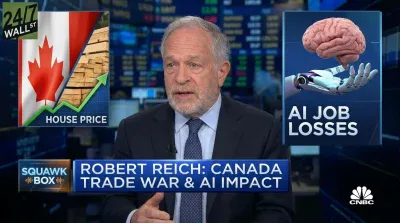
Robert Reich, UC Berkeley emeritus professor of public policy and Labor Secretary under President Bill Clinton, appeared on CNBC’s Squawk Box this morning to argue that the escalating U.S.-Canada trade fight will hit American homebuyers, that AI will displace large numbers of white-collar workers, and that a wealth tax has broad public appeal. Reich is a prominent progressive commentator who just turned 80 this year.
The US-Canada Trade War Has No Clear Winner
Reich’s central claim was blunt. “I think it’s very damaging for both sides. Trade wars are very bad. They’re bad for the economy. They’re bad for American workers. They’re bad for American consumers. They’re bad for Canada,” he said. The trigger is Canada’s announcement of retaliatory tariffs of up to 50% on $20 billion worth of U.S. imports.
Reich argues the U.S. side is driving the breakdown. In his view, “our President is simply lashing out because he wants to show dominance. He feels so trapped in Iran, he feels so trapped by so many forces that are now working against him, that Canada is just an easy mark for a bully.” That is Reich’s political interpretation, and as with any opinion, it may not be correct.
From the opposite perspective, former White House trade advisor Kelly Ann Shaw argued on August 24 that the breakdown reflects Canada’s domestic politics and Prime Minister Carney walking away from a near-final deal at the eleventh hour. Bloomberg reported on August 19 that President Trump delayed a 50% tariff on Canadian products for three days pending a deal.
Why Canadian Lumber Tariffs Could Hit American Homebuyers
The clearest investor takeaway is housing. Reich said: “What I really worry about is home prices. We have a housing sector that is already in trouble. And as Canadian wood products become even more expensive, forest products, you’re going to see housing becoming even more of a basket case.“
The S&P CoreLogic Case-Shiller U.S. National Home Price Index hit 335.1 in May 2026, a record high in the reported series, sitting in the 90th percentile of observations. Housing starts fell to 1.24M annualized in July 2026, down 12.4% from the prior month. Consumer sentiment reads 49.5, a level the University of Michigan characterizes as recessionary.
“Major, Major Job Losses”: Reich’s Warning About AI
On artificial intelligence, Reich offered a forecast. “My two concerns about AI are, number one, the employment effects. There are going to be major, major job losses, particularly not just in blue-collar, but in white-collar and professional areas of this country. And my second concern has to do with human beings losing control over AI,“ he said. Reich estimates 2-3 years until AI is capable of research and development on next-generation AI without human intervention.
Current labor data does not yet show that displacement. The unemployment rate stood at 4.1% in July 2026, and JOLTS job openings were at 7.36M in June 2026, within what FRED’s guidance calls a historically strong range.
More optimistic voices, including JPMorgan Private Bank’s Stephen Parker and reindustrialization advocates Larry Kudlow and Steve Moore, have argued AI is becoming a driver of productivity and job creation.
Key Takeaways
Canadian lumber prices offer the clearest link between the trade dispute and American consumers, while labor-market data will reveal whether AI is truly beginning to displace professional workers. For investors, housing costs, unemployment, and corporate productivity gains will determine whether Reich’s warnings prove prescient or overly pessimistic.
Contact [email protected] for any questions or corrections.
Thomas Richmond is a financial writer and content strategist with 5+ years of experience covering stocks and financial markets. He has published over 500 articles focused on individual stock analysis, helping investors better understand business fundamentals, stock valuations, and long-term opportunities.
Thomas previously served as a Content Lead at TIKR, a stock research platform, where he helped scale the company’s blog to hundreds of articles per month and contributed to a weekly newsletter reaching more than 100,000 investors.
Outside of work, Thomas enjoys weight lifting and soccer.