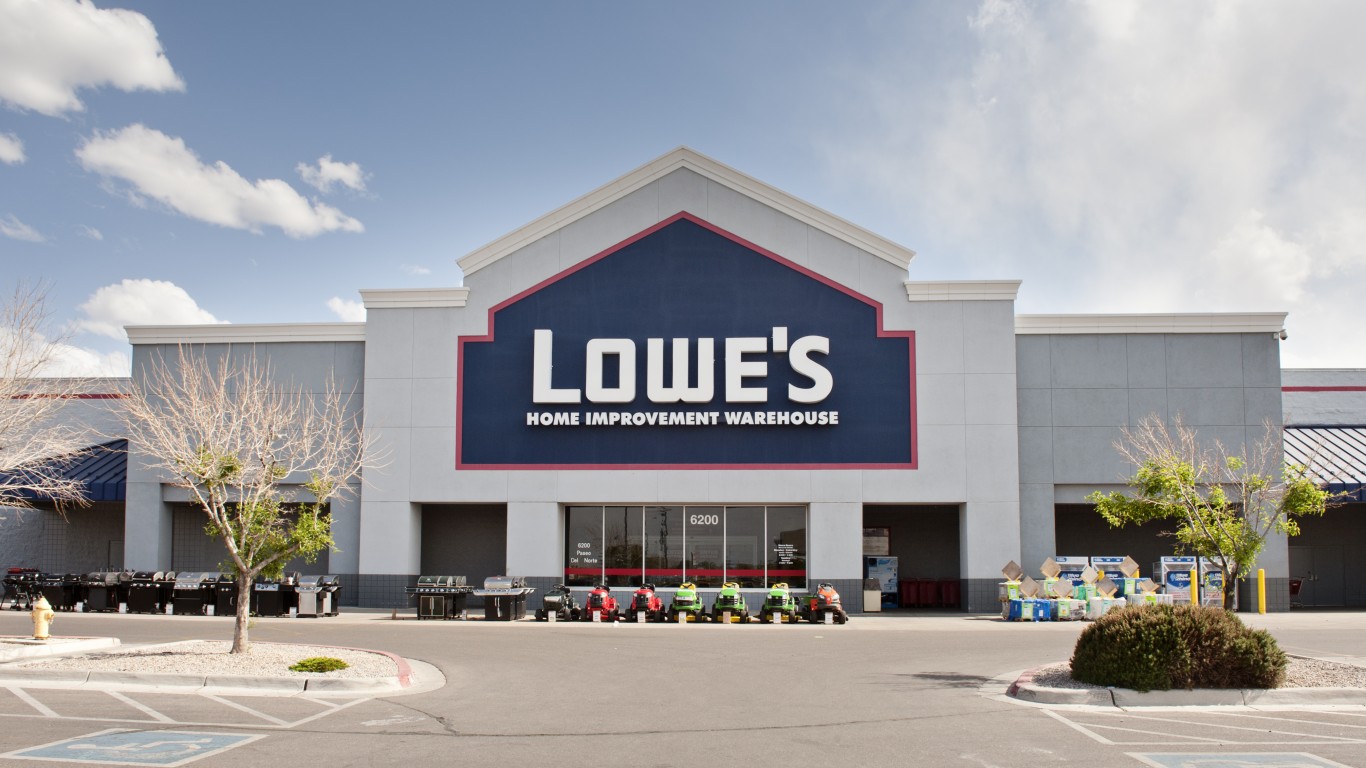
Target or Lowe’s: Whose Dividend Streak Cracks First?
Target and Lowe's both reported earnings on the same day while defending dividend streaks built over decades, but the balance sheets underneath those payouts tell very different stories about which one is actually safe.


Target (NYSE:TGT | TGT Price Prediction) and Lowe’s (NYSE:LOW) both reported second-quarter results on August 19, 2026, defending long dividend streaks in very different ways. Target leaned on a tariff-refund-boosted quarter and a token raise. Lowe’s delivered a healthier bump but against negative shareholders’ equity and fresh acquisition debt. That contrast frames a real question for income holders.
Small Raise at Target, Bigger Raise at Lowe’s
Target’s latest quarterly dividend moved to $1.16 from $1.14, a modest step after several quarters held flat. Lowe’s pushed its quarterly payout to $1.25 from $1.20, a firmer signal to income holders. Yield tilts the other way: Target yields 2.8% versus Lowe’s 2.4%, partly because Target shares trade at $164.04 after a 67.8% year-to-date rip, while Lowe’s trades at $210.36, down 12.8% on the year.
| Dividend Lens | Target | Lowe’s |
| Quarterly dividend | $1.16 | $1.25 |
| Annualized forward | $4.64 | $5.00 |
| TTM EPS | $9.63 | $11.83 |
| Book value/share | $39.28 | −$13.26 |
Coverage at Target, Leverage at Lowe’s
Target paid $518 million in dividends in the second quarter and told investors it is moving toward a 40% payout ratio over time while defending its middle-A credit ratings. CFO Jim Lee laid out the priority order plainly: business investment first, dividend second, buybacks last. That order protects the payout before repurchases resume in the back half.
Lowe’s cash generation is stronger on an absolute basis, with $3.1 billion in free cash flow in the quarter against $673 million in dividends. The concern is the balance sheet. Shareholders’ equity was negative $7.44 billion at the end of July, and adjusted debt to EBITDA is 3.0 times after funding Foundation Building Materials and Artisan Design Group. Management is targeting 2.75 times leverage by mid-2027, which limits room for aggressive dividend acceleration.
What Would Actually Pressure Either Payout
Target’s risk is earnings quality. Q2 adjusted EPS of $4.11 included a $1.65 benefit from tariff refunds, and the tiny raise suggests management wants a wider cushion before committing to bigger hikes. Lowe’s narrowed full-year guidance to the low end, with sales around $92 billion and adjusted EPS near $12.25. DIY discretionary remains soft, and ADG is 100% exposed to residential construction.
Why Lowe’s Payout Is Structurally More Fragile
Both companies have kept their streaks intact, but Lowe’s likely stands on softer ground. The dividend is well-covered by cash today, yet negative equity, acquisition-driven leverage, and a housing cycle that has yet to recover all sit under it. Target’s raise was almost embarrassingly small, and that is exactly why its payout looks safer: management is conserving flexibility instead of stretching. Income investors prioritizing durability may find Target’s conservatism reassuring, while those willing to tolerate a leveraged balance sheet through a soft home-improvement cycle will see a bigger dividend raise from Lowe’s. (For investors who want streaks measured in half-centuries rather than decades, we ranked ten Dividend Kings by valuation in a free report here).


Contact [email protected] for any questions or corrections.
Trey has been an editor and author at 24/7 Wall St. for more than a decade, where he has published thousands of articles analyzing corporate earnings, dividend stocks, short interest, insider buying, private equity, and market trends. His comprehensive coverage spans the full spectrum of financial markets, from blue-chip stalwarts to emerging growth companies.
Beyond 24/7 Wall St., Trey has created and edited financial content for Benzinga and AOL's BloggingStocks, contributing additional hundreds of articles to the investment community. He previously oversaw the 24/7 Climate Insights site, managing editorial operations and content strategy, and currently oversees and creates content for My Investing News.
Trey's editorial expertise extends across multiple publishing environments. He served as production editor at Dearborn Financial Publishing and development editor at Kaplan, where he helped shape financial education materials. Earlier in his career, he worked as a writer-producer at SVE. His freelance editing portfolio includes work for prestigious clients such as Sage Publications, Rand McNally, the Institute for Supply Management, the American Library Association, Eggplant Literary Productions, and Spiegel.
Outside of financial journalism, Trey writes fiction and has been an active member of the writing community for years, overseeing a long-running critique group and moderating workshop sessions at regional conventions. He lives with his family in an old house in the Midwest.