Nvidia’s Blockbuster Quarter Has One Ugly Loose End. $27 Billion of Free Cash Flow Vanished
Nvidia posted the kind of revenue numbers that silence critics, yet something inside the balance sheet quietly swallowed tens of billions in cash. The explanation touches on extended payment terms, $279 billion in supply commitments, and a growing web of…

This post may contain links from our sponsors and affiliates, and Flywheel Publishing may receive compensation for actions taken through them.
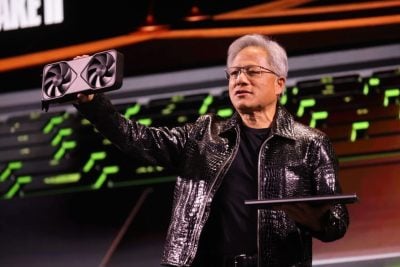
NVIDIA (NASDAQ:NVDA | NVDA Price Prediction)’s fiscal second quarter of 2027 was the kind of report that would ordinarily leave nothing to argue about. Revenue reached $96.2 billion, up 18% sequentially and 106% from a year ago, and shares traded at $225.92 on Thursday afternoon.
The uncomfortable line sits below the income statement. Free cash flow fell from $48.6 billion in the previous quarter to $21.3 billion, a $27.2 billion sequential decline.

That figure deserves context. Free cash flow was still 59% higher than a year ago, and “vanished” refers only to the sequential drop.
The question is whether that drop reflects the mechanics of a company growing at this speed, or the earliest visible shape of vendor financing at NVIDIA.
Where the Cash Went
Operating income was high, landing at $63.73 billion, and capital spending stayed modest at $2.68 billion. The gap opened inside working capital.
Accounts receivable climbed by more than $22 billion to $63.1 billion, and inventory rose by $5.8 billion to $31.6 billion ahead of the Vera Rubin rollout. Higher cash taxes applied further pressure.
Each of those items describes a supplier issuing very large invoices, holding more parts, and paying a larger tax bill within the same ninety days.
Receivables Stretch Out
Days sales outstanding measures the average time between shipping a product and collecting cash. NVIDIA’s DSO increased from 45 days to 60 days, which the company attributed to “extended payment terms for large purchases by certain investment grade customers to be shipped over multiple quarters”.
On a revenue base this large, each additional day of collection is meaningful cash sitting outside the bank account. The investment-grade characterization is NVIDIA’s own language, worth reading as such rather than as independently verified credit analysis.
Extending terms is a choice. A supplier that lengthens payment terms to help buyers commit to multi-quarter orders is doing more than selling; it’s providing financing.
Indeed, Nvidia has been providing financing to many current and potential customers, and that has only been accelerating. Many are calling this circular financing, though AI bulls don’t think so.
Temporary Squeeze or Vendor Financing
The benign reading has real force. A company doubling revenue year over year mechanically ties up cash in receivables and inventory, and building stock before a product transition like Vera Rubin is what competent management does.
The uncomfortable reading has more force than it did a quarter ago. Alongside longer terms, NVIDIA disclosed $279 billion in supply commitments and guarantee obligations capped at $108.5 billion for AI cloud partners, on top of financing partnerships with Apollo, BlackRock, Blackstone, Brookfield, Goldman Sachs, and KKR.
Jensen Huang described the moment plainly: “AI has reached its inflection point. It’s doing useful work. Its tokens are productive and profitable. Now, compute is revenue.” Some of that revenue is being financed by the seller.

The fiscal second quarter is mostly the benign story. Investors watching NVIDIA should treat working capital as a genuine line of analysis rather than a footnote, and can consult NVIDIA’s Q2 FY27 release and its CFO commentary for the underlying disclosures.
Contact [email protected] for any questions or corrections.
Omor Ibne Ehsan is a writer at 24/7 Wall St. He is a self-taught investor with a focus on growth, cyclical, and dividend equities that have strong fundamentals, value, and long-term potential. He also has an interest in high-risk, high-reward investments such as penny stocks.