Memory Now Accounts for 50% of Global Semiconductor Revenue — But There’s a Catch
AI has transformed memory from a boom-and-bust commodity into critical infrastructure, sending forecasts to levels that would have seemed absurd a few years ago. But a ghost from 2018 is lurking in the data, and it raises an uncomfortable question…


The semiconductor industry is undergoing a strange inversion. For decades, memory was the quintessential commodity business: huge capital requirements, brutal pricing swings, and profits that could disappear when supply outran demand. Artificial intelligence is changing that equation. AI accelerators need enormous amounts of high-bandwidth memory, and hyperscalers are scrambling to secure supplies years ahead of time.
Gartner’s April forecast showed memory revenue jumping from $216.3 billion in 2025 to $633.3 billion in 2026, taking its share of the $1.32 trillion semiconductor market to roughly 48%. Its August forecast is even more striking: memory revenue is now expected to reach $837.3 billion, or 54% of the $1.56 trillion industry.
That makes memory much more than another semiconductor category. It has become critical AI infrastructure.
AI Has Changed the Demand Equation
The clearest evidence is coming from procurement rather than forecasts. Nvidia (NASDAQ:NVDA | NVDA Price Prediction) increased its supply and capacity commitments from $119 billion to $279 billion in just one quarter. The company says those commitments are primarily related to memory, with $92 billion due in the remainder of fiscal 2027, $87 billion in 2028, and $88 billion in 2029.
That is extraordinary visibility for the memory manufacturers.
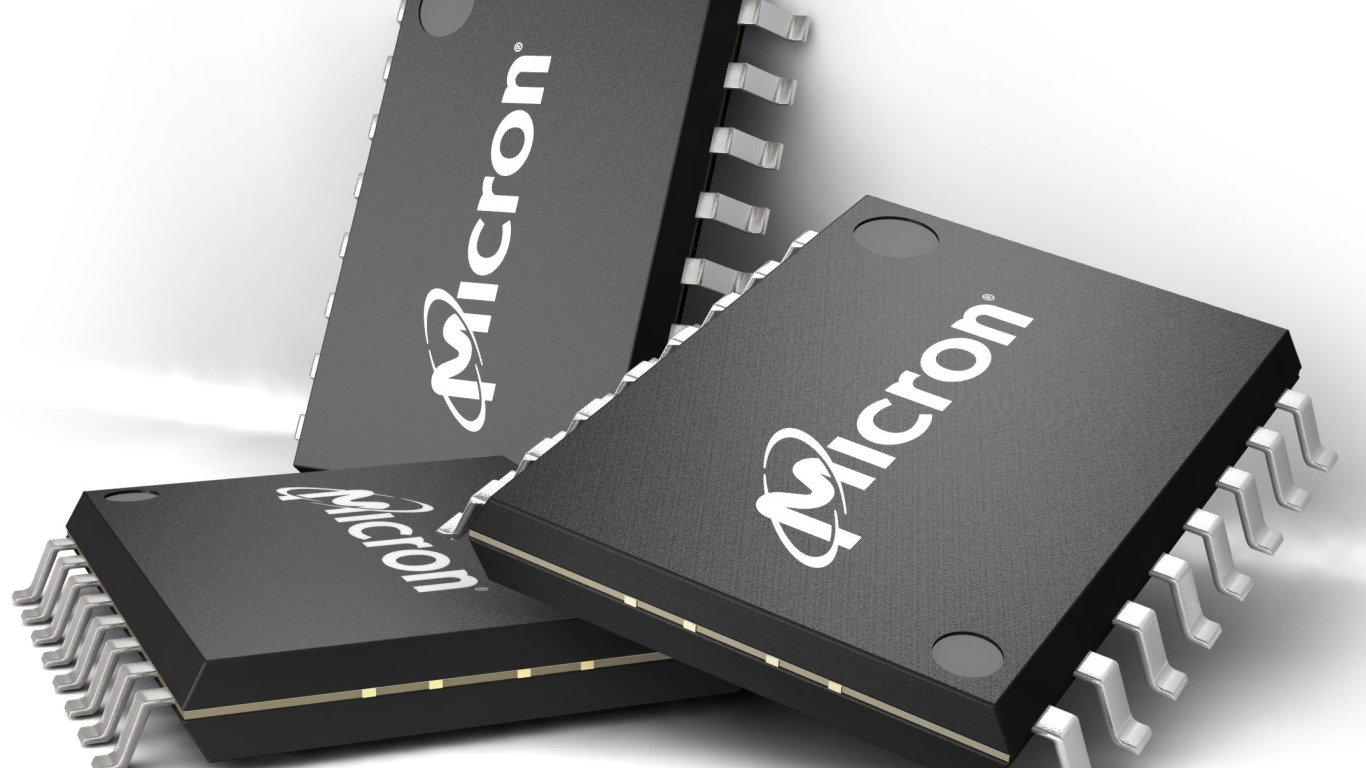
Three companies dominate the market: Micron Technology (NASDAQ:MU), SK hynix (NASDAQ:SKHY), and Samsung Electronics. SK hynix has secured long-term agreements with about 10 customers, while Micron says 16 strategic customer agreements cover roughly 20% of its DRAM volume and one-third of its NAND volume over their contract periods. Samsung has also secured multiyear memory agreements with major customers.
These agreements provide substantially more demand visibility than memory companies typically enjoyed in previous cycles. But they do not magically eliminate the industry’s pricing mechanism.
The Memory Cycle Isn’t Dead Yet
Here’s the uncomfortable part for investors: memory’s share of semiconductor revenue is heavily influenced by price.
Memory previously reached roughly 34% of semiconductor revenue in 2018. The following year, memory revenue plunged 31.5%, while DRAM average selling prices fell 47.4%. Memory’s industry share fell back to 26.7%. Gartner attributed the collapse to oversupply and falling prices. In other words, memory consumption didn’t need to collapse for revenue to crater. Pricing did the damage.
Long-term agreements help because they lock in volumes and, in some cases, pricing. But they aren’t a permanent floor underneath every memory product. Conventional DRAM and NAND remain exposed to new capacity, inventory levels, and competitive pricing.
And new capacity is coming. SK hynix plans a $4 billion Indiana facility for next-generation HBM packaging, while the company has approved 54.3 trillion won, or about $38.3 billion, of investment through 2031.
There is also a technological wildcard. SK hynix and Sandisk (NASDAQ:SNDK) have introduced a High Bandwidth Flash standard designed to alleviate AI memory bottlenecks, potentially allowing flash-based architectures to handle workloads currently demanding scarce HBM.
Key Takeaway
In short, AI has undeniably changed memory’s trajectory. Gartner’s latest forecast puts memory at 54% of semiconductor revenue in 2026, compared with 27% in 2025. That supports the bull case for Micron, SK hynix, and Samsung.
But smart investors shouldn’t conclude that memory has permanently escaped cyclicality. New capacity, technological substitutions, and eventually normalized pricing can still turn today’s shortage into tomorrow’s oversupply.
The better thesis is that AI has extended and enlarged the memory cycle — not necessarily abolished it. That distinction could matter enormously when today’s $837 billion memory market eventually meets tomorrow’s supply.
Contact [email protected] for any questions or corrections.
After two decades of patrolling the dark corners of suburbia as a police officer, Rich Duprey hung up his badge and gun to begin writing full time about stocks and investing. For the past 20 years, he’s been cruising the markets looking for companies to lock up as long-term holdings in a portfolio while writing extensively on the broad sectors of consumer goods, technology, and industrials. Because his experience isn’t from the typical financial analyst track, Rich is able to break down complex topics into understandable and useful action points for the average investor. His writings have appeared on The Motley Fool, InvestorPlace, Yahoo! Finance, Money Morning, and, of course, 24/7 Wall St. He has been featured in both U.S. and international publications, including MarketWatch, Financial Times, Forbes, Fast Company, and USA Today.