Goldman Sachs CEO Says America Has Two Choices: Grow Faster or Spend Less
Goldman Sachs CEO David Solomon sees artificial intelligence as a potential economic game-changer, but he is putting Washington on notice: the window to course-correct on spending is narrowing fast.

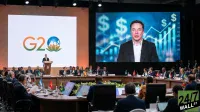
Speaking from the G20 finance meeting in North Carolina on Monday, Goldman Sachs (NYSE:GS | GS Price Prediction) Chairman and CEO David Solomon delivered a conditional bull case for the U.S. economy. In Solomon’s view, artificial intelligence could push the country onto a faster structural growth path, but only if Washington can rein in fiscal spending.
Solomon Says the Consumer Is Still Resilient
Solomon opened by saying how the U.S. has strong consumers today: “The consumer is still pretty resilient. The economy is performing well. We have an enormous investment cycle that’s obviously contributing to growth and activity. The level of earnings growth has really been extraordinary,“ he said.
The macro data supports him. Bureau of Economic Analysis figures show real GDP growth of 1.5% in Q2’26, down from 2.1% in Q1’26, and total corporate profits reached $4,827.4 billion in the second quarter, with reported year-over-year growth of 22.8%.
Consumer spending is holding: total personal consumption expenditures ran at $22,250.4 billion in July 2026. The personal saving rate was 2.8% in Q2’26, down from 3.9% in Q1’26.
AI Could Lift U.S. Growth for the Next 5-10 Years
Solomon reflected on how AI could drive massive growth for the U.S: “If I step back and take a longer lens and start thinking about the next 5-10 years, I think with AI being developed into the economy and the enterprise, the productivity opportunity, the productivity gains, actually gives us a real opportunity to run at a higher growth rate,“ he said.
That echoes what he told investors on Goldman Sachs’s July 14 earnings call, where he cautioned that “these things don’t go in a straight line, and they can ebb and flow” and that the AI cycle should eventually see “a recalibration, a reset, you know, a drawdown, and then a further acceleration.” He also framed the buildout as “a multi-year investment cycle“ reaching into infrastructure, energy, and data centers.
America Eventually Has to Grow Faster or Spend Less
While everything would be sunshine and rainbows if we could grow our way out of all our problems, Solomon addressed that our current environment has been shaped by too much government spending: “We are either going to have to drive higher levels of economic growth consistently, given our levels of spending and debt, or we’re going to have to adjust our spending policy. The pressure on us over time will grow if we don’t get that balance right,” he said.
The 30-year Treasury yield closed at 5.22% on August 28, 2026, against a 10-year yield of 4.73%. Bloomberg’s Ven Ram has attributed earlier long-end pressure to AI capex demand plus deficits, while Treasury Secretary Scott Bessent has argued the U.S. bond market remains the most resilient in the world.
Why Huge Capital Markets Issuance May Not Be as Frothy as It Looks
Solomon offered two counterarguments to the “market froth” thesis. On credit, “A lot of the credit issuance is coming from very, very large companies that have fundamentally strong underlying cash flow characteristics. I don’t see a lot of risks in the system at the moment,” he said. This viewpoint makes sense next to fears around Nvidia’s $500 billion financing.
On equity issuance, Solomon’s point was that we’re not doing anything too unprecedented. “In the current environment, I think you’re going to see continued strong issuance in the capital markets. If you go back and you look at equity issuance as a percentage of overall market cap, we look like we’re running at kind of a ten-year average,” he said. Nominally, the large volumes we’re seeing today actually look pretty regular against a much larger market cap base.
What to Watch Next
Solomon’s bull case is that AI productivity could allow the U.S. economy to sustain a faster growth rate over the next decade. But that growth increasingly matters to the country’s fiscal outlook. If AI cannot deliver enough additional economic output, his warning is simple: spending policy will eventually have to adjust.
Contact [email protected] for any questions or corrections.
Thomas Richmond is a financial writer and content strategist with 5+ years of experience covering stocks and financial markets. He has published over 500 articles focused on individual stock analysis, helping investors better understand business fundamentals, stock valuations, and long-term opportunities.
Thomas previously served as a Content Lead at TIKR, a stock research platform, where he helped scale the company’s blog to hundreds of articles per month and contributed to a weekly newsletter reaching more than 100,000 investors.
Outside of work, Thomas enjoys weight lifting and soccer.