Wall Street Warns AI Stocks Are Starting to Trade Like Interest-Rate-Sensitive Credit
The bond market is quietly reshaping how investors should think about NVIDIA and the broader AI trade, and Wall Street strategists are raising alarms that most equity investors are not watching the right risk.

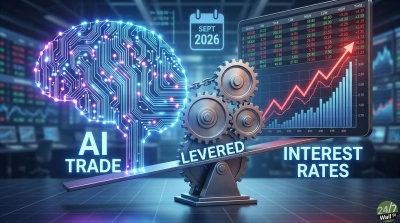
The biggest risk to the AI trade may increasingly come from the bond market rather than the technology itself.
A CNBC panel on Monday featuring Mike O’Rourke of JonesTrading, Peter Tchir and Jay Woods argued that NVIDIA and other companies funding the enormous AI infrastructure buildout are becoming more exposed to interest rates, credit markets and economic conditions as hundreds of billions of dollars flow into data centers and compute capacity.
Nvidia May Be Turning From a Pure Growth Stock Into a Financing Story
JonesTrading’s Mike O’Rourke put NVIDIA (NASDAQ:NVDA | NVDA Price Prediction) at the center of the shift towards a financing company: “Nvidia is repositioning itself, that it wants to finance this AI buildout to the tune of hundreds of billions of dollars. And that’s been a risk, that you are going to take yourself from being this tech, high-growth company to something levered to the economy, interest rates and financial markets.“

When a company finances the demand for its own products, its cash flows co-move with credit spreads and discount rates. NVIDIA’s July-quarter disclosures back up the scale of that pivot: supply obligations tied to memory procurement for Vera Rubin, financing partnerships with Apollo, BlackRock, Blackstone, Brookfield, Goldman Sachs, and KKR designed to “raise over $500 billion of third-party capital,” and a management concession that “we recognize the scale of this support, and we know some will call this circular financing. We see it differently.”

O’Rourke was careful about the trigger. He said, “If we do wind up with interest rate hikes, which I’m not even sure I’m really there in that camp, that we’re going to get them, it’s going to put pressure on the AI trade. It’s going to deflate multiples.“ The expectation of hikes alone can compress valuations. Former Fed Vice Chair Roger Ferguson’s August 28 call for two rate hikes sharpened that expectation.
The AI Buildout Is Flooding the Bond Market With New Debt
Tchir moved the discussion from policy to global capital supply. His claim: “[In] August, we did $100 billion more in corporate credit than we typically do in August. That’s putting pressure globally.“
Layer on long-end Treasury yields under pressure from global sovereign debt issuance for infrastructure and defense, and the long end reprices on lesser supply rather than just in anticipation of what the Fed will do. The Treasury curve on August 28 showed the 10-year at 4.73%, the 20-year at 5.21%, and the 30-year at 5.22%, while the 10Y-2Y spread narrowed to 0.39%.
Tchir discussed how Treasuries seem relatively unappealing today: “I’d rather own some of the compute bonds than Treasuries. And I think the rest of the world doesn’t care as much about Treasuries either.”

Oracle (NYSE:ORCL) guided to raise around $40 billion in debt and equity in fiscal year 2027, with a net cash CapEx outlay of around $70 billion, and CFO Hilary Maxson insisted the company will preserve its “investment-grade credit rating.” Backlog reached $638 billion in RPO. The stock is up 28.12% over the past month at $149.40, though still down 36.51% year-over-year.
Can the Bond Market Finally Spill Into AI Stocks?
Woods framed the setup directly: “We’re starting to see some momentum slow. And so what I’m looking forward to is, will the bond market affect the equity market?“
Treasury Secretary Bessent argued in a Monday interview that the U.S. bond market is the most resilient in the world, and Goldman Sachs CEO David Solomon said credit issuance is coming from very large companies with strong cash flow and that he does not see significant risks in the system. Retail is split too: NVDA Reddit sentiment hit a very bullish 81 on Friday before drifting to neutral 58 by Monday morning. To add to that, September is historically the worst month of the year for stocks, which shows the market could be in for some turbulence.
Key Takeaways
The AI boom is becoming increasingly capital-intensive, pulling companies like NVIDIA and Oracle deeper into credit markets. That means investors may have to watch Treasury yields, corporate issuance, and financing conditions alongside GPU demand and earnings growth. If the bond market tightens, the AI trade could feel it on both rising financing costs and falling valuation multiples.
Contact [email protected] for any questions or corrections.
Thomas Richmond is a financial writer and content strategist with 5+ years of experience covering stocks and financial markets. He has published over 500 articles focused on individual stock analysis, helping investors better understand business fundamentals, stock valuations, and long-term opportunities.
Thomas previously served as a Content Lead at TIKR, a stock research platform, where he helped scale the company’s blog to hundreds of articles per month and contributed to a weekly newsletter reaching more than 100,000 investors.
Outside of work, Thomas enjoys weight lifting and soccer.