Palantir Vs. Intel: Choose One for The Rest of 2026
Palantir posted record software growth while Intel staged its biggest revenue comeback in fifteen years, and choosing between them for the second half of 2026 comes down to a single uncomfortable question about valuation versus velocity.

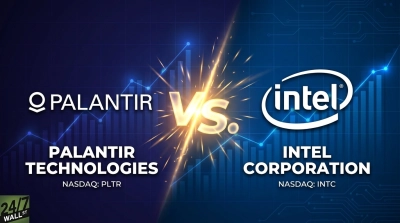
Palantir (NASDAQ: PLTR | PLTR Price Prediction) and Intel (NASDAQ: INTC) closed Q2 2026 from opposite ends of the AI economy. Palantir posted 93% revenue growth on pure software. Intel delivered its strongest revenue growth in more than fifteen years while rebuilding its foundry. Choosing between them for the last four months of 2026 is a debate about momentum versus math.
Software Sovereignty Vs. Silicon Reboot
Palantir’s Q2 was carried by AIP. U.S. commercial revenue jumped 149% year over year to $764 million, and Alex Karp described the quarter as “otherworldly”. A Rule of 40 score of 155% is rare outside a slide deck.
Intel’s engine was Data Center and AI. That segment jumped 59% year over year to $6.26 billion, with Xeon 6 called one of the fastest-ramping products in Intel history. Lip-Bu Tan told analysts “server CPU demand continues to far outpace available supply”. Foundry still bled $2.1 billion, so the turnaround remains uneven.
| Business Driver | Palantir | Intel |
| Main Growth Engine | U.S. commercial AIP deals | DCAI and Xeon 6 ramp |
| Gross Margin | ~82% | 41.8% non-GAAP |
| Management Focus | Sovereign AI stack | 18A yields, capacity |
Where The Bets Really Diverge
Palantir is selling an operational layer. Karp framed it plainly: “Palantir, of course, is now both infrastructure, software, FDEs, orchestration, and business know-how”. That combination pushed net dollar retention to 157%. The catch is a price-to-sales ratio of 73 that leaves almost no room to disappoint.
Intel is placing a capital-heavy bet on domestic silicon. It raised 2026 capex to more than $20 billion, with 2027 expected to run significantly higher. Backing from NVIDIA (NASDAQ:NVDA)’s $5.0B equity stake and SoftBank’s $2.0B gives Tan cover to keep spending. The 2026 fiscal-year EPS estimate has climbed to 1.5129 from 1.0971 thirty days ago, driven by 32 upward revisions, reflecting this shift.
What Decides The Next Four Months
For Palantir, the setup is the risk. When shares trade at a P/E of 264 and change hands near $186.38, even a clean Q3 earnings report at guidance of $2.160 to $2.164 billion may not satisfy positioning.
Intel’s Q3 guide of $15.8 billion to $16.8 billion with non-GAAP EPS of $0.38 looks conservative given consensus revisions. Watch 18A yields, Panther Lake ramp, and whether external foundry revenue moves beyond $293 million.
Why I Lean Intel For The Rest Of 2026
For long-term software dominance, Palantir is hard to fault. The Rule of 40 at 155% is real, and the sovereign AI thesis is landing with customers.
For the next four months, I lean Intel. Estimates are still catching up to the business, positioning is cleaner, and the CHIPS Act and NVIDIA equity give the turnaround a floor Palantir’s multiple does not have. Shares are already up 142.57% year to date, so the entry point matters. If foundry losses narrow in Q3, Intel keeps working. If they widen, the thesis unravels quickly.
Contact [email protected] for any questions or corrections.
Alex Sirois is a financial writer with experience spanning both retail and institutional investing. He has written for InvestorPlace and held roles at BNY Mellon and Bernstein, giving him a perspective that bridges Main Street portfolios and Wall Street analysis.
Alex holds an MBA from George Washington University and has built his career across multiple industries, including e-commerce, education, and translation — a breadth of experience that informs how he breaks down complex financial topics for everyday investors. His writing is conversational, actionable, and grounded in long-term, buy-and-hold investing principles.
At 247 Wall St., Alex focuses on delivering analysis that is both accessible and useful, with a clear emphasis on helping readers make more informed decisions with their money.