Nvidia vs. Palantir: One Is the Clearer Buy After Earnings
Both NVIDIA and Palantir crushed earnings, raised guidance, and rode the same AI wave to triple-digit growth. But when two stocks tell the same story from opposite ends of the stack, only one valuation actually holds up.

This post may contain links from our sponsors and affiliates, and Flywheel Publishing may receive compensation for actions taken through them.
NVIDIA (NASDAQ:NVDA | NVDA Price Prediction) and Palantir (NASDAQ:PLTR) just posted results that tell the same AI story from opposite ends of the stack.
NVIDIA sells the compute. Palantir sells the operational layer that turns compute into workflows. Both grew triple digits, both raised guidance, and both are now priced for perfection. That is exactly why comparing them right now matters.
Blackwell Ramps Hard. Palantir Turns Tokens Into Contracts.
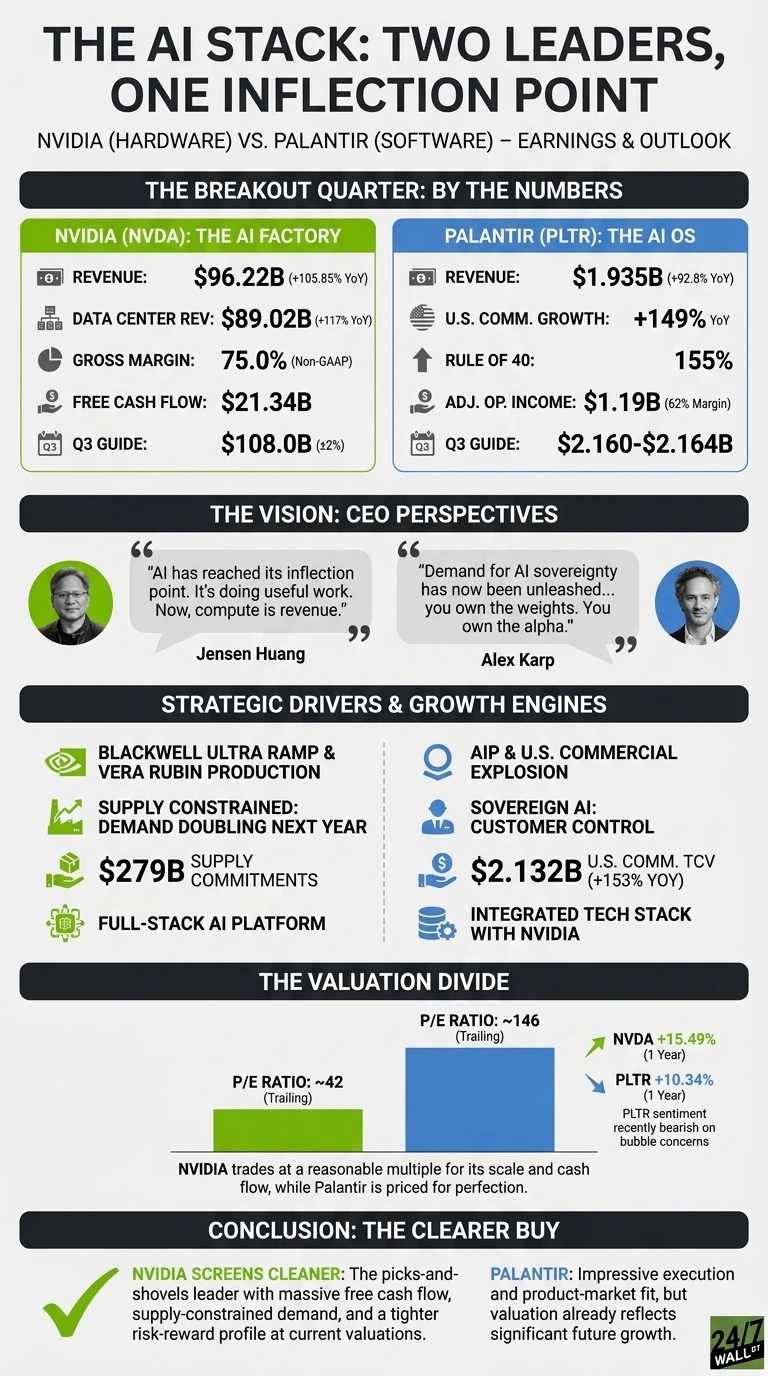
NVIDIA delivered $96.22 billion in revenue, up 105.85% year over year, with Data Center alone hitting $89 billion on the Blackwell Ultra ramp. Jensen Huang framed the moment plainly: “AI has reached its inflection point. It’s doing useful work. Its tokens are productive and profitable.
Now, compute is revenue.” Networking grew 138% year over year, and Vera Rubin production shipments have already started, with management calling it the fastest ramp in company history.

Palantir came in smaller but arguably louder. Revenue of $1.94 billion grew 92.8%, and U.S. commercial revenue jumped 149% year-over-year. Alex Karp called it “otherworldly,” and the Rule of 40 hit 155%. The company signed 73 deals worth at least $10 million. AIP is doing the heavy lifting, embedding into enterprise workflows one bake-off at a time.

| Business Driver | NVIDIA | Palantir |
| Growth Engine | Blackwell Ultra, Vera Rubin | AIP, U.S. commercial |
| Gross Margin | 75.0% non-GAAP | 86% adjusted |
| Next-Quarter Revenue Guide | $108.0B | $2.16B |
Full-Stack Hardware Versus Sovereign Software
Huang wants NVIDIA seen as more than a chip vendor. He told analysts, “Today, we’re not just selling the best chips. We’re selling a full-stack AI factory platform.” Vera Rubin, he said, generates $40 billion per gigawatt of revenue opportunity, versus $25 billion for Blackwell.
The catch: NVIDIA is supply constrained and expects only “approximately 70%” revenue growth next fiscal year despite demand doubling.

Palantir is playing a different game. Karp is selling AI sovereignty, promising customers “you own the weights. You own the alpha. You own everything.” That pitch is resonating: U.S. commercial TCV bookings hit $2.132 billion, up 153% year-over-year.
The kicker is that Palantir’s fine-tuning stack runs on NVIDIA hardware, so they are partners as much as adjacent bets.

Valuation Is the Real Divide
NVIDIA trades near a P/E of 42 after climbing 15.49% over the past year. Palantir sits at a P/E of roughly 146, with an analyst target of $191.68 that is barely above the current $185.91 quote. Reddit sentiment on NVDA flipped sharply bullish after the report, scoring 67, while PLTR readings turned bearish in mid-August on bubble concerns.
I will be watching whether NVIDIA can convert its $279 billion in supply commitments into margin expansion once memory pricing settles. For Palantir, the tell is whether U.S. commercial can keep compounding at triple digits without diluting shareholders through the $265 million quarterly stock-based comp bill.
Why NVIDIA Screens Cleaner Than Palantir Right Now
On a relative basis, NVIDIA screens cleaner. The multiple is reasonable for a business printing $21.34 billion in quarterly free cash flow, with supply-constrained demand that management says could double.

Palantir’s execution is genuinely impressive, and Karp’s sovereign-AI pitch has product-market fit. The stock, however, already reflects the next three years of hypergrowth.

For investors weighing exposure to the AI buildout, the picks-and-shovels layer offers a tighter risk-reward profile than the application layer at current valuations, while PLTR would become more interesting if its multiple compressed meaningfully.
Contact [email protected] for any questions or corrections.
Vandita Jadeja is a financial publisher with over a decade of experience writing about financial topics, including investment, savings, retirement, insurance and banking. Vandita is a Chartered Accountant who loves to debunk financial concepts for readers.
Her work has appeared on sites that include The Motley Fool, InvestorPlace, and Benzinga. She covers investing and focuses on stock picks and price prediction for 24/7 Wall St.
When not looking for the next stock investment opportunity, she can be found traveling, reading, chasing sunsets and enjoying her iced latte.