Strait of Hormuz Will Be a “Worthless Piece of Water” in Two Years. Why Oil Just Crossed $90/Barrel Anways
Treasury Secretary Scott Bessent just told G20 finance chiefs the Strait of Hormuz will stop mattering to global oil within two years, but Iran is already mining the waterway and threatening to attack neighboring energy infrastructure.

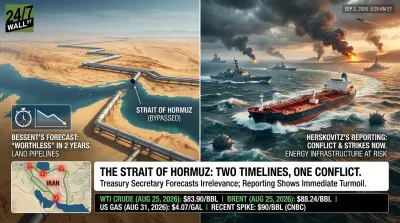
Treasury Secretary Scott Bessent, speaking at the G20 finance chiefs meeting, offered a two-year forecast in which he predicted the Strait of Hormuz would stop mattering to global oil. Meanwhile, Bloomberg’s Jon Herskovitz described how a fresh round of U.S.-Iran strikes is happening now.
Bessent Says Pipelines Will Make Hormuz “Worthless” in 2 Years
Bessent had an optimistic forecast for oil over the medium-term: “In two years, the Strait of Hormuz will be, like, a worthless piece of water, as the oil will be going on pipelines across land,” he said. He explained that the current disruption hurts other countries far more than it hurts the U.S.: “It’s not a choke point for the US, but it is a choke point for many, many other countries.”
Land pipeline capacity at the scale required to remove Hormuz from the global oil map demands construction, financing, host-country agreements, and physical security. Pipeline projects of that scale rarely are completely built on a two-year timeline, and the segment offered no detail on routes, capital sources, or throughput.
Recently, CNBC’s Brian Sullivan detailed why the announced Venezuela arrangement will likely not relieve near-term supply, citing production that has fallen from roughly 3.2 million barrels per day in 1997 to about 1.2 million with dilapidated infrastructure. Energy security proposals keep hitting the same timeline problem.
Hormuz Matters Far More to Asia Than the United States
The United States is a net exporter of crude and refined products, and its marginal barrels do not transit through Hormuz. For allied economies in Asia and parts of Europe, the Strait remains central for their oil imports. The Strait of Hormuz has more drastic consequences for oil importers, which is why global oil markets and allied economies absorb the risk even when U.S. domestic supply does not.
That framing echoes remarks from former Chevron (NYSE:CVX | CVX Price Prediction) Latin America president Ali Moshiri on August 28, who argued U.S. energy security depends on sources avoiding Hormuz, Red Sea, and Black Sea chokepoints, with Western Hemisphere supply from Brazil, Venezuela, and Argentina as the answer.
Iran Is Threatening Energy Infrastructure Beyond Hormuz
Against that two-year horizon, Herskovitz described events on a compressed timeline. “The US has escalated its round of strikes. The first strikes, which got it started, were at two launchers, artillery rocket launchers, which were suspected of being able to place mines in Hormuz. The latest attacks were broader,” he said.
“Iran has changed its strategy. It said that it’s looking to a longer-range battle where it can go after its neighbors in the region. If Iran sees its infrastructure attacked, it’s looking to go after infrastructure in the region of its neighbors, energy infrastructure, which could damage the economies of these regions and also really affect global oil supplies,” Herskovitz said. Attacks on neighboring energy infrastructure would move supply regardless of the Strait’s status.
Oil Is Back Near $90 as the Conflict Escalates
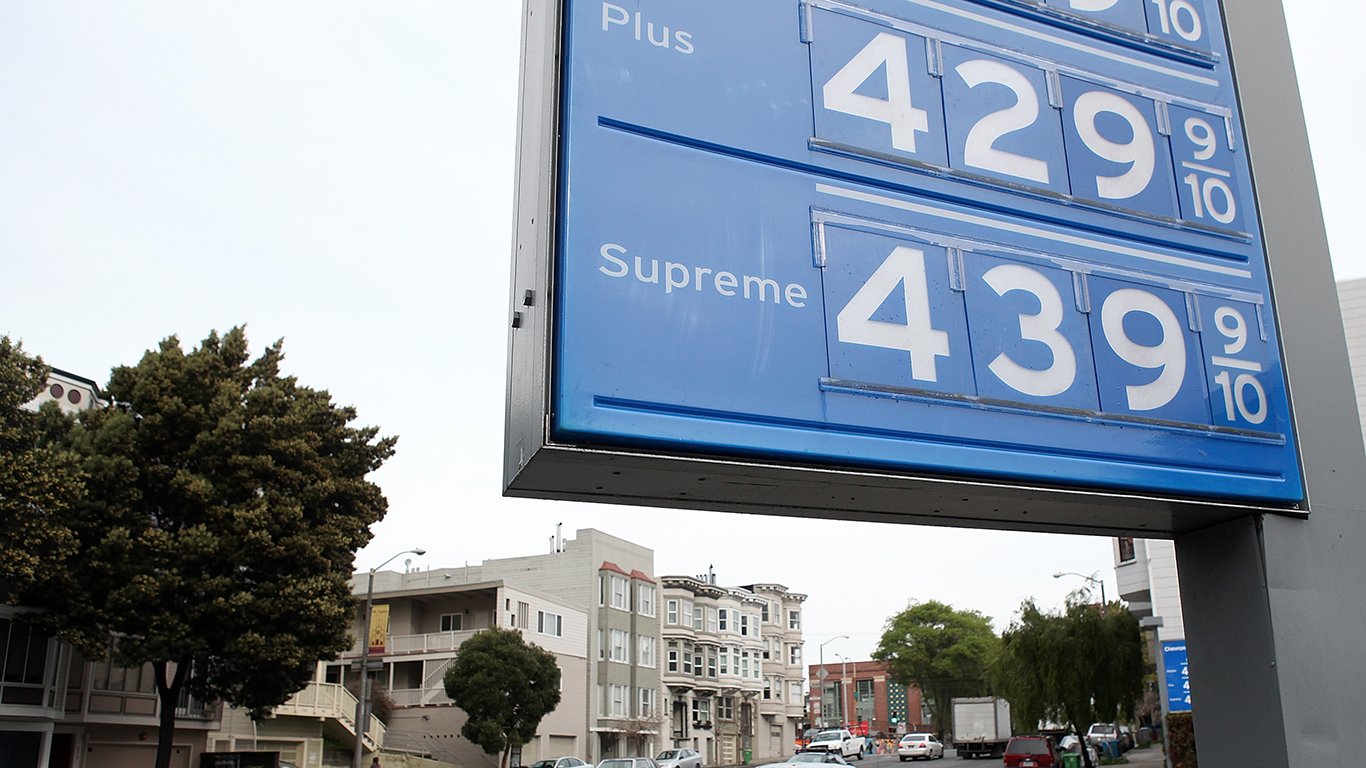
WTI opened at over $90 per barrel on September 2, down nearly 10% from a month earlier but well above the $55.44 low from December 16, 2025. U.S. regular gasoline sat at $4.07 per gallon on August 31, 2026. Overnight, CNBC reported Iran said two tankers hit Hormuz naval mines while it attacked regional targets in retaliation.
Key Takeaways
Bessent may ultimately be right that pipelines and alternative supply routes will reduce the world’s dependence on Hormuz. But with U.S.-Iran strikes escalating, regional energy assets under threat, and crude back around $90 per barrel, the oil market’s immediate problem remains the conflict happening today.
Contact [email protected] for any questions or corrections.
Thomas Richmond is a financial writer and content strategist with 5+ years of experience covering stocks and financial markets. He has published over 500 articles focused on individual stock analysis, helping investors better understand business fundamentals, stock valuations, and long-term opportunities.
Thomas previously served as a Content Lead at TIKR, a stock research platform, where he helped scale the company’s blog to hundreds of articles per month and contributed to a weekly newsletter reaching more than 100,000 investors.
Outside of work, Thomas enjoys weight lifting and soccer.