Scott Bessent Calls the Strait of Hormuz “Irrelevant.” Chevron Shows Exactly How It Happens
Washington wants to strip Iran of its most powerful economic weapon, and Chevron is already involved in one of the projects that could make it happen. The question is whether pipelines through conflict zones can actually deliver on that promise.


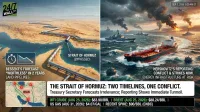
The Strait of Hormuz is one of the world’s biggest energy vulnerabilities. Roughly 20 million barrels of petroleum liquids — about 20% of global consumption — passed through the waterway in 2024, according to the U.S. Energy Information Administration. That makes the strait more than a shipping lane. It gives Iran a relatively inexpensive way to threaten a huge portion of the world’s oil supply.
Treasury Secretary Scott Bessent says Washington wants to change that equation, calling the strait potentially “irrelevant” within two years as more oil moves through pipelines. For Chevron (NYSE:CVX | CVX Price Prediction), that’s more than a geopolitical talking point. The company is already involved in studying one of those potential escape routes: a pipeline connecting Iraq’s oil network to Syria’s Mediterranean coast.
The Goal Is Bigger Than Iraqi Oil
Iraq’s Haditha-Baniyas pipeline is important because it illustrates the broader idea: move oil overland to export terminals outside the Persian Gulf rather than forcing every barrel through Hormuz.
The proposed route would connect Iraq’s oil network at Haditha with Syria’s Mediterranean port of Baniyas. It is closely related to the historic Kirkuk-Baniyas corridor, which once transported Iraqi crude through Syria to the Mediterranean. However, the current proposal is not simply a restoration of the old pipeline.
More importantly, Iraq is only one piece of the puzzle. The EIA estimates Saudi Arabia and the United Arab Emirates have about 4.7 million barrels per day of unused pipeline capacity that can bypass Hormuz. That’s nowhere near the roughly 20 million barrels per day that crossed the strait in 2024, which explains why Washington cannot make Hormuz irrelevant with one pipeline project. It needs a network.
Why That Matters to Chevron
That’s where Chevron gets interesting. The oil giant is participating in studies for the Haditha-Baniyas project alongside Iraq and Syria. If the project eventually moves from feasibility studies to construction, the company could gain a role in developing infrastructure connecting Middle Eastern oil to Mediterranean markets.
But the bigger investment thesis is strategic. Every barrel that can reach a Mediterranean or Red Sea terminal without passing through Hormuz reduces the amount of traffic that has to be protected in the strait. That potentially reduces the military burden of keeping the waterway open — particularly important after a prolonged conflict has consumed precision missiles and air-defense interceptors.
The U.S. military has reportedly depleted large portions of several missile inventories during the Iran war and after years of supporting Ukraine. Rebuilding those inventories will take money, production capacity, and time.
That creates a second reason for Washington to favor infrastructure over perpetual military protection: a pipeline is a permanent piece of energy infrastructure, while interceptors are one-time expenditures.
The Pipeline Has Its Own Weaknesses
Granted, pipelines aren’t invulnerable. Iran and other regional adversaries have shown they can readily attack fixed infrastructure with missiles and drones. A pipeline running through Iraq and Syria could become a tempting target precisely because it cannot move out of harm’s way.
But the risk is different. A damaged pipeline is a localized infrastructure problem. A threatened Strait of Hormuz can become a global shipping and energy problem affecting millions of barrels per day. That asymmetry is the point.
For Chevron, meanwhile, the opportunity doesn’t depend entirely on this one project. The company generated $33.9 billion of operating cash flow and $20.2 billion of adjusted free cash flow in 2025, while returning $27.1 billion to shareholders.
The pipeline opportunity would therefore sit on top of an already cash-generating energy business rather than determine its entire investment case.
Key Takeaway
In short, Bessent’s “irrelevant” comment shouldn’t be interpreted as a plan to replace Hormuz with the Haditha-Baniyas pipeline. The objective is much larger: build enough alternative energy infrastructure that Iran can no longer hold the global oil market hostage simply by threatening one narrow waterway.
Chevron’s involvement in Haditha-Baniyas gives investors a tangible example of what that transition could look like. The project remains preliminary, and pipelines through conflict zones carry obvious risks. But if Washington is genuinely shifting from defending Hormuz indefinitely to building around it, Chevron deserves a place on investors’ watch lists.
The most interesting part isn’t the Iraqi oil. It’s the infrastructure required to make the world’s most important oil chokepoint matter less.
Contact [email protected] for any questions or corrections.
After two decades of patrolling the dark corners of suburbia as a police officer, Rich Duprey hung up his badge and gun to begin writing full time about stocks and investing. For the past 20 years, he’s been cruising the markets looking for companies to lock up as long-term holdings in a portfolio while writing extensively on the broad sectors of consumer goods, technology, and industrials. Because his experience isn’t from the typical financial analyst track, Rich is able to break down complex topics into understandable and useful action points for the average investor. His writings have appeared on The Motley Fool, InvestorPlace, Yahoo! Finance, Money Morning, and, of course, 24/7 Wall St. He has been featured in both U.S. and international publications, including MarketWatch, Financial Times, Forbes, Fast Company, and USA Today.