The U.S. Mint Just Started Selling New Trump “Gold Coins.” If You Spend Them They Are Worth $1, But They Will Cost You More Than That To Buy.
The U.S. Mint is now selling a legal-tender dollar coin bearing Donald Trump's face, the first living president to appear on American currency in nearly a century. There is just one catch: you will pay well above face value to…

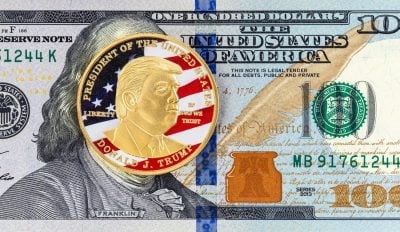
The U.S. Mint began selling a new gold-colored $1 coin featuring Donald Trump’s face on Wednesday, September 2, 2026 at 12:00 p.m. ET. The coin is legal tender. You can walk into a bodega and hand it over for a pack of gum. Almost no one will. To buy one from the Mint, you have to pay considerably more than a dollar, which is the point.
The coins were struck at the Philadelphia Mint as part of the U.S. Mint’s America’s 250th anniversary (semiquincentennial) program. The obverse carries Trump’s portrait alongside “LIBERTY,” “IN GOD WE TRUST,” and “1776 ~ 2026”. The reverse shows the presidential seal, with “250” inscribed on its shield.
Gold in Name Only
Despite the marketing shorthand, the coins contain no precious metal. They are mostly copper, with zinc, manganese and nickel, the same general composition as prior “golden dollar” coins such as the Sacagawea dollar. Actual gold, for reference, closed near $4,383 an ounce on Wednesday. The Trump coin is gold in hue and nothing else.
A separate product, a 24-karat, one-ounce Trump gold proof coin approved by the Commission of Fine Arts in March 2026, is a completely different item. No price or release date has been announced for it, and it is not the coin now on sale.
What Buyers Actually Pay
Per Al Jazeera, a 25-coin roll costs $61, and a 100-coin bag costs $154.50. That works out to $2.44 per coin in a roll and $1.55 per coin in a bag, both well above the $1 face value. Collectors chasing scarcity have another hook: 250,000 coins carry a “July 4” privy mark, randomly mixed into standard rolls and bags.
The Mint’s own product page notes the coins “have circulating finishes but have never been placed into circulation,” meaning they are being sold directly to buyers rather than pushed out through banks. CNN reported Wednesday afternoon that the coins went out of stock within hours of going on sale.
First Living President on U.S. Currency in Nearly 100 Years
Per Al Jazeera, this is the first time in nearly 100 years that a living person has appeared on U.S. currency. The Trump administration points to 1926, when the Mint struck a coin for the nation’s 150th anniversary featuring George Washington alongside Calvin Coolidge, then a sitting president, as precedent. Critics counter that the 1926 piece was commemorative and not intended for circulation.
Federal law states that “Only the portrait of a deceased individual may appear on United States currency and securities,” a rule Congress passed in 1866 after Treasury official Spencer M. Clark put his own face on a five-cent note. Trump signed the Circulating Collection Coin Redesign Act of 2020 during his first term, which authorized $1 semiquincentennial coins and bars a portrait of “any person, living or dead” only on the reverse. Trump’s image is on the obverse, so the design likely complies.
Treasury Secretary Scott Bessent first announced the coin on X on July 15, 2026, saying it “celebrates the strength of American values, and the promise of a nation dedicated to preserving freedom for all.” The design was approved earlier in 2026 by the U.S. Commission of Fine Arts, whose members were appointed by Trump.
The pitch lands into a jittery consumer economy. University of Michigan consumer sentiment sits at 55.2 in July 2026, still below the 60 threshold the survey associates with recessionary readings. Sen. Elizabeth Warren, reacting in July, put it this way: “Americans voted for lower costs on day 1. Not Donald Trump’s face on a $1 coin.”
Contact [email protected] for any questions or corrections.
AJ spent 10 years writing about financial markets at The Motley Fool. His coverage centers on technology stocks and the broader macroeconomic trends, from interest rates to geopolitics, that shape where markets are headed next. AJ is drawn to the stories where big-picture economics and individual companies collide.