The $1 Trillion Question Hanging Over Palantir Stock
Palantir just posted the kind of revenue growth that makes software investors stop mid-scroll, yet the stock sits 8% below its all-time high with insiders selling and a valuation that has skeptics reaching for antacids. Whether that tension resolves as…


Palantir (NASDAQ:PLTR | PLTR Price Prediction) is closing in on a market cap of roughly $387 billion, and the trillion-dollar question is whether hyper-growth in U.S. commercial AI can justify the multiple. After a Q2 that CEO Alex Karp called “otherworldly”, our proprietary model still sees room to run.
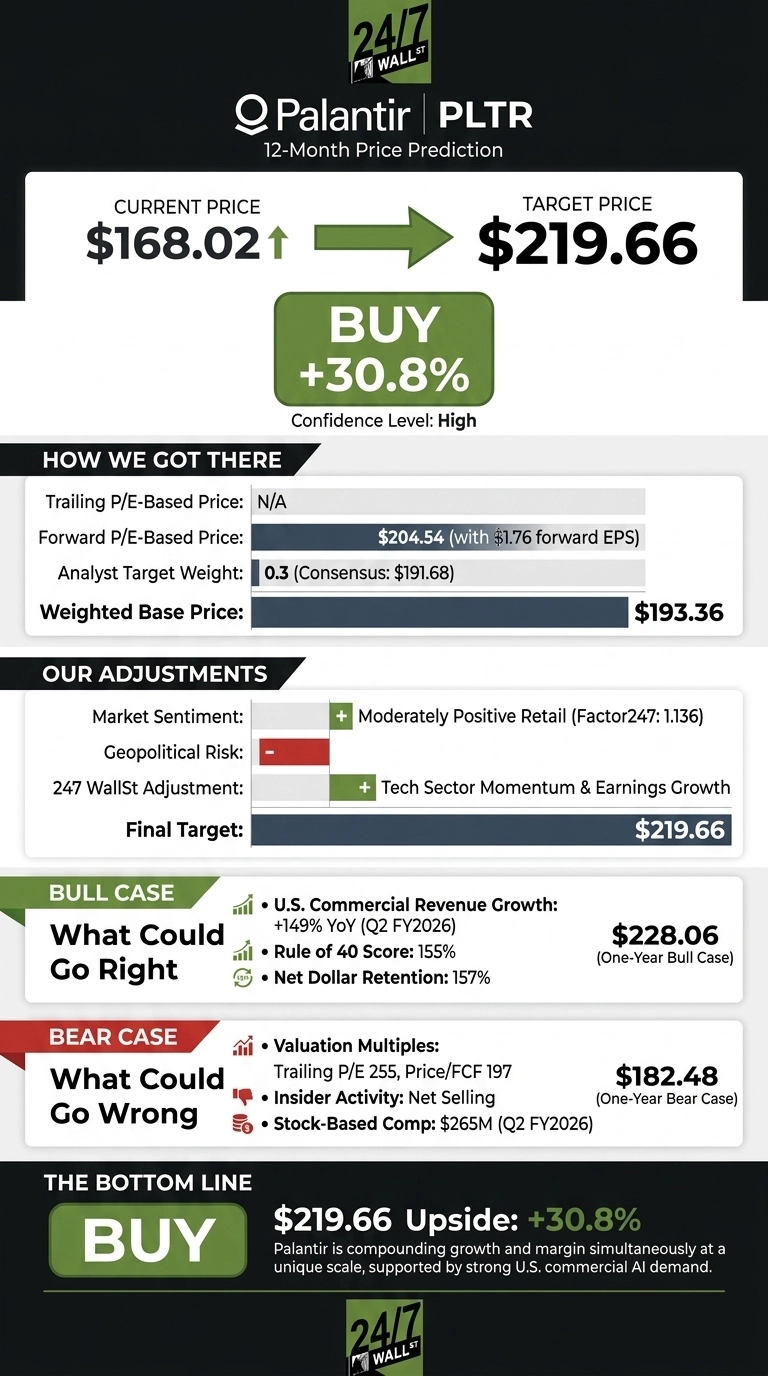
The 24/7 Wall St. price target for Palantir is $219.66 over the next 12 months, an upside of 30.8% from the current $168.02. Our model signals meaningful upside with high confidence.
24/7 Wall St. Price Target Summary
| Metric | Value |
|---|---|
| Current Price | $168.02 |
| 24/7 Wall St. Price Target | $219.66 |
| Upside | 30.8% |
| Directional Bias | Constructive |
| Confidence Level | 90% |

A Melt-Up Month Meets a Volatile Session
PLTR has been on a tear. Shares are up 46.21% over the past month and 4.16% over the past week, though today’s session opened weak with a 6.62% pullback from the prior close of $179.92. YTD, the stock is only 1.22% higher after a February drawdown, and it sits 8% below its 52-week high of $207.52.
The catalyst has been Q2 FY2026: revenue of $1.94 billion grew 92.83% year over year, EPS of $0.41 beat consensus by 46.43%, and U.S. commercial revenue rocketed 149%. Management raised full-year guidance to $8.150 to $8.158 billion, which they described as their “largest-ever full-year revenue guidance raise.”

Bull Case: $228 and Beyond
Bulls have a straightforward thesis. Palantir’s Rule of 40 score hit 155%, net dollar retention reached 157%, and Total Contract Value grew 129% on a duration-weighted basis. Karp told investors he is “driving the business to grow at a rate equal or above to what we have in U.S. commercial for the next 18 months.”
Government exposure adds another leg: the FY2027 Department of War budget requests a historic $58.5 billion for AI investment, and Palantir’s trailing 12-month defense revenue is still less than 25 basis points of the Pentagon’s budget. Our bull-case one-year target is $228.06.

What Could Go Wrong
The bear case starts with valuation. PLTR trades at a trailing P/E of 255 and a price-to-free-cash-flow of 197. Insider activity has skewed toward selling, and Polymarket’s near-term composite sentiment reads bearish at 39.55.
Stock-based comp of $265 million in Q2 is real dilution. Bulls will note that SBC funds the elite technical hiring driving the platform, and GAAP operating margin still expanded to 47%. Our bear-case one-year target is $182.48.
How Palantir Compares to ServiceNow and Snowflake
ServiceNow (NYSE:NOW) is the closest scaled enterprise AI workflow peer. NOW posted Q2 FY2026 revenue of $3.99 billion, up 24%, with ServiceNow AI crossing $1 billion in ACV. Palantir grew nearly four times faster off a smaller base, which supports our premium target.
Snowflake (NYSE:SNOW) is the data-platform contrast. SNOW’s Q1 FY2027 revenue rose 33.5% to $1.39 billion, but the company remains unprofitable with a negative earnings yield of -1.2%. Palantir’s 62% adjusted operating margin makes the 24/7 Wall St. price target look reasonable relative to this peer set.
Palantir Price Prediction 2026-2030
The 24/7 Wall St. price target of $219.66 rests on one factor above all: Palantir is compounding growth and margin simultaneously at a scale nothing else in software matches.
The constructive case strengthens if U.S. commercial TCV keeps growing above 100%. The setup weakens if the Rule of 40 score slips below 100% or if government AI budgets stall. For now, the fundamentals support the premium multiple.
| Year | 24/7 Wall St. Price Target |
|---|---|
| 2026 | $219.66 |
| 2027 | $258 |
| 2028 | $298 |
| 2029 | $330 |
| 2030 | $362 |
These projections assume Palantir executes on its sovereign AI roadmap and defense pipeline. A recession-driven pause in enterprise AI budgets, or accelerated share dilution, could compress this trajectory materially.
Contact [email protected] for any questions or corrections.
Vandita Jadeja is a financial publisher with over a decade of experience writing about financial topics, including investment, savings, retirement, insurance and banking. Vandita is a Chartered Accountant who loves to debunk financial concepts for readers.
Her work has appeared on sites that include The Motley Fool, InvestorPlace, and Benzinga. She covers investing and focuses on stock picks and price prediction for 24/7 Wall St.
When not looking for the next stock investment opportunity, she can be found traveling, reading, chasing sunsets and enjoying her iced latte.