Palantir Stock Has a Growth Story Few Companies Can Match
Palantir is posting revenue growth that most software companies only dream about, while somehow staying GAAP-profitable, but the valuation number sitting above it all raises a question that every serious investor needs to answer before buying.


Few software stories in the market right now match the sheer velocity of Palantir (NASDAQ:PLTR | PLTR Price Prediction). Revenue is accelerating, margins are expanding, and the company is quickly becoming a default sovereign-AI provider for U.S. commercial and government customers.
Our 24/7 Wall St. price target for Palantir is $311.42, roughly 68.3% above the current price of $192.03. Our recommendation is buy with high confidence at 0.9.
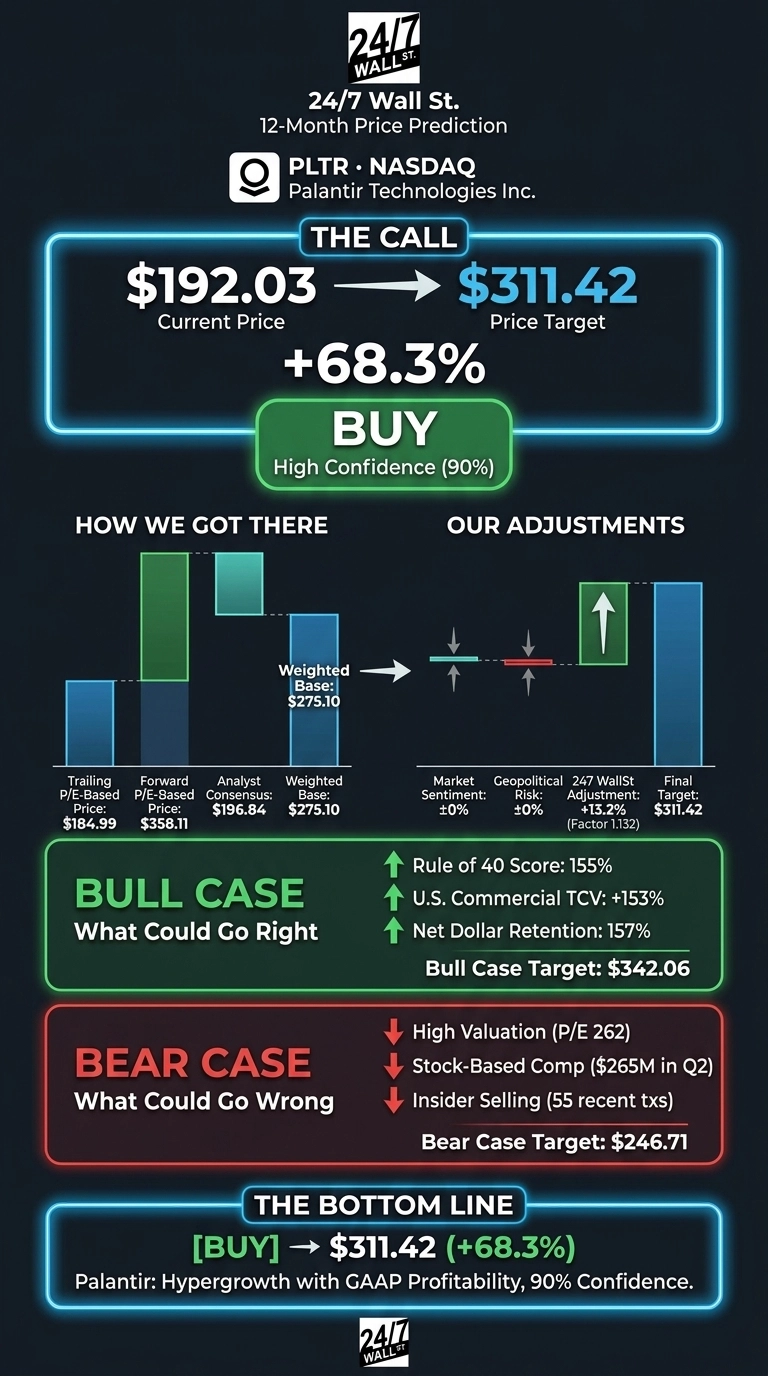
24/7 Wall St. Price Target Summary
| Metric | Value |
|---|---|
| Current Price | $192.03 |
| 24/7 Wall St. Price Target | $311.42 |
| Upside | 68.3% |
| Recommendation | BUY |
| Confidence Level | 90% |

A Vertical Move Into a New Trading Range
PLTR is up 11.28% over the past week and 8.03% year to date, sitting just below the 52-week high of $207.52. Five-year returns of 567.47% speak for themselves.
The Q2 2026 report was the driver. Revenue landed at $1.935 billion, up 92.83% year over year, EPS came in at $0.41 against a $0.28 estimate, and management raised full-year 2026 revenue guidance to $8.150 to $8.158 billion, roughly 82% growth. A separate PwC alliance announced on September 3, 2026 deepens the enterprise distribution story.
Why Bulls See a Breakout Above $340
The bull case starts with a Rule of 40 score of 155%, U.S. commercial TCV bookings of $2.132 billion (up 153%), and net dollar retention of 157%.
CEO Alex Karp told investors he is driving the business to grow at rates “equal or above to what we have in U.S. commercial for the next 18 months.” If AIP continues compounding at that clip, our own bull-scenario one-year path points to $342.06, and the forward-EPS math supports upside toward $358.

Risks Worth Watching
Valuation is the obvious pushback. PLTR trades at a P/E of 262 and a P/FCF of 203. Stock-based compensation of $265 million in Q2 pressures shareholders, though bulls fairly note that GAAP operating margin still expanded to 47% despite that expense.
Government contracts are terminable for convenience, and insider activity has been net selling per 55 recent transactions. Our bear-scenario path lands at $246.71, still above today’s price but well below the base case.

How Palantir Compares to Snowflake and CrowdStrike
Snowflake (NYSE:SNOW) is the closest data-platform peer, with Q2 FY2027 product revenue growth of 37%, net revenue retention of 126%, and a market cap of $119.95 billion.
Snowflake trades at a P/FCF of 106 while running GAAP operating losses. Palantir grows more than twice as fast and is GAAP-profitable, which makes our target look reasonable.
CrowdStrike (NASDAQ:CRWD) is the AI-security comparison. Q2 FY2027 revenue grew 25.83%, ARR reached $5.84 billion, and net new ARR accelerated 51%. At a market cap of $267 billion, CRWD commands a scarcity premium.
Palantir’s growth is roughly three times faster, which is why our 24/7 Wall St. price target embeds meaningful upside despite the multiple.
A Bullish Setup
Palantir is one of the rare software names combining hypergrowth with GAAP profitability. Our 24/7 Wall St. price target of $311.42 is a buy with 90% confidence.
The setup strengthens if U.S. commercial bookings hold above 100% growth next quarter. It weakens if the Rule of 40 rolls back under 120% or if sovereign-AI demand cools.
Palantir is also one of the non-chipmaker names riding the AI infrastructure buildout, a theme we broke down in a free report on seven AI beneficiaries beyond the chipmakers. Right now, the numbers point higher.
| Year | 24/7 Wall St. Price Target |
|---|---|
| 2026 | $216 |
| 2027 | $311 |
| 2028 | $447 |
| 2029 | $557 |
| 2030 | $676 |
These projections assume Palantir continues executing on AIP adoption, U.S. commercial expansion, and sustained government demand. Significant upside or downside could come from a shift in sovereign-AI budgets or an unexpected multiple compression across high-growth software.
Contact [email protected] for any questions or corrections.
Vandita Jadeja is a financial publisher with over a decade of experience writing about financial topics, including investment, savings, retirement, insurance and banking. Vandita is a Chartered Accountant who loves to debunk financial concepts for readers.
Her work has appeared on sites that include The Motley Fool, InvestorPlace, and Benzinga. She covers investing and focuses on stock picks and price prediction for 24/7 Wall St.
When not looking for the next stock investment opportunity, she can be found traveling, reading, chasing sunsets and enjoying her iced latte.