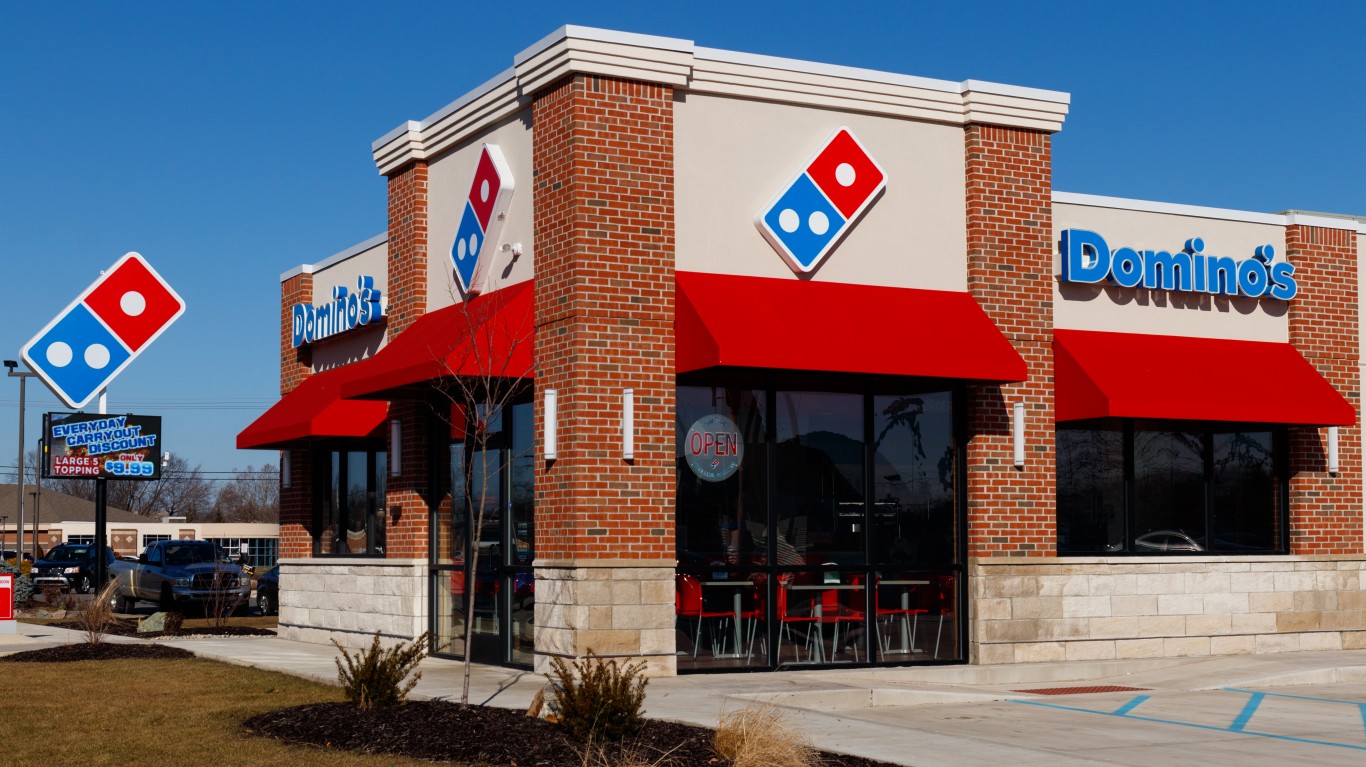
YUM vs. DPZ: Which Dividend Stock Actually Delivers for Retirement Investors?
Two fast-food franchisors share nearly identical business models, yet one has quietly crushed the other on dividend growth while losing badly on share price stability. Picking the wrong one for retirement could cost you years of income.

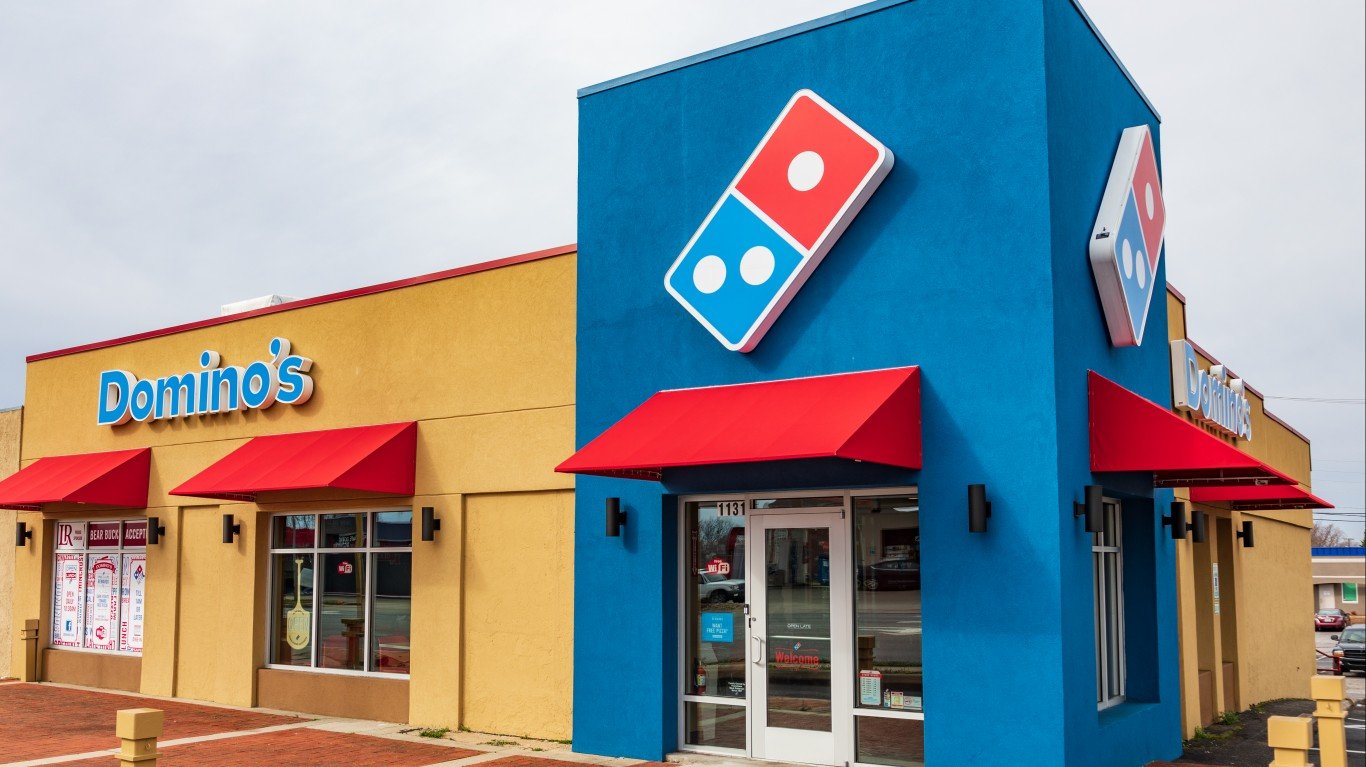
Between Yum Brands (NYSE:YUM | YUM Price Prediction) and Domino’s Pizza (NASDAQ:DPZ), which one better fits a retirement-focused income investor’s goals? Both pay a quarterly dividend that has gone up over time. Both run asset-light franchise models. Both have spent so heavily on buybacks that shareholders’ equity is negative. Where they split is yield, the rate of dividend increases, and how much the share price has tested investors’ patience.
Typically, a franchisor makes its money by collecting royalties and fees from independent operators, and those operators pay for most restaurant buildouts. Capital spending remains low, so a large share of revenue turns into cash. In 2025 Yum spent $371 million on capital projects against $2.01 billion of operating cash flow. Domino’s spent $120.6 million against $792.1 million. That surplus cash is what pays for the dividends.
Income: Domino’s Pays More and Raises Faster
At $303.70, Domino’s $7.96 annualized forward dividend yields about 2.6%. Yum’s $3 forward payout on a $139.34 share price yields about 2.2%.


Domino’s also increases its dividend faster. The most recent raise was 15%, bringing the quarterly payout to $1.99 from $1.74. Yum’s latest raise was 6%, to $0.75 from $0.71. Since 2017, Domino’s quarterly payout has grown from $0.46 at a compound annual rate of about 17.7%. Yum’s grew from $0.30 at about 10.7%. Domino’s has increases its dividend every year from 2013 through 2026.
Domino’s also covers its dividend more easily. In 2025 it generated $671.5 million of free cash flow and paid out $236.9 million in dividends, roughly 35%. Yum’s $789 million in dividends used about 48% of its free cash flow (operating cash flow minus capital spending). Winner: Domino’s.
Growth Trajectory: Taco Bell Gives Yum the Edge
Taco Bell same-store sales rose 7% in Yum’s second quarter, and the segment’s operating profit climbed 19% to $311 million. KFC opened 660 new restaurants. Total revenue rose 12.3% to $2.17 billion, and adjusted EPS of $1.62 came in above the $1.56 estimate. Yum is selling Pizza Hut in a deal expected to close in Q3 2026.
Domino’s growth has stalled. U.S. same-store sales rose just 0.1%, compared with 3.4% a year earlier. International same-store sales slipped 0.1% excluding currency effects. EPS of $4.07 missed expectations of $4.17. Winner: Yum.


Risk: Yum Has Been the Smoother Ride
Yum’s beta is 0.546, compared with 0.951 for Domino’s, so Yum’s shares have moved less with the broader market. Domino’s shares are down 27.28% over the past year and 32.22% over five years. Yum is down 5.72% over one year and up 23.94% over five. Both carry heavy debt.
Domino’s has a stockholders’ deficit of about $3.98 billion and $4.77 billion in securitized notes. Yum has negative equity of about $7.1 billion, plus exposure to China and a July 2026 cyclospora outbreak at Taco Bell. Winner: Yum.


Verdict: Domino’s Is the Better Dividend Stock
Yum wins two of the three categories, but a dividend stock should be judged on its dividend, and Domino’s wins that one clearly. It offers a higher yield, increases faster, and uses a smaller share of its cash to pay shareholders. It also trades at a forward P/E of 14, compared with 20 for Yum. The selloff is what drove the yield this high, and the board added another $1.0 billion in buyback authority in April.
Yum suits retirees who rank a steady share price above income growth. For retirees who want the biggest and fastest-growing dividend checks, Domino’s offers the stronger dividend profile (the idea of living on the checks without ever selling a share is the whole premise of our free dividend ladder guide: here). The key thing to watch is U.S. same-store sales: if they remains flat, future dividend increases could get smaller.
Contact [email protected] for any questions or corrections.
Chris Lange is a financial and geopolitical writer with more than a decade of experience covering a myriad of topics. He has published thousands of articles for 24/7 Wall St., with past coverage focused heavily on stocks, IPOs, healthcare, defense, global affairs, and technology.
His work has been quoted, or referenced by a number of outlets including Business Insider, USA Today, Yahoo Finance, MSN, The Motley Fool, and many other publications. A graduate of Southwestern University, he studied business with a focus on investments and has previous experience in banking and startups.
When not reading or writing the news, he is following his passion for Lacrosse, playing chess, or building solar projects with his dad.