Federal Regulators Open Investigation After Tesla Launches Car With No Steering Wheel
Tesla launched the Cybercab without asking a single regulator for permission, and now the federal government wants to know how that was even possible. The answer sits inside a legal gray zone that could decide the future of every driverless…

This post may contain links from our sponsors and affiliates, and Flywheel Publishing may receive compensation for actions taken through them.
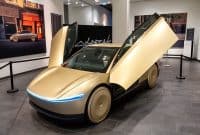
On Thursday evening, at ACL Live in downtown Austin, Tesla (NASDAQ:TSLA | TSLA Price Prediction) held an invitation-only launch event for the Cybercab, a passenger vehicle with no steering wheel, no pedals, and no side mirrors. Attendees rode in it first. Public rides opened Friday morning inside a limited zone of Austin. Before those rides began, the National Highway Traffic Safety Administration opened a formal audit query into how the car got on the road at all.

Here is the part most drivers do not know: Tesla did not ask a regulator for permission. It declared the Cybercab legal itself. In American vehicle safety law, that is the system. Automakers self-certify that their vehicles meet every Federal Motor Vehicle Safety Standard, and NHTSA polices that assertion after the fact. Self-certification is standard industry practice. What is unusual is applying it to a car that ships without the physical controls the standards were written around.
What the Government Is Actually Auditing
The National Highway Traffic Safety Administration said its audit query will “examine the process and technical data on which Tesla relied when certifying the Cybercab and related issues.” The agency also said it will weigh how far Tesla’s self-certification depended on the company’s own determination that certain federal motor vehicle safety standards are inapplicable to a vehicle designed without manual controls. The audit is a fight over the basis of the certification itself, with no connection to any crash, injury, or defect involving the Cybercab.
There was another road Tesla could have taken. TechCrunch notes that Part 555 is the formal federal exemption process for vehicles that do not meet all the standards, and it is the path a company would normally use to put a steering-wheel-free car on public streets. According to 24/7 Wall St., Tesla had not filed an exemption request as of Wednesday, the day before the launch. By self-certifying instead, Tesla is attempting to skip the exemption process entirely. The audit query is the government testing whether it can.
Zoox Precedent Regulators Are Working From
NHTSA has run this play before. Zoox, the Amazon-owned robotaxi company, self-certified its own driverless shuttle. NHTSA answered with a special order for information, then an audit query the following year, the same instrument now pointed at Tesla. Zoox eventually received an exemption permitting demonstration only, not commercial service, then filed a Part 555 request for a temporary exemption from eight Federal Motor Vehicle Safety Standards, according to TechCrunch, won final approval, and began charging for rides in Las Vegas weeks later. The process consumed years. It is unclear whether Tesla’s path resolves on anything like that timeline.
One variable could rewrite the whole question. The Department of Transportation has proposed removing manual control requirements for vehicles built to drive themselves. If that rule takes effect, the terrain of the audit shifts under everyone’s feet. Whether it does, and when, is not something to predict.
Context on the broader regulatory backdrop is covered in our companion piece, Tesla Falls 3% as Cybercab Launch Leaves Deployment Questions Unanswered, according to 24/7 Wall St.. Tesla also has at least two other active NHTSA investigations into its self-driving systems, covering at least nine documented crashes including a fatal pedestrian collision, plus scrutiny over allegedly slow crash reporting.
The signal to watch is narrow and specific. NHTSA’s next move is either a request for the underlying certification documents or a determination that Tesla’s inapplicability findings do not hold. Either would tell the market whether self-certification remains a workable route for a car built without a driver’s seat.
Contact [email protected] for any questions or corrections.
AJ has spent the past 10 years writing about financial markets at The Motley Fool. His coverage centers on technology stocks and the broader macroeconomic trends, from interest rates to geopolitics, that shape where markets are headed next. AJ is drawn to the stories where big-picture economics and individual companies collide.