Forget Starlink? Japan’s $1 Billion BlueBird Play Makes ASTS the National Satellite OS
Japan just handed a foreign satellite company something no G20 nation has ever offered before, and the telecom giant most investors are obsessing over right now has nothing to do with it.


Every retirement account in America seems to want a piece of SpaceX (NASDAQ:SPCX | SPCX Price Prediction), the freshly public Starlink parent now carrying a $2 trillion market cap after a 36.65% one-month rip. But here’s what you should actually be watching.
Crowded, Unprofitable, and Priced for Perfection
SpaceX just posted $7.81B in Q2 2026 revenue and beat consensus by 14.59%, yet still reported an operating loss of $143M and a net loss of $541M. The Connectivity segment grew 66% year over year, but Starlink ARPU compressed from $85 to $66 even as subscribers doubled. That is classic late-cycle unit economics dressed up as growth.
Then there is the capital sinkhole. Capex hit $18.37B in a single quarter, with $15.83B directed at AI compute, and a $60B pending acquisition of Cursor is scheduled to close in Q3. One podcast host summed up the pivot bluntly, calling SpaceX “his AI holding company”. Retirement investors chasing a trillion-dollar rocket-and-GPU conglomerate through a post-IPO hype cycle are providing the exit liquidity.
The Sovereign Satellite Layer Nobody Is Pricing In
The smarter play sits at roughly $18.68 billion in market cap: AST SpaceMobile (NASDAQ:ASTS). While Starlink chases consumer broadband and Musk chases compute, ASTS is quietly becoming the operating system for direct-to-device cellular from space. Three points make the case.
Japan Just Blessed a National BlueBird Constellation
Japan’s Ministry of Internal Affairs and Communications preliminarily selected the Rakuten and AST joint venture for the J-LEO initiative, worth up to approximately $1 billion in non-dilutive, non-debt government capital. Separately, Japan filed an ITU application for a 136-satellite “J-BLUEBIRD-NGSO” architecture, with government subsidies covering as much as 50% of eligible costs and private matching pushing the program toward $2 billion. As President Scott Wisniewski put it, “I don’t know why a G20 country wouldn’t want this kind of capability given the price.” This is a template: governments finance and own AST-powered constellations while AST collects the platform economics.
BlueBird Constellation Is Actually Flying
ASTS now has 13 BlueBird spacecraft in orbit with roughly 20,000 sq ft of aperture hardware deployed, launched six spacecraft in 50 days, and is producing approximately six fully assembled satellites per month. BlueBirds 14 through 16 are ready to ship, BlueBirds 17 through 46 are in production, and the target is roughly 45 satellites in orbit by early 2027. Block 2 satellites are engineered for peak data rates approaching 200 Mbps. Commercial service can begin with as little as 45 satellites.
Fortress Balance Sheet and a 3-Billion-Subscriber Rolodex
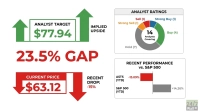
Pro forma liquidity exceeds $3.70 billion following the July 2026 $1.150 billion convertible offering. Backlog sits at roughly $1.30 billion. Over 60 MNO partners cover 3+ billion subscribers, including Vodafone, Verizon, AT&T, Rakuten, and Deutsche Telekom, and $125 million in U.S. Government awards anchor a defense pipeline. Analysts carry an average target of $79.61 against a last close of $62.31.
What to Do
Stop rubbernecking the SpaceX ticker and start doing the work on ASTS before Japan converts a preliminary award into a signed contract.
Contact [email protected] for any questions or corrections.
After two decades of patrolling the dark corners of suburbia as a police officer, Rich Duprey hung up his badge and gun to begin writing full time about stocks and investing. For the past 20 years, he’s been cruising the markets looking for companies to lock up as long-term holdings in a portfolio while writing extensively on the broad sectors of consumer goods, technology, and industrials. Because his experience isn’t from the typical financial analyst track, Rich is able to break down complex topics into understandable and useful action points for the average investor. His writings have appeared on The Motley Fool, InvestorPlace, Yahoo! Finance, Money Morning, and, of course, 24/7 Wall St. He has been featured in both U.S. and international publications, including MarketWatch, Financial Times, Forbes, Fast Company, and USA Today.