As Starlink Passes 11,000 Satellites, These 5 Stocks Will Feel It First
Washington just started writing checks specifically to prevent a Starlink monopoly in orbit, and five U.S.-listed stocks sit directly in the path of that money before the window closes.


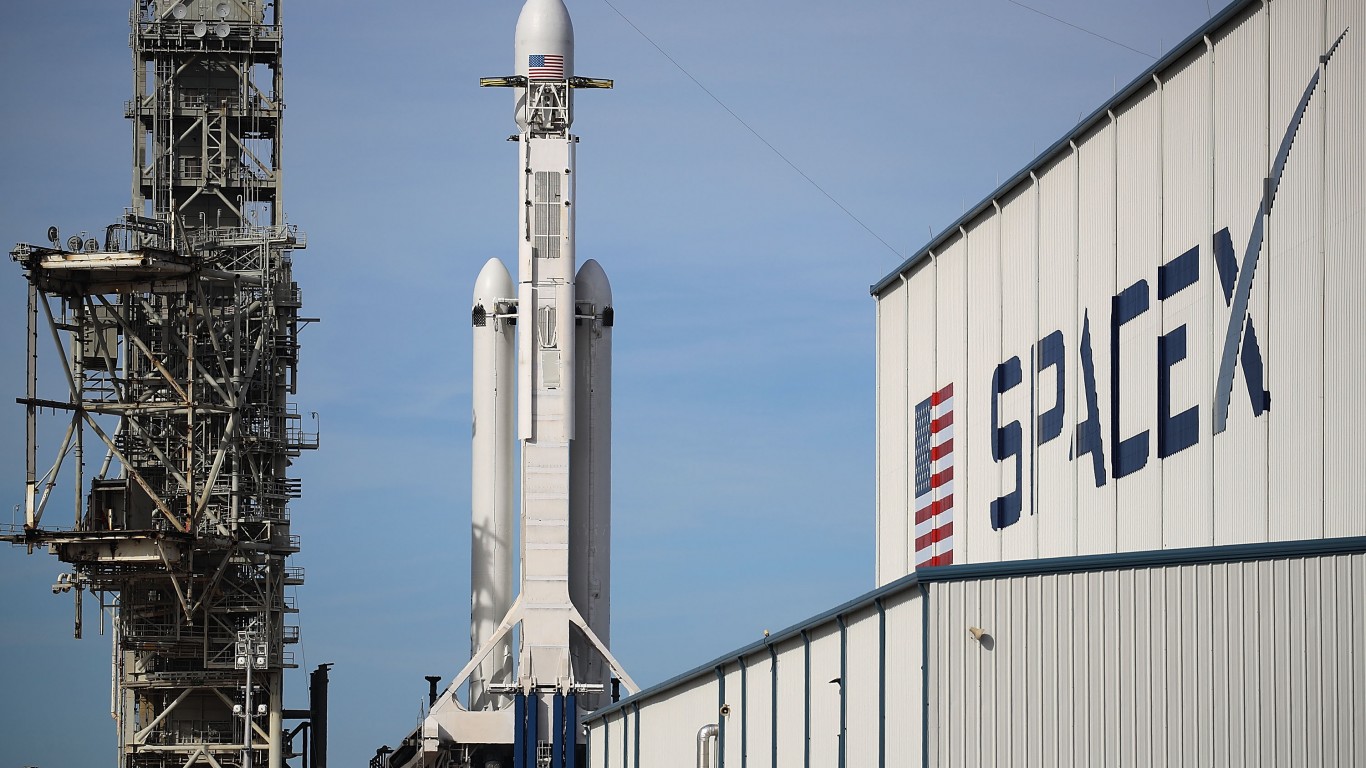
On Tuesday, Aug. 18, SpaceX (NASDAQ:SPCX | SPCX Price Prediction) completed its 100th launch of 2026, sending 24 Starlink satellites into orbit from Vandenberg SFB aboard a Falcon 9 and pushing the constellation past 11,000 satellites in low Earth orbit.
That number includes spacecraft that are non-operational, failed or queued for deorbit, but it does not change what the Pentagon just did: The Space Force cut five separate $12 million contracts under a $60 million effort to prove that non-SpaceX satellites can plug into the Space Data Network backbone that SpaceX itself built under a $2.29 billion award in May 2026.
Washington is paying, in cash, to make sure it never has to depend on one vendor in orbit. Five U.S.-listed names sit directly in the flow of that money.
1. L3Harris Technologies (LHX): The Anti-Lock-In Prime
The obvious read on 11,000 Starlinks is “short the legacy names.” The correct read is that the Department of War is now writing checks specifically to avoid single-vendor dependency in space, and the prime with the deepest missile-tracking, PNT, and space payload footprint is L3Harris Technologies (NYSE:LHX). CEO Chris Kubasik put it bluntly on the Q2 call: “We are the only company to be awarded all five contracts related to missile tracking.” Proliferated LEO is the delivery mechanism for that franchise.
The numbers back the thesis. Q2 revenue landed at $5.9 billion, up 8% year over year, orders came in at $7.3 billion with a 1.2x book-to-bill, and backlog climbed to a record $42 billion. Management raised full-year EPS guidance to $11.80 to $12.00 on revenue of $23.2 to $23.7 billion. Analysts carry a $341.73 price target against a stock trading around $278, with a forward P/E of 25.
Yet LHX is down 8.70% year to date (YTD) while satellite peers have re-rated hard. That gap is the setup. The stocks feeling Starlink first are the ones the market still thinks lose to it.

2. AST SpaceMobile (ASTS): The Direct-to-Device Collision
AST SpaceMobile (NASDAQ:ASTS) is the only publicly traded name whose entire product roadmap collides head-on with Starlink’s direct-to-cell service. The company has 13 spacecraft in orbit with roughly 20,000 square feet of aperture, is targeting about 45 satellites by early 2027, and has already activated 3,000 digital cells across the Continental US with 60-plus MNO partners covering more than 3 billion subscribers.
Q2 2026 revenue printed at $31.52 million, up 2,626.6% year over year, missing consensus by 8.36%, and GAAP EPS of -77 cents included a $125.9 million BB7 launch loss. Management reaffirmed FY2026 revenue guidance of $150 million to $200 million and pro forma liquidity now sits above $3.7 billion after the July convertible offering. But the company’s backlog of $1.3 billion contracted, including U.S. government awards over $125 million and a preliminary $1 billion selection with Rakuten for Japan’s J-LEO, provides solace for investors.
Reddit sentiment turned very bullish (score 86) on r/wallstreetbets on Aug. 14, and shares are up 47.18% over the past year even after a 20.74% YTD loss. Retail is treating every Starlink milestone as the reason to buy the only pure-play D2D competitor. The launch cadence that funds that thesis belongs to the next name.
3. Rocket Lab (RKLB): The Picks-and-Shovels Heavyweight
Every satellite in orbit was launched by someone. Rocket Lab (NASDAQ:RKLB) is one of the five names the Space Force just funded to demonstrate SDN interoperability, with its contract covering design and ground testing of a Photon spacecraft with optical communications hardware ahead of a 2027 flight. That is the Pentagon paying Rocket Lab directly to be a Starlink alternative. CEO Peter Beck framed the ambition on the Q2 call: “Rocket Lab is one of only two companies capable of” building and launching its own satellites.
Q2 revenue reached a record $234 million, up 62% year over year, non-GAAP gross margin expanded to 41.5% from 36.9%, and backlog stands at $2.36 billion, split 40% launch and 60% space systems. Post-quarter contract wins already exceed $1 billion, including the $397 million Flatellite/SBAMTI award and a $266 million Space Force Haste suborbital contract, the largest launch contract in company history. Neutron’s debut is targeted for Q4 2026, with initial ASPs of $50 to $55 million and no early-launch discounting.
Beck’s read on the market: “Launch has never been so constrained… if you want to book a launch now, or especially after 2029, the options are extremely limited.” Shares trade around $76.09 with an analyst target of $112.94. That premium is what a self-launching space power costs before the acquisition on slide five closes.

4. Viasat (VSAT): The Legacy Pivot Nobody Priced In
Viasat (NASDAQ:VSAT) was supposed to be the roadkill trade. Instead, shares are up 104.2% YTD and 194.63% over the past year. CEO Mark Dankberg’s pivot to multi-orbit, dual-use, and defense is showing up in the awards: Q1 FY2027 company-wide awards of $1.3 billion, up 10% year over year, and backlog of $4.2 billion, up 19%.
The Defense & Advanced Technologies segment is the story: Q1 DAT awards of $524 million, up 22% year over year, tactical networking revenue up 36% year over year, and a $4 billion ceiling on the PTSG win. Aviation revenue grew 11% year over year across roughly 4,530 commercial aircraft, and Viasat-3 Flight 2 is expected to enter service late August or early September 2026 with what Dankberg called “orders of magnitude” capacity gains.
Dankberg conceded the pressure on legacy consumer broadband but drew the line clearly: “We recognize the effects of greater competition in our legacy commercial services, but are seeing growth in emerging segments of dual-use, multi-orbit, multi-band.” That reframing is why the stock has doubled while Starlink added thousands of satellites. It sets up the last name, because one of the four growth pillars Viasat’s smaller rival has been building around is about to disappear from the public markets entirely.
5. Iridium Communications (IRDM): The Deal Closing Underneath Everyone
Iridium Communications (NASDAQ:IRDM) is the payoff. Rocket Lab announced an $8 billion all-stock acquisition of Iridium on June 28, targeted to close mid-2027, folding 66 operational satellites, 2.5 million-plus subscribers, and roughly $870 million in annual revenue into what Beck calls a “self-launching tier one space power.” Own IRDM here and you are pre-positioning into the only vertically integrated public alternative to SpaceX.
Q2 2026 revenue came in at $225.24 million, up 3.84% year over year, beating consensus by 2.17%, with billable subscribers of 2.63 million, up 6% year over year. The Aireon acquisition closed July 2, 2026 for $366.7 million and adds $100 million annualized service revenue plus $30 million OEBITDA. Iridium NTN Direct, the standards-based D2D service, is launching later in 2026 with seven MNO agreements signed. Shares are up 174.63% YTD. The market is already front-running the deal.
Matt Desch’s framing of the L-band moat is what makes the RKLB combination lethal: “Freedom NTN Direct is positioned as complementary to the big B2B services that are emerging from Starlink, AST, and now Amazon Leo.” Complementary today. Vertically integrated with a launch monopoly tomorrow.

The Setup
Starlink at 11,000 satellites is the reason Washington is now spending real money to make sure five other providers can do what SpaceX does. LHX, ASTS, RKLB, VSAT and IRDM sit directly in the flow of those dollars, and four of the five have already re-rated hard in 2026. The question is whether the fifth catches up before Neutron flies and the Iridium deal closes.
Contact [email protected] for any questions or corrections.
Joel South covers large-cap stocks, dividend investing, and major market trends, with a focus on earnings analysis, valuation, and turning complex data into actionable insights for investors.
He brings more than 15 years of experience as an investor and financial journalist, including 12 years at The Motley Fool, where he served as an investment analyst, Bureau Chief, and later led the Fool.com investing news desk. He has also co-hosted an investing podcast and appeared across TV and radio discussing market trends.