South Korea’s ‘AI for All’ Is Great for Chipmakers, but It Will Run Into Wall of Reality
South Korea just promised free, unlimited AI to 51 million citizens, and the chipmakers supplying the hardware are already booking it as a win. But the gap between that promise and the compute reality behind it exposes something investors are…


South Korea’s government has selected a consortium led by SK Telecom, Kakao, and KT to deliver free, unlimited-access general-purpose AI chatbots and agents to roughly 51 to 52 million citizens, with beta testing in September and full launch by year-end. The state is seeding the program with a combined 512 NVIDIA B200 GPUs this year and plans operating subsidies from 2027 onward, alongside a domestic-model quota. That is a rounding error against the compute base frontier labs run on, which is exactly why the demand signal for the three chipmakers below is real but bounded. NVIDIA already flagged the linkage: its most recent 10-Q disclosed an expanded Korea AI factory ecosystem through partnerships with SK Telecom, NAVER, and Brookfield, and a multiyear technology partnership with SK hynix for next-generation memory.
NVIDIA: The Compute Anchor Behind Korea’s AI Push
NVIDIA (NASDAQ:NVDA | NVDA Price Prediction) sells the B200 accelerators the Korean state is buying and the Vera Rubin systems the country’s private operators will layer on top. Q2 FY2027 revenue landed at $96.22 billion, up 105.8% year over year, with Data Center at $89.02 billion, up 117%. On the call, management said its sovereign AI business, “grew 35% sequentially and more than tripled year over year in Q2,” and specifically flagged that “South Korea’s LG and Hyundai Motor Group are partnering with NVIDIA to build and scale AI.” Shares are up 23.67% year to date to $230.36, and the P/E sits at 46.
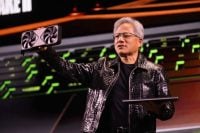
The bull case is that Korea is one instance of a repeatable regional-cloud template. CEO Jensen Huang told analysts that “a country or region can allocate land and power directly to a regional cloud partner in ways it never would to a foreign hyperscaler,” and NVIDIA now expects non-hyperscaler business, including sovereigns and neoclouds, to represent “roughly half of our data center business.” The risk: the Korean disclosure is qualitative, not quantified. The transcript provides no GPU volume, dollar value, or delivery schedule for the LG or Hyundai partnerships, and the 512-GPU state allocation is not remotely hyperscaler-scale. Meanwhile, NVIDIA carries its own concentration risk, with $279.0 billion in supply commitments tied largely to memory procurement for Vera Rubin and no China Data Center compute revenue assumed in Q3 guidance.
SK hynix: The HBM Choke Point With a Korean Passport
SK hynix (NASDAQ:SKHY) is the memory half of the “AI for All” equation. Every B200 shipped into Korea, and every Vera Rubin rack behind it, carries the company’s high-bandwidth memory stacks. Preliminary Q2 FY2026 revenue came in at KRW 79.32 trillion, up 50.9% quarter over quarter and 256.8% year over year, with operating profit up 557.2% and net profit attributable to controlling interests up 1,240.8% year over year. The ADS is up 17.2% over the past month to $177.
The bull case is structural HBM scarcity plus geographic diversification. SK hynix held a groundbreaking ceremony for an HBM production base in Indiana on August 27, 2026, framed as “beginning a new future for US-Korea AI”, and it is accelerating a 40 trillion won share repurchase and cancellation program with a target of returning over 50% of free cash flow. NVIDIA itself said memory scarcity is being driven “in large part by the AI build-out itself” and that price increases have exceeded prior expectations. The risk: preliminary results are subject to audit revision, KRW-denominated reporting exposes ADS holders to currency swings, and the AI for All hardware allocation is small enough that it moves Korean policy narrative more than SK hynix’s order book.
TSMC: The Foundry That Prints Everyone’s Silicon
Taiwan Semiconductor Manufacturing (NYSE:TSM) fabricates the B200s Korea is deploying, the Rubin dies coming behind them, and the custom accelerators Korean domestic-model developers will inevitably tape out. Q2 2026 revenue reached $40.20 billion, up 36.0% year over year, with HPC at 66% of second-quarter revenue, up 20% quarter over quarter, and advanced nodes at 7nm and below at 77% of wafer revenue. Full-year 2026 revenue is guided to grow “slightly above 40%” in USD terms. The stock is up 41.85% year to date to $428.91.
The bull case is a capacity story with almost no substitutes: TSMC raised its 2026 capital budget to $60 billion to $64 billion and said CAPEX in the next three years will be “even more significantly higher than the past three years”, with an additional $100 billion investment in Arizona bringing total planned Arizona spend to $265 billion. Advanced packaging is the pinch point: management said “our packaging capacity is so tight that now it’s a little bit of my customers’ growth.” The risk is discipline. TSMC’s own chairman warned that aggregating aggressive customer forecasts requires judgment: “I believe every customer tells me the truth. Everyone. You put all the truth together, it’s not the truth.” Q3 gross margin is guided to 65% to 67%, with a 3 to 4 percentage point dilution expected from the 2nm ramp.
Bottom Line
Korea’s AI for All is a real, policy-locked demand line for NVIDIA compute, SK hynix HBM, and TSMC wafers. It is too small to meaningfully move any of these earnings models. The initial 512-GPU allocation is a fraction of what a single frontier lab consumes in a week, and the “no limits” language will quickly collide with rate limits, queues, and domestic-model quotas long before it collides with the physics of inference at population scale. Investors should treat the program as one more sovereign proof point for the neocloud playbook Jensen Huang laid out on the last earnings call. The chipmakers get the headlines, but the same buildout has to be powered, cooled, and networked by somebody; we pulled seven of those suppliers into a free report here: 7 Stocks Powering the AI Boom (That Aren’t Chipmakers).
Contact [email protected] for any questions or corrections.
After two decades of patrolling the dark corners of suburbia as a police officer, Rich Duprey hung up his badge and gun to begin writing full time about stocks and investing. For the past 20 years, he’s been cruising the markets looking for companies to lock up as long-term holdings in a portfolio while writing extensively on the broad sectors of consumer goods, technology, and industrials. Because his experience isn’t from the typical financial analyst track, Rich is able to break down complex topics into understandable and useful action points for the average investor. His writings have appeared on The Motley Fool, InvestorPlace, Yahoo! Finance, Money Morning, and, of course, 24/7 Wall St. He has been featured in both U.S. and international publications, including MarketWatch, Financial Times, Forbes, Fast Company, and USA Today.