Nvidia’s New Partner Says Banks Want AI on Machines They Can Unplug
Big banks are demanding AI systems they can physically disconnect from the internet, and the CEO of one of Nvidia's newest partners says that changes everything about where the next trillion dollars in AI compute actually gets built.

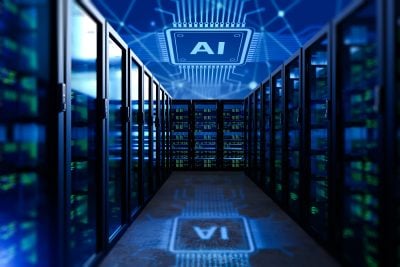
The CEO of AI search startup Perplexity handed retail investors a sharp counterpoint to the cloud data center boom behind NVIDIA (NASDAQ:NVDA | NVDA Price Prediction)’s $5.48 trillion market cap. Speaking on CNBC’s Squawk on the Street on September 4, 2026, Perplexity CEO Aravind Srinivas argued that data centers alone cannot carry AI’s next phase. Big banks, he said, want part of that computing power on their own premises, in machines they control and can physically unplug.

Terawatt Problem Looms Over AI
Srinivas framed the ceiling clearly, saying, “If a billion people need to run 24 over seven agents, they’re going to need a terawatt of power and a lot of memory. And so you’re not going to be able to do this just with data centers.” His fix is hybrid: route privacy-sensitive workloads to local hardware while keeping cloud access for frontier models. He noted that “there’s a lot of ram in our own devices, there’s a lot of power in our own offices, in our own homes that we’re not actually tapping into for AI inference today.”
Why Banks Want the Plug
For banks, the appeal of running AI closer to home begins with control. Srinivas shared that firms like Morgan Stanley or JPMorgan want “air gapped implementation”, disconnected boxes running “the product, the model, the agent, everything” on-premises because they fear “their ip leaking to frontier labs.” The hardware he pointed to is NVIDIA’s DGX Spark, the desk-side box built for local inference.
NVIDIA’s Q2 FY27 numbers show this on-prem market is substantial. CFO Colette Kress told analysts that “on a trailing 12-month basis, on-prem revenue in the automotive vertical reached $8 billion, while financial services, manufacturing, and healthcare combined contributed $7 billion in revenue.” She named Hudson River Trading and Jane Street as trading firms running quantitative workloads on NVIDIA AI factories.
Funding Both Sides of the Compute Equation
NVIDIA is bankrolling both ends of the spectrum. Finance chief Kress said non-hyperscaler categories, sovereign AI, regional neoclouds, enterprise edge and air-gapped data centers will make up roughly half of the data center business. NVIDIA has also lined up heavy-hitters Apollo, BlackRock, Blackstone, Brookfield, Goldman Sachs and KKR to mobilize over $500B for centralized AI infrastructure (the power, cooling, and networking suppliers behind that buildout are the subject of a free report on seven AI infrastructure names that aren’t chipmakers). Its Confidential Computing GPUs power Apple (NASDAQ:AAPL) Private Cloud Compute, the hybrid architecture former CEO Tim Cook described as running “on device” and “on servers using private cloud compute.”
What to Watch Next
Jensen Huang’s pitch on the Q2 FY27 call was that NVIDIA is “an entire AI factory platform” that customers “can use in any cloud” or run anywhere. If workloads migrate to the desk, NVIDIA still sells the silicon. The stock is up 35% over the past year and 21.7% year to date. Q3 FY27 guidance sits at $108B in revenue (±2%). The question is whether an on-prem shift compresses the hyperscaler capex that has driven Data Center revenue to $89.02B (+117% YoY), or routes it through a different SKU on the same invoice. Banks may pull some workloads out of the cloud. NVIDIA is betting its chips will still power the machines running them.

Contact [email protected] for any questions or corrections.
Gerelyn Terzo is the author of dividend investing handbook "Dividend Investing Strategies: How to Have Your Cake & Eat It Too." A veteran financial journalist, she covers agri-finance for outlets like Global AgInvesting and the broader stock market and personal finance for 24/7 Wall Street. She began at CNBC and later helped launch Fox Business in New York. Gerelyn currently resides in Woodland Park, Colorado and dabbles in nature photography as a hobby.