Prediction: This Megacap Stock Could Crush the S&P 500 Through 2030
AWS just posted its fastest growth in 18 quarters, yet Amazon shares are lagging the S&P 500 and sliding further. Here is why that disconnect could set up one of the boldest stock plays of the decade.


Amazon (NASDAQ:AMZN | AMZN Price Prediction) just posted its fastest AWS growth in 18 quarters, yet the stock is up only 10.88% year to date, trailing the S&P 500’s 12.53%.
That’s a strange result for a business where AWS is now running at a $169 billion annualized run rate and CEO Andy Jassy is publicly guiding investors toward a potential trillion dollar annual revenue business for AWS alone. Which brings me to the question I want to answer: can Amazon shares realistically hit $500 by 2030?

Why Amazon Shares Are Stuck Despite a Booming AWS
Shares have gone the wrong way lately. AMZN is down 3.94% over the past week and 6.13% over the past month, with a one-year return of just 8.6% against the S&P’s 18.22%.
The disconnect is capex. Amazon spent $54.208 billion in a single quarter, plans roughly $200 billion in 2026, and trailing free cash flow flipped to negative $7.6 billion. Q3 guidance also implies growth decelerates to 9% to 12%. Add a beta of 1.44, and you get exactly what we’re seeing: a nervous market punishing near-term cash burn even while the demand story gets bigger.
Wall Street Sees 27% Upside. Our Model Says 38%
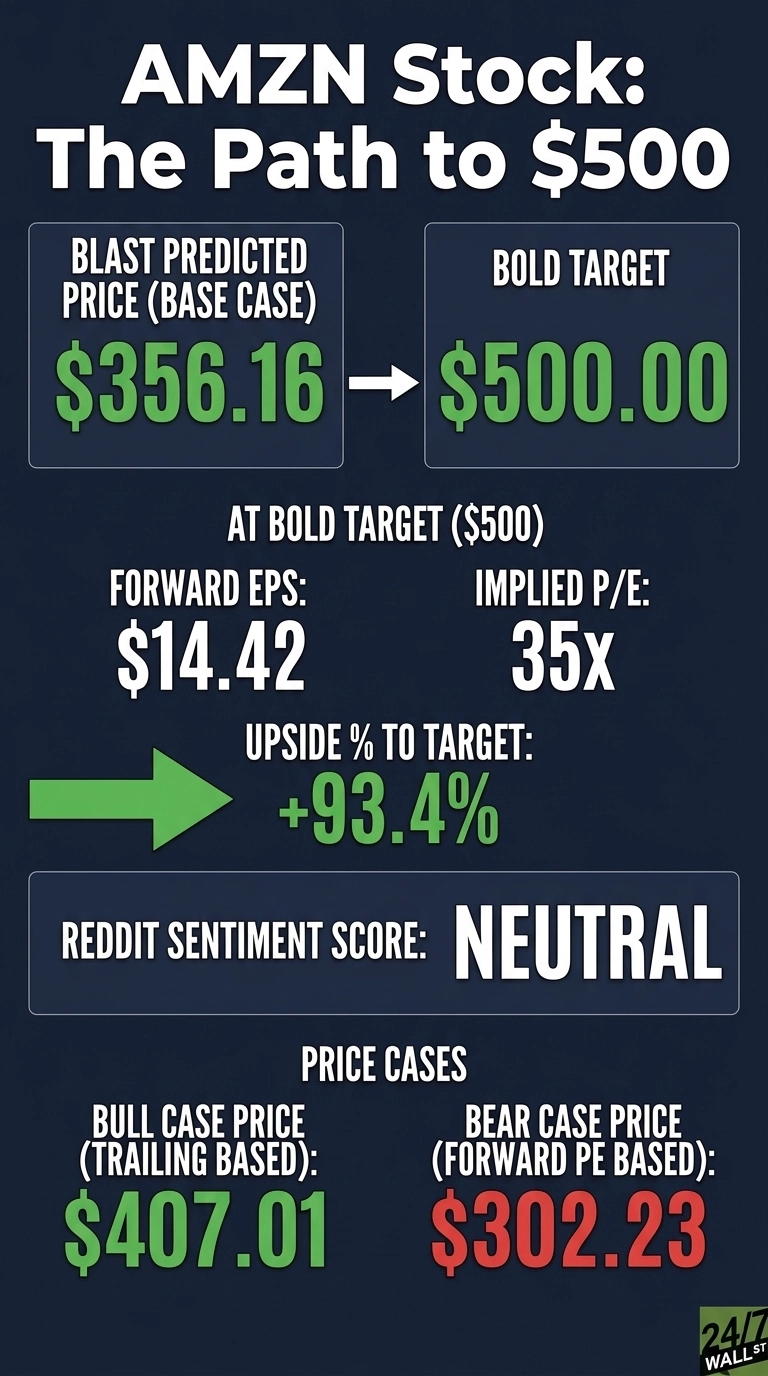
The Street is heavily bullish. The consensus target sits at $328.17, with 15 Strong Buys, 44 Buys, 2 Holds, and zero Sells. Our own model goes further, projecting a one-year base case of $356.16, an upside of 37.77%, with a bull case at $407.01 and confidence rated high (0.9). I think the consensus is too conservative.
With 97% of analysts bullish and earnings growth contributing meaningfully to our 247Factor via strong earnings acceleration, the setup argues for multiple expansion once capex intensity peaks. Analysts often lag the pivot from “investment mode” to “harvest mode.” That’s the window Amazon is walking into.

Charting a Path to $500 Per Share by 2030
Reaching $500 from today’s price of $258.51 would require a gain of 93.4%. With forward EPS of $14.42, a price of $500 implies a forward P/E of 35x. Our base case of $356.16 already implies 21x, meaning the bold target requires 14x of additional multiple expansion.
That is a real stretch, but it is achievable if EPS compounds meaningfully by 2030 and the market rewards the AWS earnings mix. The 247Factor adjustment of 1.097 already reflects strong analyst consensus and earnings acceleration.
Jassy told investors AWS “added over $4.6 billion in revenue quarter over quarter” with a $496 billion backlog, and that the chips business now has an annual revenue run rate of over $25 billion, growing triple-digit percentages year over year.
Ads at $19.809 billion quarterly (up 26%) is the profit accelerant Wall Street still underestimates. The primary risk is that AI capex overshoots demand and depresses returns on invested capital for years.
Where Amazon Trades Today vs Its Earnings Power
At $258.51 against forward EPS of $14.42, Amazon trades at roughly 18x forward earnings. That looks reasonable for a business compounding AWS at 37% and ads at 26%.
Shares sit between a 52-week low of $196 and a high of $287.20, and the 10-year return of 548.88% more than doubles the S&P’s 250.34%. That long-term track record is exactly what supports paying up for the earnings power still building underneath the capex wave.
Is $500 Realistic? Here’s My Take
Reaching $500 by 2030 requires a 93.4% gain from here. My verdict: a stretch, but a credible one.
Three things need to go right. AWS has to keep compounding above 30% into 2027 as capacity contracted for 2027 and 2028 comes online. Free cash flow has to inflect sharply once data-center spend normalizes. And advertising plus custom silicon need to keep pushing operating margin higher.
The derailer would be AI demand slowing before that $200 billion 2026 capex program earns its return. Returns at this level shouldn’t be expected every year, but we’ve outlined the blueprint for how Amazon could reach $500 in 2030.
Contact [email protected] for any questions or corrections.
Vandita Jadeja is a financial publisher with over a decade of experience writing about financial topics, including investment, savings, retirement, insurance and banking. Vandita is a Chartered Accountant who loves to debunk financial concepts for readers.
Her work has appeared on sites that include The Motley Fool, InvestorPlace, and Benzinga. She covers investing and focuses on stock picks and price prediction for 24/7 Wall St.
When not looking for the next stock investment opportunity, she can be found traveling, reading, chasing sunsets and enjoying her iced latte.