AMD Rises 3% as CFO Lifts AI Chip Market Forecast Toward $3 Trillion; Intel Ticks Up
AMD's CFO just reshaped how big the AI chip market could get, and investors sent the stock surging past a key technical level while quietly slamming a door on one of Intel's biggest hopes.

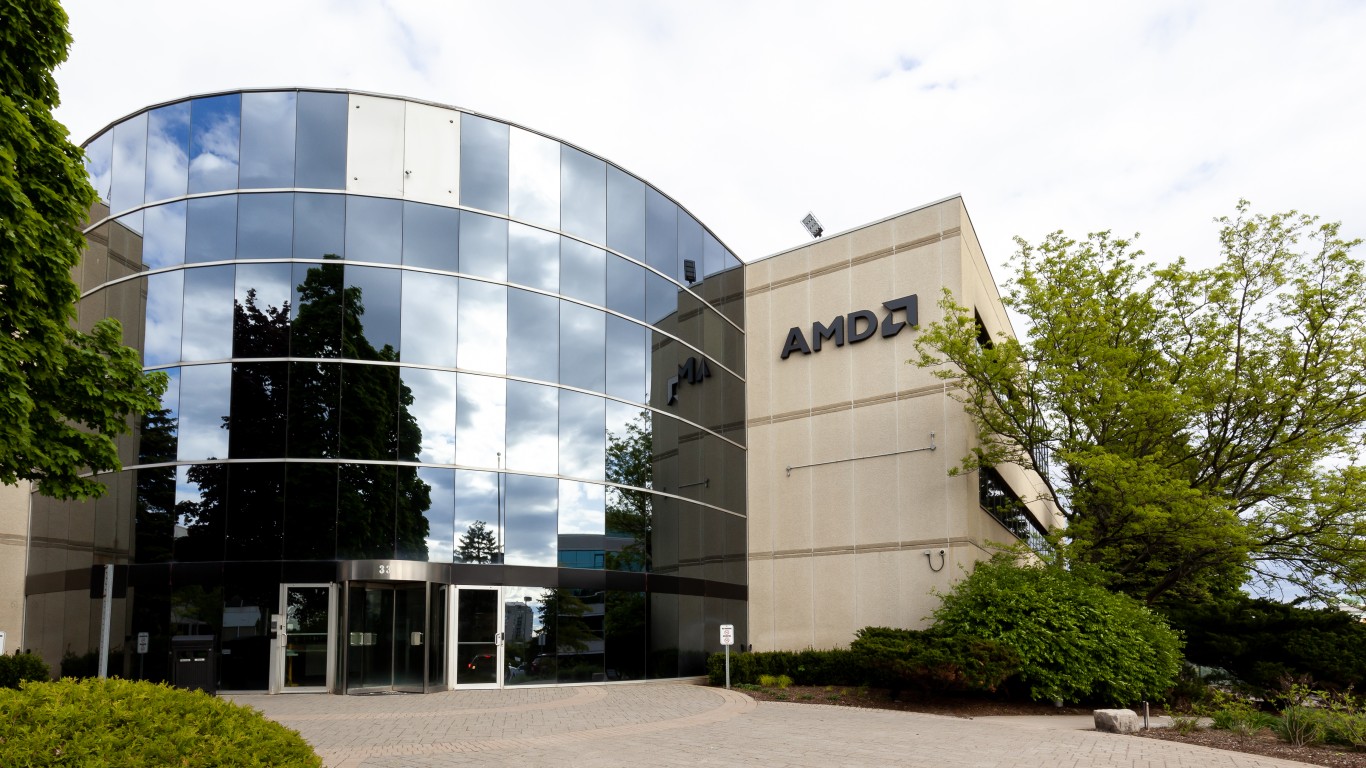
Advanced Micro Devices (NASDAQ:AMD | AMD Price Prediction) stock is up 3% to $521.59 in Wednesday morning trading, extending a rally that began after CFO Jean Hu addressed the Citi Global TMT Conference on Tuesday. AMD stock was up 144.4% year to date heading into the session, powered by a Data Center segment that more than doubled year over year last quarter. The shares have marched past their 50-day moving average of $499.27 in the process.
At the same time, Intel (NASDAQ:INTC) stock is up 1% to $105.76, a muted move as the AI chip narrative rotated toward AMD. The move here is company specific rather than a broad semiconductor bid, since AMD is climbing several times harder than its own sector fund on a session when large-cap tech is slightly lower.
For a framing check on the sector, the iShares Semiconductor ETF (NASDAQ:SOXX) is up 0.8% to $532.50, a modest tailwind for chip names broadly. Meanwhile, the Invesco QQQ Trust (NASDAQ:QQQ) is down 0.04% to $718, underscoring how narrow the AMD bid really is.
CFO Raises the Ceiling on AI Chip TAM
Speaking at the Citi Global TMT Conference, AMD Chief Financial Officer Jean Hu said the total addressable market for AI chips could reach $2 trillion to $3 trillion by 2030. That lifts the top of AMD’s prior $2 trillion framing and is the specific line that spiked the stock Tuesday afternoon. It also stacks on top of CEO Lisa Su’s August commentary that the data center AI accelerator market alone could reach $1.4 trillion by 2030, according to AMD.
Hu stated, “This AI super investment cycle is at the very beginning, and over time, we’re going to continue to see strong demand for AMD’s product.” She added that AMD’s data center business is expected to more than double next year, with supply very tight across wafers, advanced packaging, and high-bandwidth memory. The company backed that up in August with an agreement under which Anthropic will deploy up to 2 gigawatts of MI450 Series GPUs in AMD’s Helios racks.
Meta Platforms (NASDAQ:META) is one of AMD’s anchor AI customers alongside OpenAI and Anthropic, and Hu said those customers’ forecasts came in above what AMD had anticipated at the start of the partnerships. AMD’s Q2 2026 report reinforces that framing, when the company’s Data Center revenue jumped 107% year over year to $6.72 billion and the Data Center segment accounted for 58% of total sales.

TSMC Stays the Primary Foundry
The underrated line of the day may be Hu’s answer on foundry strategy. Asked whether AMD would tap Intel Foundry, she declared, “You should expect us to continue to view TSMC as our primary supplier on the wafer side,” and confirmed AMD co-develops technology with Taiwan Semiconductor Manufacturing (NYSE:TSM). That answer sits alongside TSMC’s own commentary that its 2026 capital budget has climbed to a range of $60 billion to $64 billion to keep pace with AI demand.
The reaffirmation quietly closes a door the market had been speculating about for Intel. Intel Foundry generated $5.76 billion in Q2 2026 revenue, up 31% year over year, though it also carried a $2.1 billion operating loss, and CEO Lip-Bu Tan is still working to win external logic customers at scale. Losing a prospective AMD wafer allocation, even a rhetorical one, keeps the foundry timeline squarely on Intel’s own product ramps.
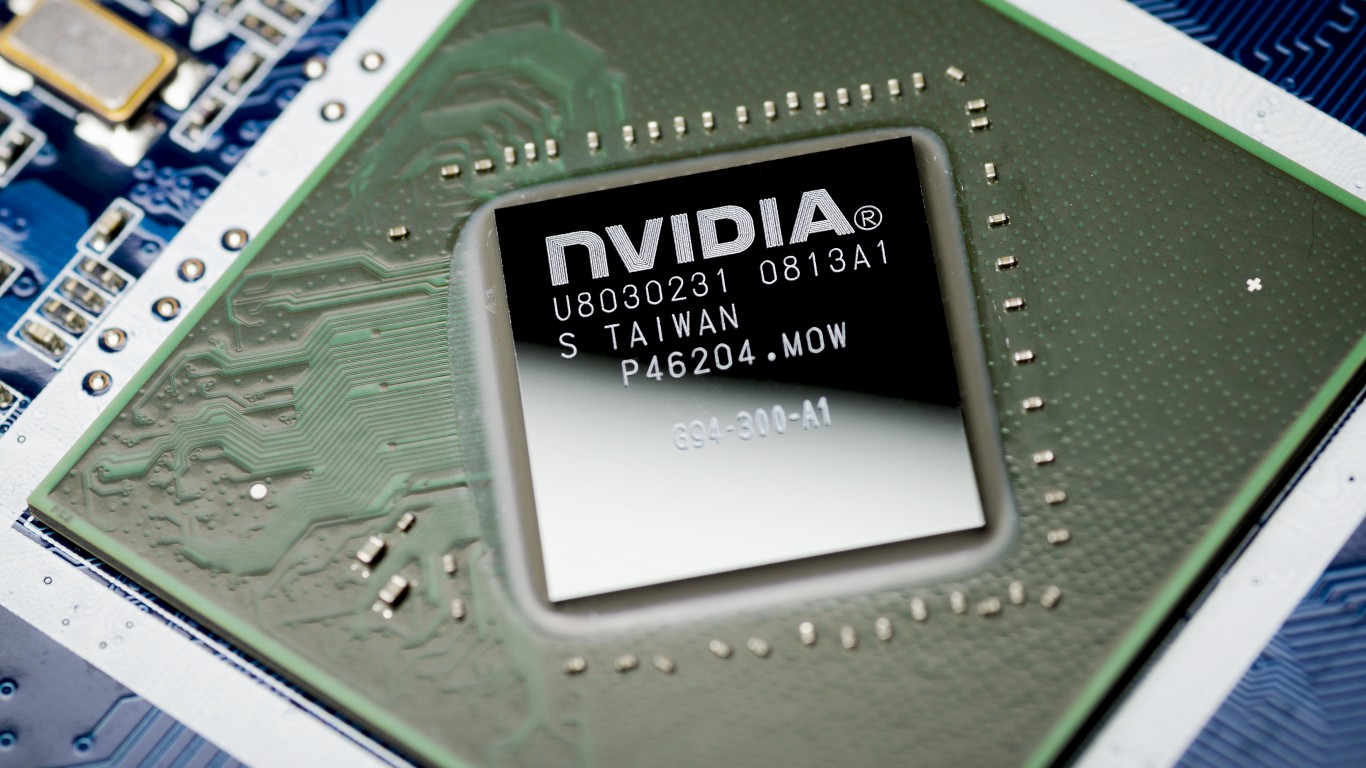
NVIDIA (NASDAQ:NVDA) remains the incumbent AI accelerator competitor and the yardstick against which AMD’s expanded market forecast gets measured. NVIDIA’s most recent quarterly revenue reached $96.22 billion, so the bull case for AMD hinges on capturing a growing share of the same customer wallets rather than displacing the leader. That buildout also feeds a wider set of suppliers beyond the chipmakers, and we profiled seven of them, from power to cooling, in a free report you can grab here.
What to Watch
The sharper single-session spike came Tuesday after the conference remarks, so Wednesday’s continuation move is a follow-through rather than the initial reaction. The substance here is a raised ceiling on a forecast rather than a reported result, which is why the skeptical case points at valuation. AMD stock trades at a trailing P/E ratio of 129.02x and a forward P/E ratio of 30.67x against an analyst target price of $615.38.

Analyst sentiment on AMD has swung in the same direction as the stock. The consensus fiscal 2027 EPS estimate has climbed to $15.4507 from $12.9595 ninety days ago, with 33 upward revisions against 3 downward revisions in the trailing 30 days. A composite forecast sentiment score reads 67.8, described as bullish with medium confidence.

The next scheduled catalyst is AMD’s Q3 2026 report, where management has guided to revenue around $13 billion, up 41% year over year. Investors can watch for whether AMD stock holds above $520 into the close and may want to size their exposure with that valuation debate in mind.
Contact [email protected] for any questions or corrections.
David Moadel is financial writer specializing in stocks, ETFs, options, precious metals, and Bitcoin. David has written well over 1,000 articles for leading online publications, helping investors understand markets, income strategies, and risk.His work has appeared in The Motley Fool, InvestorPlace, U.S. News & World Report, TipRanks, ValueWalk, Benzinga, Market Realist, TalkMarkets, Finmasters, 24/7 Wall St., and others.With a master’s degree in education, David has taught at the elementary, high school, and college levels. That teaching background shapes his writing style: clear, educational, and practical. David has also built a loyal social-media audience by providing trustworthy financial content on YouTube, X/Twitter, and StockTwits.