Prediction: Intel Stock Will Double on This Date
Intel shares have surged over 300% in the past year, yet Wall Street remains skeptical and the stock sits nearly 20% off its peak. A specific set of milestones could push INTC to a price most analysts refuse to say…


Intel (NASDAQ:INTC | INTC Price Prediction) has become the most improbable comeback story in semiconductors. CEO Lip-Bu Tan told investors on the July call that Q2 delivered “the strongest revenue growth in more than 15 years,” and the market has responded.
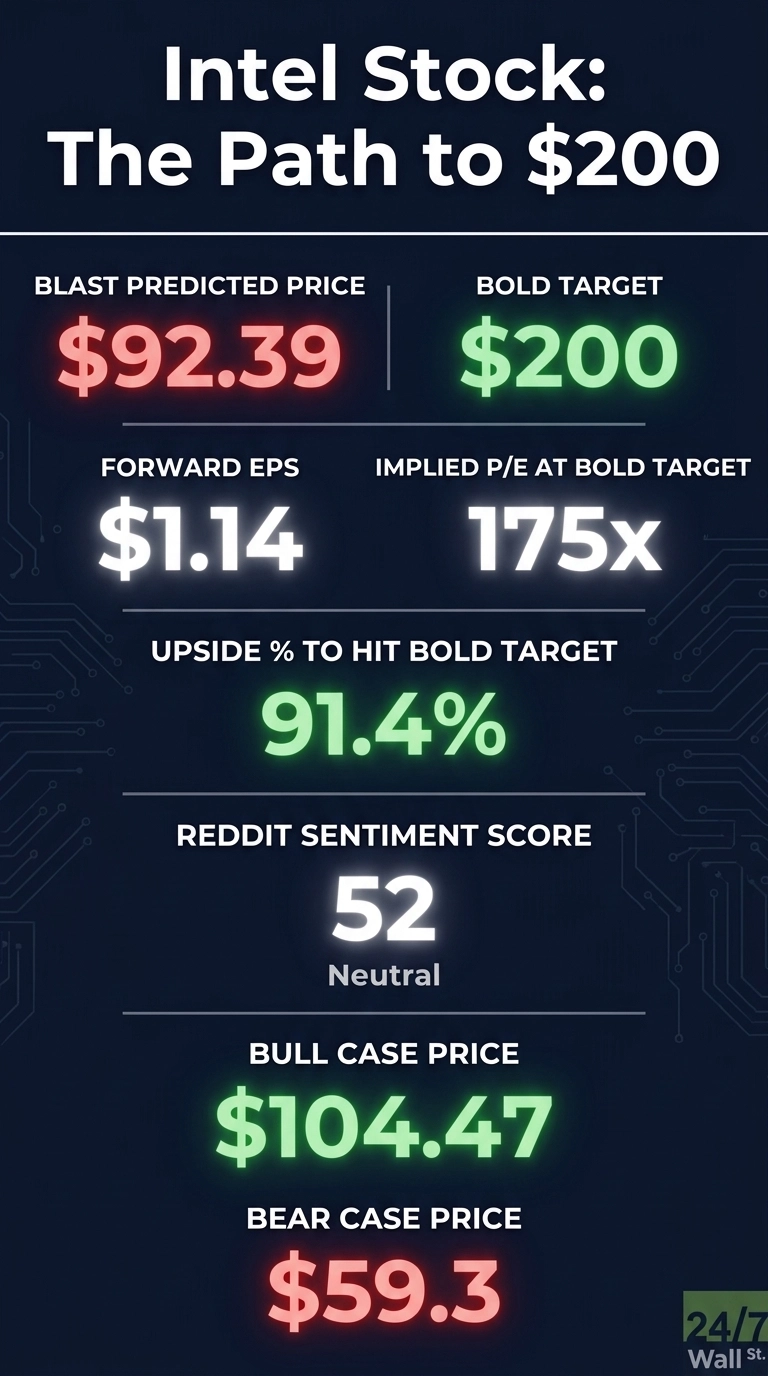
Shares are up 183.12% year to date and 326.76% over the last year. At $104.47, the natural next question is whether Intel can double again to $200. I think it is possible, and here is what has to happen.
Why Intel Shares Have Stalled After a Historic Run
The rally has cooled. INTC sits 19% below its 52-week high of $142.35, and the one-month return of just 2.77% masks a choppy period that included prints in the $88 to $90 range before the recent 17.42% one-week rebound. With a beta of 2.231, this is a violent stock.
The skepticism is real: Intel Foundry still posted a $2.1 billion quarterly operating loss, and GAAP results included an $11 billion net loss driven by a $12.53 billion non-cash CHIPS Act escrow charge. Composite sentiment reads neutral at 47.01, down 12.25 in a week. Investors are asking a fair question: how much good news is already priced in?
Wall Street Sees 11% Upside. I Think the Ceiling Is Higher
The Street is cautious. The consensus target sits at $115.88, implying roughly 10.92% upside. Ratings break down as 1 strong buy, 13 buy, 32 hold, 1 sell, and 1 strong sell. Our own model is even more conservative near term at $92.39 with a hold rating and high confidence, largely because a mega-cap dampener and negative trailing earnings pull the blend down.

But only 29% of analysts are bullish, and the earnings growth contribution is scored at -0.03 using trailing data that predates the DCAI acceleration. In my view, both the Street and the model are anchored to a past that no longer describes the business. Data Center and AI revenue grew 59% year over year. That is a growth curve well beyond hold-quality.
Charting a Realistic Path to $200 Per Share
Reaching $200 from today’s price of $104.47 would require a gain of 91.4%. With forward EPS of $1.14, a price of $200 implies a forward P/E of 175x. Our base case of $92.39 already implies 96x, meaning the bold target requires roughly 80x of additional multiple expansion at today’s depressed EPS.
That sounds absurd until you realize the compression story runs the other way: earnings power has to do the work. Q2 non-GAAP EPS of $0.42 beat by 93.1%, DCAI operating margin hit 40%, and the ASIC business is “approaching a $2 billion run rate” heading to $4 billion.
Tan sees CPU demand accelerating as “the next wave of AI will bring intelligence closer to the end user, moving from foundational models to inference to agentic.”
Add the NVIDIA (NASDAQ:NVDA) $5B equity stake and Xeon 6 being “one of the fastest ramping products in Intel history,” and the earnings ramp becomes plausible. The primary risk is that Intel 14A slips or loses an anchor customer.

Where Intel Trades Today vs Its Earnings Power
At $104.47 against forward EPS of $1.14, Intel trades near 92x forward earnings. That looks expensive in isolation, but the number is distorted by foundry losses that are already narrowing.
Shares sit near the upper band between the 52-week low of $24.05 and high of $142.35, and the 10-year return of 263.69% still lags the broader semi complex. If DCAI and ASIC scale the way management guides, the P/E resets naturally as EPS climbs into the mid-single digits, and $200 stops looking like a fantasy multiple.
$200 Is a Stretch, But Here’s Why It’s Possible
Reaching $200 requires a 91.4% gain from here. Realistic? Ambitious but achievable.
Three things have to go right: DCAI has to sustain 40%+ operating margins as Xeon 6 and Clearwater Forest ramp, Intel Foundry has to narrow its $2.1 billion quarterly loss with external customer wins on 18A-P and 14A, and the ASIC business has to hit its $4 billion run rate.
A missed 14A milestone or a PC demand collapse would derail it. Returns at this level shouldn’t be expected every year, but we’ve outlined the blueprint for how Intel could reach $200 in 2028.
Contact [email protected] for any questions or corrections.
Vandita Jadeja is a financial publisher with over a decade of experience writing about financial topics, including investment, savings, retirement, insurance and banking. Vandita is a Chartered Accountant who loves to debunk financial concepts for readers.
Her work has appeared on sites that include The Motley Fool, InvestorPlace, and Benzinga. She covers investing and focuses on stock picks and price prediction for 24/7 Wall St.
When not looking for the next stock investment opportunity, she can be found traveling, reading, chasing sunsets and enjoying her iced latte.