Prediction: Intel Stock Is Up Big in 2026. But the Best May Still Be Ahead
Intel shares have already surged over 140% this year, but a bold price target sitting 64% above current levels is forcing a real question: does the math actually hold, or is this rally running on fumes?


Intel (NASDAQ:INTC | INTC Price Prediction) is the comeback story of 2026. Shares are up 144.04% year to date, and CEO Lip-Bu Tan just delivered “the strongest revenue growth in more than 15 years”.
Tan told analysts that “AI is driving unprecedented demand for compute” and that Intel is positioned to capture it across CPUs, ASICs, advanced packaging, and its foundry network. Q2 data center revenue climbed 59% year over year.
The stock trades near $91.45. Can Intel shares actually hit $150 before 2026 closes? That is the question I want to answer with math, not narrative.
Why Intel Shares Have Stalled After a Monster Rally
Intel ripped from the low $20s to a 52-week high of $142.35, then cooled off. Over the past month the stock is down 1.04%, and one-week action is a modest 2.05%. The pause makes sense. Beta sits at 2.241, which means every wobble in AI sentiment is amplified here.
The bear case is real. Intel Foundry still posted an operating loss of $2.1 billion in Q2, external foundry revenue was only $293 million, and a $12.53B non-cash charge on CHIPS Act escrow shares dragged GAAP results deep into the red.
PC consumption is expected to be down low double digits percent for all of 2026 because of memory pricing. Traders locked in gains, and the stock has been rangebound since.
Wall Street Sees 25% Upside. I Think the Model Is Underweighting the Ramp
The consensus analyst target is $114.88, implying roughly 25.61% upside. Ratings break down as 2 strong buy, 12 buy, 31 hold, 2 sell, and 1 strong sell. Our own model is more cautious, with a base case of $86.90, an optimistic case of $107.81, a bear case of $67.32, and high confidence at 0.9.
Here is where I push back. The consensus is anchored to trailing losses. Analysts have raised FY26 EPS estimates 32 times in the trailing 30 days with zero cuts. Estimates are still chasing reality here, with the Street mid-re-rating.

Path to $150 Per Share
Reaching $150 from today’s price of $91.45 would require a gain of 64%. That is aggressive, but not crazy for a stock with a beta above 2. Now the P/E math.
With forward EPS of $1.14, a price of $150 implies a forward P/E of 132x. Our base case of $86.90 already implies 84x, meaning the bold target requires roughly 48x of additional multiple expansion on trailing forward EPS.
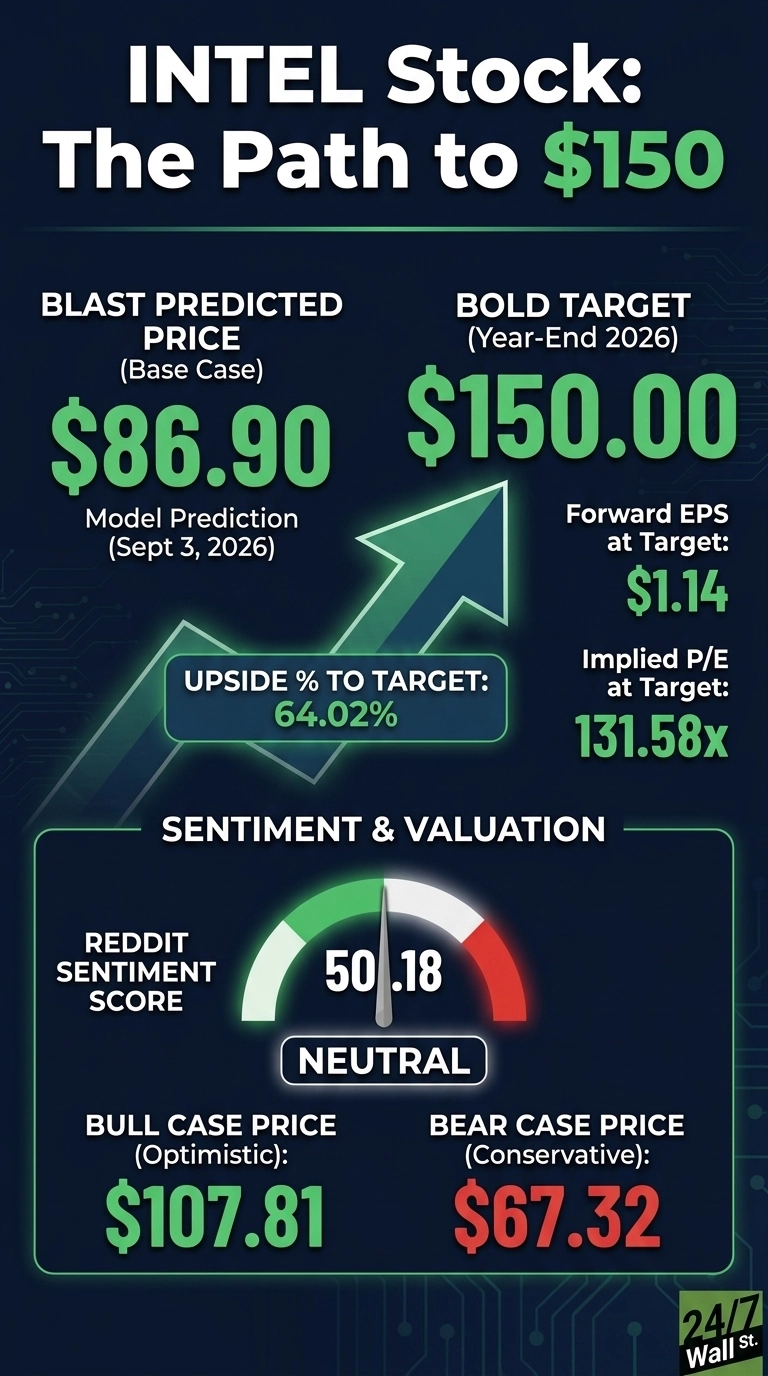
That headline number looks absurd until you look forward. The 2027 EPS consensus has surged to $2.04, up from $1.51 ninety days ago. On that number, $150 is roughly 73x. Keep compounding and the multiple compresses fast.
The catalysts backing it: Intel 18A yields are “trending ahead of targets set in March”, 18A output ran approximately 25% above target, Xeon 6 is “one of the fastest ramping products in Intel history”, and Tan said the ASIC opportunity has a TAM “over 100 billion”. The primary risk is that Foundry losses persist and 14A slips without an anchor external customer.

Where Intel Trades Today Versus Its Earnings Power
At $91.45, Intel trades at roughly 80x current forward EPS of $1.14. Optically expensive. Against 2027 consensus of $2.04, that drops to roughly 45x, which is a growth multiple for a company just posting +25.4% YoY revenue growth.
Shares sit between a 52-week low of $24.05 and a high of $142.35. The 10-year return is 207.93%. If EPS keeps compounding while the multiple only modestly re-rates, the math for $150 works itself out.
Is $150 Realistic? Here’s My Verdict
Reaching $150 requires a 64% gain from here, and that is a stretch. I would call it possible, not likely, before 2026 closes.
What has to go right: 18A yields keep beating plan, Xeon 6 supply catches up to demand, and FY27 EPS estimates keep drifting toward the $3.44 high end.
What derails it: Foundry losses widen or a 14A external anchor customer fails to materialize. Insiders are net buyers across 5 recent transactions, which I read as quiet confidence.
The traits that show up years before a monster run in a chip name are the ones we cataloged in a free playbook here. Returns at this level shouldn’t be expected every year, but we’ve outlined the blueprint for how Intel could reach $150 in 2026.
Contact [email protected] for any questions or corrections.
Vandita Jadeja is a financial publisher with over a decade of experience writing about financial topics, including investment, savings, retirement, insurance and banking. Vandita is a Chartered Accountant who loves to debunk financial concepts for readers.
Her work has appeared on sites that include The Motley Fool, InvestorPlace, and Benzinga. She covers investing and focuses on stock picks and price prediction for 24/7 Wall St.
When not looking for the next stock investment opportunity, she can be found traveling, reading, chasing sunsets and enjoying her iced latte.