Is Michael Burry Waving a White Flag? ‘Big Short’ Investor Reduces Bearish Bets on NVDA, CRWV
Michael Burry just quietly closed one of his biggest bearish AI bets, but he insists he has not gone bullish. The reason behind his retreat reveals something uncomfortable about the cost of being right too early.


Michael Burry, the Scion Asset Management founder made famous by The Big Short, is trimming his sails. In a Substack post cited this week, Burry said he “pulled in risk” in September and now has cash he is “happy to sit on” while he watches how markets develop. The most notable change: he shed December 2026 put options on NVIDIA without rolling them into later-dated contracts, a direct reduction of his most-watched bearish AI trade.
That matters because Burry had built a sizable options-based short against the AI infrastructure complex, including $187 million in put options on NVIDIA as part of roughly $1 billion in bearish AI wagers disclosed earlier. Closing the December strikes tells you something about how expensive those hedges became to carry as the underlying stocks kept grinding higher. (The buildout goes well beyond the chipmakers themselves, and we profiled seven of the power, cooling, and networking suppliers benefiting from it in a free report here.)
Why Burry Is Trimming Exposure Now
Burry has not flipped bullish. He continues to hold 2027 puts on Palantir (NASDAQ:PLTR | PLTR Price Prediction) and the Invesco QQQ Trust (NASDAQ:QQQ), and told readers the exit should not be read as optimism. The stated reason for closing the December NVDA puts was rapid time-based decay. Short-dated puts bleed premium quickly when the stock refuses to break, and NVIDIA (NASDAQ:NVDA) has done anything but break.
The stock is up 19.16% year to date and 30.16% over the past year, closing near $221.97 with a market cap around $5.4 trillion. The full-chain put/call ratio sits at just 0.55, meaning bullish call positioning still dominates broader options flow.
NVIDIA’s Fundamentals Made the Short Painful
The Q2 FY2027 report on August 26, 2026 is the kind of quarter that squeezes shorts. NVIDIA delivered revenue of $96.22 billion, up 105.8% year over year, non-GAAP EPS of $2.22 against a $2.09 consensus, and a Data Center segment that grew 117% to $89.02 billion on the Blackwell Ultra ramp. Non-GAAP gross margin expanded to 75.0%. Management guided Q3 revenue to $108 billion, plus or minus 2%.

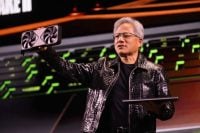
The most telling data point sits in the Q2 press release filed with the SEC: supply commitments jumped to $279 billion, largely tied to memory procurement for Vera Rubin production. CEO Jensen Huang framed the setup succinctly: “AI has reached its inflection point. It’s doing useful work. Its tokens are productive and profitable. Now, compute is revenue.” Betting against that earnings report with a four-month put was a tough hold.
Why CoreWeave Is Part of the Same Trade
CoreWeave (NASDAQ:CRWV) sits directly downstream of NVIDIA’s roadmap. It was the first to bring up and validate the NVIDIA Vera Rubin NVL72, and NVIDIA holds an equity stake in the GPU cloud operator. CoreWeave’s Q2 FY2026 revenue reached $2.58 billion, up 112.3% year over year, and its backlog swelled to roughly $104 billion with more than $25 billion in additional net new customer commitments in early Q3 2026.

The bear case is not hidden. CoreWeave posted a GAAP net loss of $1.14 per share, free cash flow of negative $5.74 billion on $6.42 billion of capex, interest expense of $640 million, and a debt-to-equity ratio of 8.94. Options traders reflect that split view: the full-chain put/call ratio is 1.15, with October and November expirations skewing heavily to puts. Shares are still up 27.48% year to date despite a 8.91% decline over the last twelve months.
What to Watch Next
Burry said “This will be an interesting market this fall,” hinting at commentary on currency markets and a falling Dollar Spot Index. His remaining 2027 Palantir and QQQ puts show the thesis is intact. For investors, the signal points to risk management on short-dated hedges while leaving the AI economics thesis intact. NVIDIA’s Q3 guide and CoreWeave’s ability to convert its $104 billion backlog into positive free cash flow will decide whether Burry’s caution or Huang’s “compute is revenue” framing carries the fall.
Contact [email protected] for any questions or corrections.
After two decades of patrolling the dark corners of suburbia as a police officer, Rich Duprey hung up his badge and gun to begin writing full time about stocks and investing. For the past 20 years, he’s been cruising the markets looking for companies to lock up as long-term holdings in a portfolio while writing extensively on the broad sectors of consumer goods, technology, and industrials. Because his experience isn’t from the typical financial analyst track, Rich is able to break down complex topics into understandable and useful action points for the average investor. His writings have appeared on The Motley Fool, InvestorPlace, Yahoo! Finance, Money Morning, and, of course, 24/7 Wall St. He has been featured in both U.S. and international publications, including MarketWatch, Financial Times, Forbes, Fast Company, and USA Today.