Vertiv Downgraded as Wall Street Cites Too Lofty Expectations
Jefferies has downgraded Vertiv Holdings (NYSE:VRT | VRT Price Prediction) from Buy to Hold, cutting its price target to $260 from $280. The firm’s core argument: Wall Street’s out-year margin assumptions are simply too optimistic, and the stock’s premium multiple…

This post may contain links from our sponsors and affiliates, and Flywheel Publishing may receive compensation for actions taken through them.

Jefferies has downgraded Vertiv Holdings (NYSE:VRT | VRT Price Prediction) from Buy to Hold, cutting its price target to $260 from $280. The firm’s core argument: Wall Street’s out-year margin assumptions are simply too optimistic, and the stock’s premium multiple leaves little room for error if those assumptions prove wrong.
| Ticker | Company | Firm | Old → New Rating | New Price Target | One-Line Takeaway |
|---|---|---|---|---|---|
| VRT | Vertiv Holdings | Jefferies | Buy → Hold | $260 | Consensus margin expectations price in perfection; risk/reward now balanced |
The Analyst’s Case
Jefferies accepts Vertiv’s growth story. The concern is valuation and execution risk embedded in consensus models. Specifically, the firm believes Street estimates assume Vertiv hits its long-term margin target a full year ahead of schedule. Management has guided to a 25% adjusted operating margin by 2029, but consensus appears to front-load that path.
The second concern is capacity execution. Jefferies notes estimates assume a “smooth” capacity expansion to fulfill Vertiv’s outsized order book — an assumption that carries meaningful operational risk. Finally, the firm flags that hyperscaler capex growth slowing in 2027 and beyond could compress the stock’s multiple, even if near-term demand holds.
What the Numbers Show
Vertiv’s fundamentals remain strong. In Q4 2025, the company posted adjusted EPS of $1.36, beating estimates by 4.62%, with an adjusted operating margin of 23.2%, up 170 basis points year over year. Organic orders surged 252% year over year, and the backlog reached $15 billion, up 109% year over year.
For 2026, management guided to adjusted operating margins of 22.0% to 23.0% — a midpoint of 22.5%. That’s actually a step down from Q4’s 23.2% exit rate, partly reflecting higher CapEx stepping up to 3% to 4% of sales in 2026 from a historical 2% to 3% and investment headwinds on near-term incremental margins. The CFO acknowledged “a higher level of investment…has a little bit of pressure on us as we drive those incremental margins.”
Why the Move Matters Now
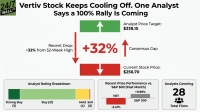
Vertiv trades at a trailing P/E of roughly 68x and a forward P/E of roughly 41x — a multiple that prices in sustained execution. The stock has pulled back to $234.22 as of March 30, down 8.51% over the past week, and sits well below its 52-week high of $282.05. The analyst consensus target of $270.21 still implies upside from current levels, but Jefferies is effectively saying that upside depends on margin assumptions that may not materialize on the timeline the Street expects.
What Investors Should Watch
Vertiv’s demand backdrop — a 2.9x book-to-bill ratio and record backlog — remains one of the most compelling in industrials. But at this valuation, the margin execution path matters as much as revenue growth. Investors already holding Vertiv have a strong fundamental story intact; the Jefferies downgrade is a signal to watch margin progression closely through 2026 as margin progression develops through 2026.
Contact [email protected] for any questions or corrections.
Joel South covers large-cap stocks, dividend investing, and major market trends, with a focus on earnings analysis, valuation, and turning complex data into actionable insights for investors.
He brings more than 15 years of experience as an investor and financial journalist, including 12 years at The Motley Fool, where he served as an investment analyst, Bureau Chief, and later led the Fool.com investing news desk. He has also co-hosted an investing podcast and appeared across TV and radio discussing market trends.