Adobe Just Fell Off Another Cliff: Why One Wall Street Manager Remains Resolute That It Will Increase 55% Soon
Adobe keeps beating earnings and raising guidance, yet its stock has collapsed nearly 29% this year while one analyst holds a price target that implies a 55% surge. Something in the market's reaction does not add up, and the answer…


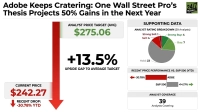
Adobe (NASDAQ:ADBE | ADBE Price Prediction) trades at $248.83, while the average Wall Street price target sits at $277.02, implying roughly 11% upside. Phillip Securities analyst Paul Chew models the stock at $385, a gap of roughly 55% above current levels.
Adobe sits at the intersection of every debate investors are having about software: creative tools, marketing clouds, document workflows, and a generative AI franchise scaling fast. The company posted its fifth consecutive EPS beat and raised full-year guidance, yet shares keep sinking. That dislocation matters. Either the market is pricing in something the numbers hide, or sellers are giving long-term holders a rare entry.
Strong Earnings, Weak Stock
Adobe fell 12.92% in the past week after reporting Q3 FY2026 results, capping a 28.9% year-to-date decline. Revenue of $6.76 billion grew 12.9% year over year and beat consensus. Non-GAAP EPS came in at $6.13.
The selloff trigger lay underneath the headline. RPO growth decelerated to 8% year over year and analysts flagged a 36% to 37% drop in net new ARR, which management attributed to a deliberate freemium push prioritizing user acquisition over near-term monetization. A CEO transition, with Shantanu Narayen handing the reins to Anil Chakravarthy, combined with AI-disruption fears tied to new OpenAI image tools, fueled the selloff. The S&P 500 slipped just 1.98% over the same week.
Bull Case: Three Pillars
Chew anchors his $385 target to three pillars. First, Firefly and generative-credit consumption are driving structural ARPU expansion inside Creative Cloud Pro. AI-first ending ARR now exceeds $650 million and grew more than 150% year over year. Firefly ARR itself expanded 40% quarter over quarter.
Second, the freemium engine. Adobe reached more than 1 billion monthly active users, with creative freemium users surpassing 100 million and growing greater than 70% year over year. Chew views that funnel as a low-cost acquisition machine converting once users hit generative paywalls. Third, valuation. Adobe trades at a forward P/E of 9, roughly a 29% discount to enterprise software peers.
The broader analyst community is more cautious. Of 40 analysts covering the stock, 4 rate it Strong Buy, 8 Buy, 23 Hold, 4 Sell, and 1 Strong Sell. Forward EPS estimates ticked higher over the past 90 days, with FY26 consensus now at $24.41 versus $23.54 ninety days ago. Chew’s timeline is tied to Adobe MAX in November and how fast agentic and Firefly monetization converts freemium volume into ARR.
Peers Fell Less
Enterprise software sold off together, but Adobe led lower. Salesforce (NYSE:CRM) trades at $243.11, down 8.1% for the week but only 7.79% year to date. Its average analyst target of $273.37 implies roughly 12% upside.
Autodesk (NASDAQ:ADSK) is the closest structural analog. Shares at $211.61 are down 28.51% year to date, yet the average analyst target of $315.37 implies roughly 49% upside. Consensus sees more room in Autodesk than in Adobe. Investors betting on the Adobe gap are siding with the bull outlier over the average analyst.
Setup and Catalysts
Adobe trades at a trailing P/E of 15 and a forward P/E of 9, with a PEG of 0.63. Shares are off 28.94% over the past year, while the S&P 500 has advanced 16.19% over the same period.
The bull thesis holds if Firefly and generative-credit monetization keep compounding at triple-digit rates while the freemium base converts on schedule. Q4 execution, the November Adobe MAX event, and early wins from the incoming CEO are the catalysts to watch. The bear thesis strengthens if net new ARR keeps decelerating and RPO growth stalls in single digits, validating concerns that OpenAI, Canva, and native model providers are commoditizing Adobe’s creative moat.
The valuation, cash flow, and AI ARR trajectory frame an attractive risk-reward, but Chew’s $385 target requires a monetization inflection not yet visible in net new ARR. The consensus $277 case looks more grounded in current data, with $385 representing upside optionality tied to an execution inflection.
Contact [email protected] for any questions or corrections.
Alex Sirois is a financial writer with experience spanning both retail and institutional investing. He has written for InvestorPlace and held roles at BNY Mellon and Bernstein, giving him a perspective that bridges Main Street portfolios and Wall Street analysis.
Alex holds an MBA from George Washington University and has built his career across multiple industries, including e-commerce, education, and translation — a breadth of experience that informs how he breaks down complex financial topics for everyday investors. His writing is conversational, actionable, and grounded in long-term, buy-and-hold investing principles.
At 247 Wall St., Alex focuses on delivering analysis that is both accessible and useful, with a clear emphasis on helping readers make more informed decisions with their money.