Chances of First Fed Rate Hike Since 2023 Now Over 90% — Markets Brace for the Warsh-Era Shock
Markets spent all of 2026 bracing for rate cuts, but surging oil prices, stubborn inflation, and a surprisingly resilient labor market have cornered the Fed into a position few anticipated, and the fallout for stocks and bonds could reach well…

The latest data have turned the September meeting of the Federal Reservce Open Market Committee into a very different event than investors expected at the start of 2026.
CME Group (NASDAQ:CME | CME Price Prediction)’s FedWatch tool now puts the probability of a 25-basis-point rate hike on Wednesday at 90.7%. Reuters’ September 14 poll found 85% of economists also expect the Federal Reserve to raise its target range to 3.75%-4.00%.
That would be quite a reversal. Markets entered 2026 expecting the Fed to deliver its third rate cut of the year this month. Instead, inflation has remained 140 basis points above the Fed’s 2% target, while energy prices are threatening to push it higher.
The Bureau of Labor Statistics’ August Consumer Price Index showed headline inflation rising 3.4% year over year, while core CPI increased 2.4%. Producer prices were even hotter: The August PPI rose 5.4% over the prior year.
The Economy Isn’t Giving Warsh an Easy Excuse to Wait
Let’s look at the other half of the Fed’s mandate: employment.
The August employment report from the Bureau of Labor Statistics showed nonfarm payrolls increased by 162,000, compared with just 21,000 in July. The 12-month average was 30,900 monthly jobs, meaning August represented a sharp acceleration.
That matters because the Fed can tolerate higher inflation for a time if the economy is deteriorating rapidly. The latest employment data doesn’t provide that justification.
Meanwhile, oil has moved above $100 a barrel. Reuters reported September 14 that Brent crude reached $107.82 and West Texas Intermediate hit $102.82 after renewed attacks on Saudi energy infrastructure. U.S. diesel prices have also climbed above $6 a gallon, a record high.
Those aren’t just energy-sector problems. Diesel is embedded in transportation, agriculture, construction, and manufacturing. Higher fuel costs can work their way through the economy and make an already stubborn inflation problem harder to extinguish.
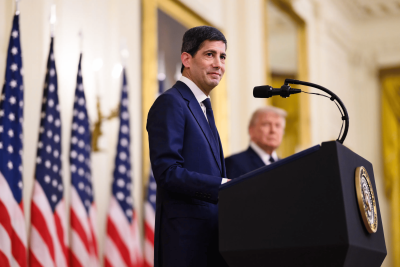
The Warsh Era Gets Its First Real Test
This makes Wednesday’s meeting more consequential than a simple 25-basis-point adjustment. The Federal Reserve’s July meeting ended with rates unchanged, although three policymakers preferred a quarter-point increase. The official minutes show the next meeting is scheduled for September 15-16.
Now Warsh faces his first major policy test with inflation at 3.4%, PPI at 5.4%, oil above $100, and payrolls increasing by 162,000.
The investment implications extend beyond stocks. The 10-year Treasury yield recently approached 5%, while the 30-year yield moved above 5.3%, according to Barron’s.
Higher yields raise the hurdle rate investors apply to stocks, particularly expensive growth companies whose valuations depend heavily on profits expected years into the future. They also increase borrowing costs for consumers and businesses.
Granted, a quarter-point hike alone isn’t catastrophic. The bigger issue is what comes next. Reuters’ September 14 economist poll found many economists expect at least one additional hike by March 2027.
Key Takeaway
In short, investors should stop treating a Fed hike as a remote possibility. With CME FedWatch assigning it a 90.7% probability, the market has already largely priced in Wednesday’s move. The bigger risk is a policy regime shift.
At the beginning of 2026, investors were positioning for falling rates. Now inflation, oil, wages, and a resilient labor market are pushing expectations in the opposite direction. Smart investors should be especially cautious with highly valued, rate-sensitive stocks and long-duration bonds until there is clearer evidence that inflation is moving back toward 2%.
Warsh’s first hike may be only 25 basis points. The real shock would be discovering that it is the beginning of something bigger.
Contact [email protected] for any questions or corrections.
After two decades of patrolling the dark corners of suburbia as a police officer, Rich Duprey hung up his badge and gun to begin writing full time about stocks and investing. For the past 20 years, he’s been cruising the markets looking for companies to lock up as long-term holdings in a portfolio while writing extensively on the broad sectors of consumer goods, technology, and industrials. Because his experience isn’t from the typical financial analyst track, Rich is able to break down complex topics into understandable and useful action points for the average investor. His writings have appeared on The Motley Fool, InvestorPlace, Yahoo! Finance, Money Morning, and, of course, 24/7 Wall St. He has been featured in both U.S. and international publications, including MarketWatch, Financial Times, Forbes, Fast Company, and USA Today.