GE Vernova Gave Back Its Gains Since July: One Wall Street Pro Says 65% Gains Will Materialize Soon
GE Vernova's blowout earnings sent shares soaring, then September erased every gain in days. Now one Wall Street analyst sees a path to 65% upside, and the order book behind that call is harder to dismiss than the selloff suggests.

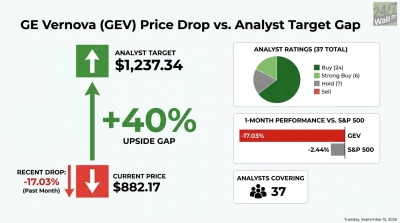
GE Vernova (NYSE:GEV | GEV Price Prediction) currently trades at $882.17, well below the consensus analyst price target of $1,237.34. That leaves an implied upside of roughly 40% to the Street average, and about 64% to the Street-high target of $1,450 from Guggenheim’s Joseph Osha.
GE Vernova is the pure-play power and grid business spun out of GE, with three segments: Power (gas turbines, nuclear), Electrification (grid equipment, HVDC, Prolec GE), and Wind. It has become one of the most direct public vehicles for the data center electricity build-out, which is why every wobble in the shares gets scrutinized.
The gap between price and target matters because analysts have been raising, not cutting, their views into the pullback.
A Sharp September Reversal Erased the Summer Rally
The stock has lost 17.03% in the past month and 9.18% in the past week alone. Measured from the day GE Vernova filed its blowout Q2 report on July 22, 2026, shares are down 10.38%, giving back the entire post-earnings surge.
There was no company-specific disaster behind the drop. The Q2 numbers were exceptional: revenue of $11.10B, up 21.8% year over year, orders of $24.20B (+88% organic), backlog of $176B, and free cash flow of $5.10B in a single quarter. Management raised full-year free cash flow guidance to $11.5-$12.5B from $6.5-$7.5B.
The selloff looks like profit-taking on a stock that had gone parabolic, aggravated by a broader rotation out of AI-power names. For context, the S&P 500 slipped just 2.44% over the same month, so GE Vernova has meaningfully underperformed the broader market.
Why Guggenheim Sees a Path to $1,450
With more than 40% upside to consensus and roughly 64% to Guggenheim’s Street-high, this is where the story gets interesting. Guggenheim’s Joseph Osha raised his target from $1,300 to $1,450 after the quarter, anchoring his call on three pillars: hyperscaler-driven demand for transformers and turbines, margin expansion from higher-priced backlog, and multi-decade cash flow from long-term service agreements on the growing HA turbine fleet.
The order book supports that framing. GE Vernova signed 20 gigawatts of gas power orders in Q2 alone, bringing contracted capacity to 116 gigawatts, with management targeting 125+ GW by year-end. First-half data center orders exceeded $5 billion, more than double all of 2025. CEO Scott Strazik called it an “electricity investment super cycle“.
Analyst posture reflects that confidence. According to the consensus breakdown, 6 rate it Strong Buy, 24 Buy, 7 Hold, and none Sell or Strong Sell. Recent revisions on the 2027 EPS line have skewed positive, with 3 upward revisions against 2 downward in the past 30 days.
Power Peers Slipped Too, but GEV Has the Deepest Discount
The wider power complex sold off alongside GE Vernova, though none of its closest peers took as hard a hit or offer as much implied upside.
Eaton (NYSE:ETN), the electrification and data center power specialist, trades at $392.26 against a consensus target of $478.17, or roughly 22% upside. Shares are down 13.09% in the past month. Of 27 analysts, 5 rate it Strong Buy, 17 Buy, 4 Hold, and 1 Strong Sell.
Constellation Energy (NASDAQ:CEG), the nuclear-heavy hyperscaler power supplier, trades at $259.89 versus a target of $348.30, an implied upside of about 34%. Constellation has fallen 26.1% year to date and is the only peer in the red for 2026, though analysts are still overwhelmingly constructive: 6 Strong Buy, 14 Buy, 3 Hold.
Across this trio, GE Vernova carries the largest analyst-implied upside, and the largest Street-high, which supports the argument that the recent drawdown reflects technical positioning more than a fundamental shift.
Data Behind the 40% Gap
At $882.17, GE Vernova sits about 26% below its 52-week high of $1,195.94. The consensus target of $1,237.34 implies roughly 40% upside, drawn from 37 analysts in total.
Even after the selloff, GEV is up 35.23% year to date and 40.64% over the past year, versus 11.07% and 14.6% for the S&P 500 proxy. It still trades at a rich forward multiple of about 39, which is the number bears will point to.
Where I Land on GEV After the Reset
GE Vernova looks compelling here if the backlog conversion story holds. The bull path is straightforward: Power scaling gas turbine output to 24 GW by 2028 and 30 GW by 2030, Electrification margins compounding as Prolec is absorbed, and Wind losses narrowing from the guided $400M EBITDA loss. If free cash flow lands anywhere near guidance and 2027 orders reprice higher, Guggenheim’s $1,450 is defensible.
The risk case: this pullback could be the market pricing in a real crack in the AI capex cycle. GE Vernova is one of the clearest non-chip beneficiaries of that spending (we profiled seven more suppliers powering the AI buildout in a free report here: 7 Stocks Powering the AI Boom). A forward P/E near 39 leaves no room for a hyperscaler pause, a wind writedown surprise, or tariff-driven supply chain hits. Any of those could easily send shares to the 200-day moving average of $895.29 and keep them there.
On balance, I lean constructive. The order book and the analyst posture argue this is a reset inside an uptrend. Sizing matters here, given the volatility around any single entry point.
Contact [email protected] for any questions or corrections.
Alex Sirois is a financial writer with experience spanning both retail and institutional investing. He has written for InvestorPlace and held roles at BNY Mellon and Bernstein, giving him a perspective that bridges Main Street portfolios and Wall Street analysis.
Alex holds an MBA from George Washington University and has built his career across multiple industries, including e-commerce, education, and translation — a breadth of experience that informs how he breaks down complex financial topics for everyday investors. His writing is conversational, actionable, and grounded in long-term, buy-and-hold investing principles.
At 247 Wall St., Alex focuses on delivering analysis that is both accessible and useful, with a clear emphasis on helping readers make more informed decisions with their money.