What Will $5,000 Invested in Tesla Stock Be Worth in 5 Years?
Tesla is burning through cash at a historic rate while simultaneously betting its future on Robotaxis, humanoid robots, and an AI platform that may or may not reach scale before investor patience runs out. That tension shapes everything about what…

Tesla (NASDAQ:TSLA | TSLA Price Prediction) trades at $357.24 heading into a five-year window that management has framed as its biggest capital cycle yet. The question for a retail investor: if you put $5,000 into Tesla today and hold for five years, what could it become?
The forecast engine models a full path out to 2031-09-14, and the modeled scenarios put a real range on that stake, from a modest single-digit gain in the bear case to nearly a double in the bull case.

Base Case: What $5,000 Could Become in 5 Years
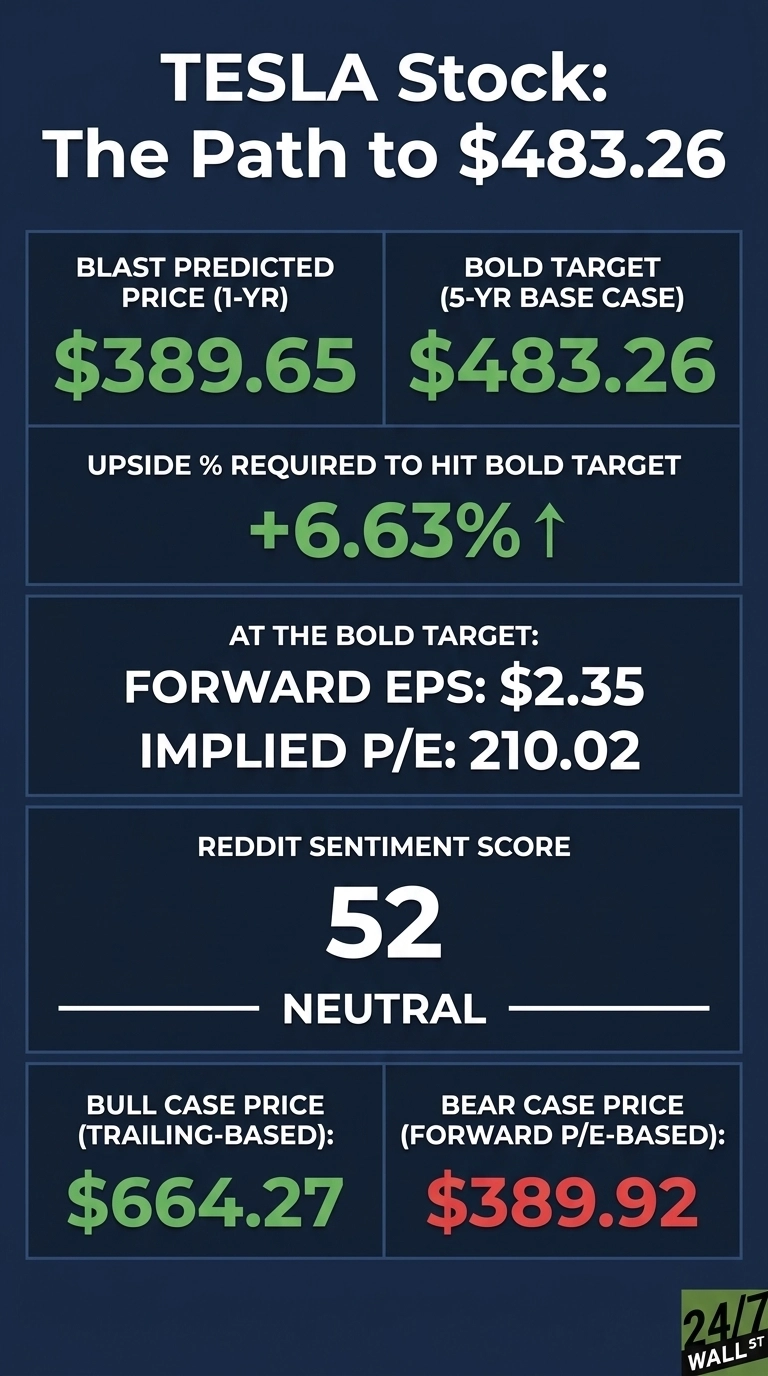
Under the model’s base case, a $5,000 Tesla investment could be worth about $6,612 by 2031, a total return of 32.24% over the five-year window. That works out to an annualized return of 5.75%.
The modeled per-share target driving that outcome is $483.26, anchored to a starting price of $365.44 in the forecast path. The model carries a confidence score of 0.9, classified as high, with a near-term buy recommendation and 6.63% implied upside to a one-year predicted price of $389.65.
Bull, Base, and Bear Scenarios Side by Side
Here is how a $5,000 stake plays out under each modeled five-year scenario. Ending values are derived from the pipeline’s supplied total-return figures.
| Scenario | Target Share Price (2031) | Total Return | Ending Value of $5,000 |
|---|---|---|---|
| Bull | $664.27 | 81.77% | $9,088.50 |
| Base | $483.26 | 32.24% | $6,612.00 |
| Bear | $389.92 | 6.70% | $5,335.00 |
For calibration, the Wall Street analyst consensus target sits at $390.09, with ratings of 6 Strong Buy, 16 Buy, 19 Hold, 3 Sell, and 2 Strong Sell. That one-year signal lands close to the modeled bear-case endpoint.
Why the Base Case Points Higher
Three drivers underpin the modeled trajectory. First, the operating scale is intact: Q2 2026 revenue hit $28.24 billion, up 25.52% year over year, on record deliveries of 480,126 vehicles and 13.5 GWh of energy storage.
Second, the software and AI attach story is compounding: active FSD subscriptions reached 1.48 million, up 56% year over year, with FSD attached to over 55% of new North American deliveries.
Third, Robotaxi service is live in seven U.S. metros, Cybercab production has started at Gigafactory Texas, and Optimus lines are being installed at Fremont.
On the earnings-power side, analysts model consensus fiscal-year EPS of $1.7688 for 2026 and $2.1586 for 2027, supported by a 2027 revenue estimate of $120.84 billion.

What Could Sink the Projection
The bear-case return is thin for a reason. Q2 operating income fell 56.88% year over year and operating margin compressed to 1.4% as opex rose 47%. Free cash flow flipped to -$1.09 billion as capex more than doubled, and management guided full-year 2026 capex above $25 billion.
Battery pack capacity remains the near-term ceiling on vehicle output, FSD approval is still pending in China and parts of Europe, and Robotaxi expansion carries real regulatory risk, with management warning that a single serious incident could trigger immediate restrictions. Recent analyst behavior reflects that uncertainty: both 2026 and 2027 EPS consensus figures have been revised lower over the past 60 and 90 days.
Prediction markets echo the caution. Polymarket traders assign only a 0.042 probability to Tesla releasing Optimus by year-end 2026, and shares have already given back 20.56% year to date, a reminder that this stock rarely moves in a straight line.
Bottom Line for a $5,000 Stake
Across the modeled five-year window, $5,000 in Tesla could be worth roughly $5,335 in the bear case, $6,612 in the base case, and $9,088.50 in the bull case, corresponding to modeled share prices of $389.92, $483.26, and $664.27.
The outcome hinges on whether Tesla’s AI, Robotaxi, and Optimus investments turn into margin-accretive revenue before the capex cycle exhausts investor patience. Treat this as a scenario projection rather than investment advice or a guarantee of future returns.
Contact [email protected] for any questions or corrections.
Vandita Jadeja is a financial publisher with over a decade of experience writing about financial topics, including investment, savings, retirement, insurance and banking. Vandita is a Chartered Accountant who loves to debunk financial concepts for readers.
Her work has appeared on sites that include The Motley Fool, InvestorPlace, and Benzinga. She covers investing and focuses on stock picks and price prediction for 24/7 Wall St.
When not looking for the next stock investment opportunity, she can be found traveling, reading, chasing sunsets and enjoying her iced latte.