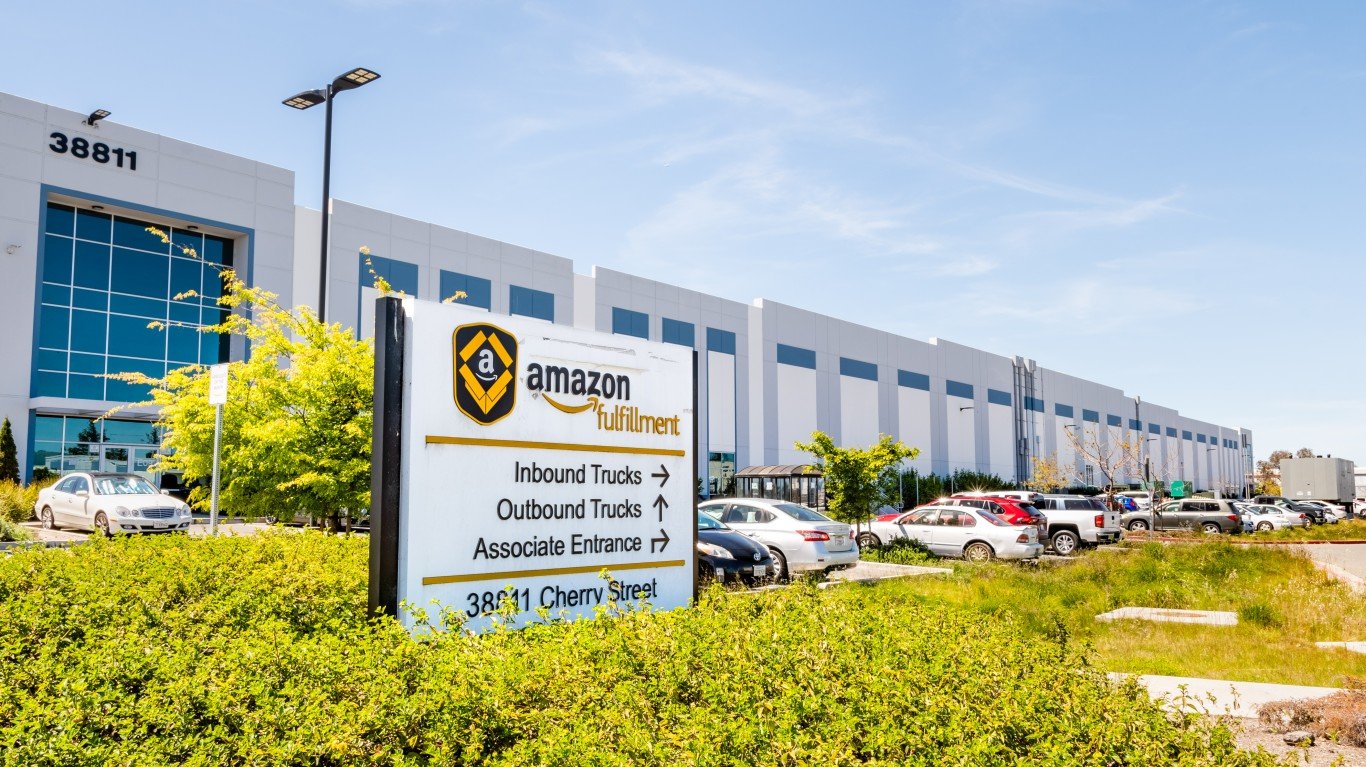
Asymmetry Keeps Me Hitting The Buy Button on Amazon
Amazon's stock chart tells one story while the business underneath tells a completely different one, and the gap between those two narratives is exactly where the opportunity lives.

I keep buying Amazon (NASDAQ:AMZN | AMZN Price Prediction) because the setup in front of me is the cleanest risk-reward asymmetry I own. The stock is down 5.87% over the past month and up only 6.56% year to date, while the business underneath it just posted the fastest AWS growth in 18 quarters. That gap is why I keep adding.
What Keeps Pulling Me Back to the Buy Button
My thesis is simple. Amazon is spending like a company that sees demand it cannot fill, and the market is pricing it like a company whose free cash flow just went negative. Both statements are true. Only one of them matters in ten years. Trailing-twelve-month free cash flow is -$7.6 billion, and Q2 capital expenditures hit $54.2 billion. That is the near-term pain. On the other side of it sits a data-center footprint management said can be monetized for 30-plus years once online.
Three Reasons the Thesis Holds
First, AWS is compounding into something larger. Q2 AWS revenue was $42.23 billion, up 37% year over year, with an annualized revenue run rate of $169 billion and a backlog of $496 billion, growing triple digits year over year. Andy Jassy told the Street he now believes AWS can be a “trillion dollar annual revenue business for us in time.” The 39.4% AWS operating margin tells me the growth is not being bought with giveaways.
Second, the ad business keeps quietly turning into a monster. Advertising revenue was $19.81 billion, up 26% year over year. That is a high-margin stream layered directly on top of the retail flywheel, and it flows through operating income, which grew 43.24% year over year in Q2.
Third, the balance sheet lets Amazon absorb the capex cycle without sweating. Debt-to-equity is 0.37, net debt to EBITDA is 0.45, and interest coverage is 35.17 times. Return on equity still runs 22.29%. Companies with a broken model do not post those numbers.
Why Not the Obvious Alternatives
I own cloud peers, but my incremental dollar goes here. Microsoft (NASDAQ:MSFT) and Alphabet (NASDAQ:GOOGL) are strong hyperscaler operators, but neither has Amazon’s specific setup: an AWS unit that just accelerated for the fifth straight quarter, custom-silicon economics where Graviton offers 30% to 40% better price performance and is used by 98% of the top 1,000 EC2 customers, and an AI plus chips run rate that each eclipsed $25 billion growing triple digits. On the retail side, Walmart (NYSE:WMT) is the natural comparison, but Amazon is already the second-largest grocer in the United States with grocery gross merchandise sales exceeding $150 billion last year, and it owns AWS, ads, Prime Video, and Zoox on top of that. I am paying 20 times trailing earnings for the whole stack.
Risk I Will Not Wave Away
The real risk is the capex bill. 2026 capex is planned at roughly $200 billion, and prediction markets currently price a 91.5% chance capex exceeds $200 billion. If AI demand softens before those data centers monetize, free cash flow stays ugly. What keeps me buying anyway is that the “lion’s share” of 2027 capacity is largely reserved and most AI capacity is being contracted for at least five-year terms. That is contracted revenue waiting for a switch to flip, and it is also why the power, cooling, and networking suppliers behind those data centers keep showing up in our free report on seven AI infrastructure stocks that aren’t chipmakers.
Why the Buy Button Stays Active
I own Amazon because the market is charging me for the risk today and giving me the compounding for free. As long as AWS backlog keeps building and Jassy keeps writing checks against contracted demand, my finger stays on the button.
Contact [email protected] for any questions or corrections.
Alex Sirois is a financial writer with experience spanning both retail and institutional investing. He has written for InvestorPlace and held roles at BNY Mellon and Bernstein, giving him a perspective that bridges Main Street portfolios and Wall Street analysis.
Alex holds an MBA from George Washington University and has built his career across multiple industries, including e-commerce, education, and translation — a breadth of experience that informs how he breaks down complex financial topics for everyday investors. His writing is conversational, actionable, and grounded in long-term, buy-and-hold investing principles.
At 247 Wall St., Alex focuses on delivering analysis that is both accessible and useful, with a clear emphasis on helping readers make more informed decisions with their money.