Marvell Technology Dropped By 25% in 3 Months: This Trusted Analyst Says 75% Returns Are Coming In The Next Year
Marvell's stock has cratered even as its AI data-center business posts record numbers and analysts pile on upgrades, and one KeyBanc analyst is drawing a very different conclusion from the selloff than the rest of the market.

This post may contain links from our sponsors and affiliates, and Flywheel Publishing may receive compensation for actions taken through them.
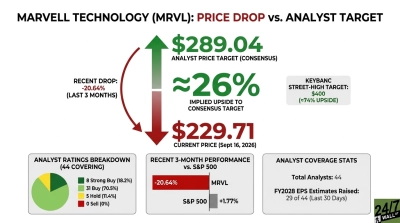
Marvell Technology (NASDAQ:MRVL | MRVL Price Prediction) trades at $229.71 against a Wall Street consensus target of $289.04, leaving roughly 26% of implied upside. One trusted analyst sees far more.
Marvell designs the switching silicon, optical DSPs, and custom XPU-attached products that stitch together modern AI clusters. Its data-center segment accounts for 79% of total revenue and is entrenched with hyperscalers on networking and custom silicon programs. The stock has fallen 20.64% over three months despite a record quarter and two guidance raises.
Blowout Quarter, Battered Stock
Marvell’s August Q2 fiscal 2027 report showed revenue of $2.7393 billion, up 36.55% year over year, with data-center revenue jumping 46%. Management lifted fiscal 2027 outlook to roughly $12 billion2 billion. Shares closed at $255.88 on the filing date and have since drifted to $229.71.
The selling reflects narrative rotation. Investors are re-underwriting how much hyperscaler AI spend flows to merchant silicon versus in-house designs. Broadcom fell 13.49% in the past month on similar worries. Over the same three-month window, the S&P 500 gained 1.77%, so Marvell trailed by more than 22 points.
KeyBanc’s John Vinh Sees a $400 Stock
KeyBanc analyst John Vinh carries a Street-high $400 price target and Overweight rating, implying roughly 74% upside. His thesis: AI data-center networking is a more durable growth engine than custom accelerators because bandwidth is what constrains cluster scale. Marvell becomes a tollbooth for the scaling of AI cluster infrastructure.
Vinh’s model puts Marvell’s data-center segment alone on a path to more than $20 billion in revenue by FY2029, well above the company’s disclosed $10 billion total line of sight. He factors in multi-year custom ASIC wins, deepened co-development with NVIDIA on silicon photonics and NVLink Fusion, and non-GAAP gross margins holding near 59%. Marvell guided Q3 gross margin to 57.5% to 58.5%, keeping that foundation intact.
Of 44 covering analysts, 8 rate it Strong Buy, 31 Buy, 5 Hold, and none Sell. Over the past 30 days, 29 analysts raised fiscal 2027 EPS estimates and zero cut. Fiscal 2028 EPS consensus has climbed to $6.7199 from $6.1726 ninety days ago. An Investor Day on October 6, 2026 is the next catalyst.
AI Chip Peers Slipped, Marvell Fell Hardest
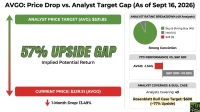
Broadcom (NASDAQ:AVGO) is the closest structural peer. Shares trade at $339.51 versus a $531.85 consensus target for about 57% implied upside. AVGO is down 13.49% in the past month despite Q3 AI semiconductor revenue growing 221% to $16.7 billion. Coverage tilts strongly Buy at 8 Strong Buy, 37 Buy, 4 Hold.
NVIDIA (NASDAQ:NVDA) sits at $213.90 against a $328.66 target, implying about 54% upside. Shares lost 4.83% in the past month but remain up nearly 15% year to date, with a 9-48-2-1 ratings split.
Advanced Micro Devices (NASDAQ:AMD) is the outlier: $512.50 against a $616.51 target for only about 20% upside after a 139% year-to-date run. Ratings run 4 Strong Buy, 39 Buy, 11 Hold.
Marvell offers the largest analyst-implied upside to the Street-high target in the group.
Where Marvell’s Numbers Stand
Marvell trades at $229.71 with a $289.04 consensus target and a $400 Street-high, translating to roughly 26% and 74% implied upside respectively. Of 44 covering analysts, 39 rate it Buy or Strong Buy. Forward P/E sits at 52, elevated but compressing as FY2028 EPS climbs toward $6.7199. Marvell is up 170.7% year to date but has given back 20.64% in the past three months while the S&P 500 rose 1.77%.
Bull and Bear Setup for Marvell
The bull case strengthens if custom silicon ramps as guided in the second half of fiscal 2027, scale-up optics accelerates into fiscal 2028, and October’s Investor Day confirms KeyBanc’s data-center trajectory. The path toward $289 runs through custom revenue more than doubling in fiscal 2028 and non-GAAP operating margin reaching the 38% to 40% target range.
The bear case takes over if hyperscalers accelerate vertical integration faster than expected, or if Google’s warrant to acquire up to 7% of Marvell shares signals a pricing concession the market has not fully digested. Customer concentration and $4.963 billion of long-term debt are real risks.
On balance, consensus alone bakes in a full quarter’s worth of missteps, and Vinh’s case is coherent.
Contact [email protected] for any questions or corrections.
Alex Sirois is a financial writer with experience spanning both retail and institutional investing. He has written for InvestorPlace and held roles at BNY Mellon and Bernstein, giving him a perspective that bridges Main Street portfolios and Wall Street analysis.
Alex holds an MBA from George Washington University and has built his career across multiple industries, including e-commerce, education, and translation — a breadth of experience that informs how he breaks down complex financial topics for everyday investors. His writing is conversational, actionable, and grounded in long-term, buy-and-hold investing principles.
At 247 Wall St., Alex focuses on delivering analysis that is both accessible and useful, with a clear emphasis on helping readers make more informed decisions with their money.