Wall Street is Bullish on Marvell. Here’s Our Price Target.
Marvell collapsed 34% from its June peak while reporting accelerating AI bookings and raising its full-year outlook, a contradiction that points to either a rare buying opportunity or a value trap hiding behind hypergrowth expectations.


Marvell Technology (NASDAQ:MRVL | MRVL Price Prediction) has ridden the AI infrastructure wave to one of the sharpest reratings in the S&P 500 this year, with shares up 122.35% year to date.
After a pullback from June highs, the setup looks more interesting than dangerous. Our 24/7 Wall St. price target sees meaningful upside from here.

The 24/7 Wall St. Price Target for Marvell
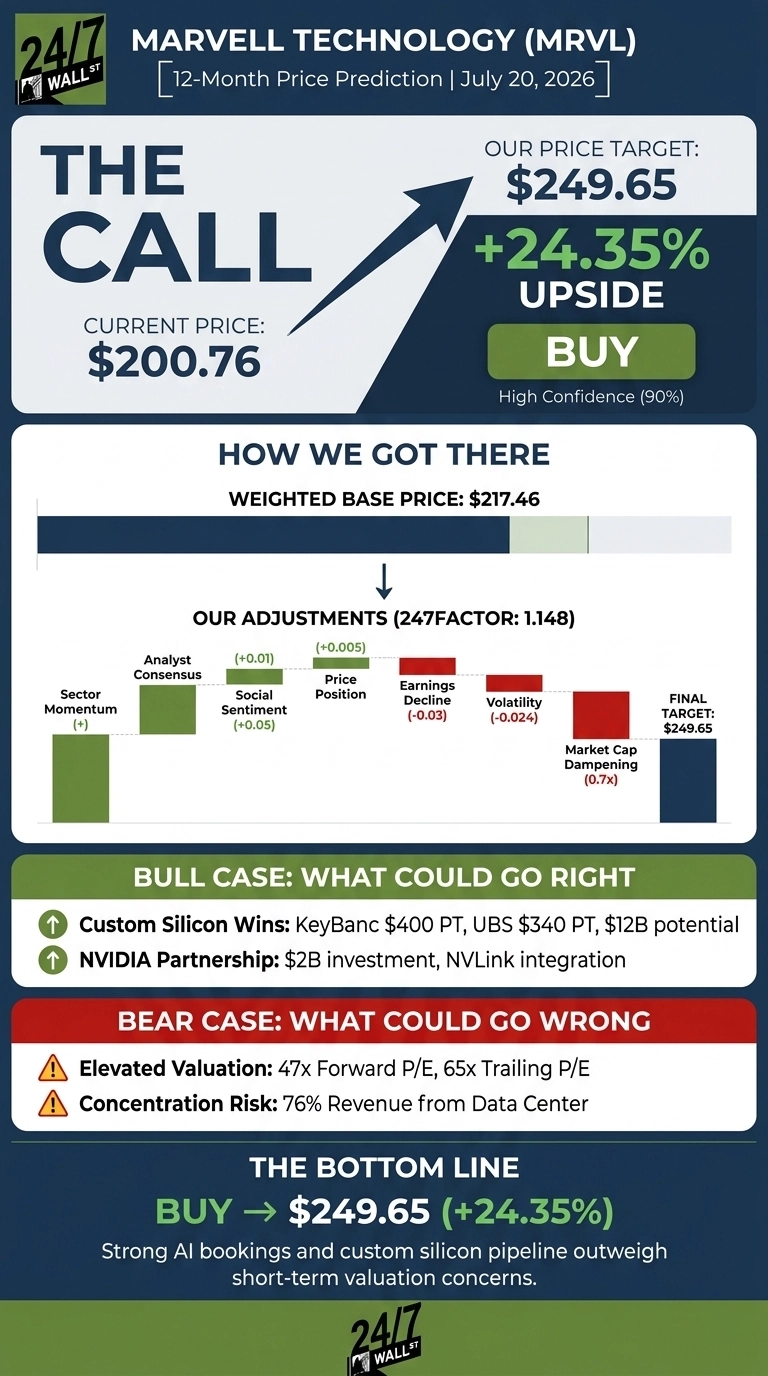
The 24/7 Wall St. price target for Marvell is $249.65, implying 24.35% upside from the current $200.76 quote. Our recommendation is buy with high confidence at 90%. Bookings acceleration, custom silicon wins, and a real Nvidia partnership give Marvell room to run.
| Metric | Value |
|---|---|
| Current Price | $200.76 |
| 24/7 Wall St. Price Target | $249.65 |
| Upside | 24.35% |
| Recommendation | BUY |
| Confidence Level | 90% |
A Wild Ride From $84 to $329 and Back
Marvell entered 2026 at $84.86, ripped to a 52-week high of $329.80 in June, then gave back 34.82% over the last month as hyperscaler capex worries hit the AI silicon complex.
In Q1 FY2027, revenue hit $2.418 billion (up 27.6% year over year) with data center contributing $1.827 billion, or 76% of total revenue.
CEO Matt Murphy said the team is seeing “exceptional AI-related bookings” and raised the outlook for both fiscal 2027 and fiscal 2028. Q2 guidance calls for $2.7 billion in revenue, roughly 35% growth. The recent selloff reflects sentiment rather than fundamentals.
Why Bulls See $340 and Beyond
The bull case rests on custom silicon. KeyBanc’s John Vinh has a $400 target tied to a potential $12 billion Google “Merope” ASIC win, and UBS raised its target to $340 on the Teralynx T100 launch.
The $2 billion NVIDIA strategic investment and NVLink Fusion integration give Marvell a seat at the table for scale-up AI networks. Management sees the custom ASIC business scaling from $1.5 billion today to over $4 billion by 2028.
The bull case one-year target sits at $347.35, roughly 73% upside if bookings hold and hyperscaler capex stays firm.
What Could Go Wrong
Marvell trades at a forward P/E of 47 and a trailing P/E of 65, both premium marks. Data center at 76% of revenue creates concentration risk, and hyperscalers pursuing in-house silicon remains a threat.
Insider selling of roughly $26.8 to $30.9 million over 90 days is a yellow flag, though largely tied to tax-related sales under 10b5-1 plans. The bear case one-year target is $191.31, a modest 4.71% decline.
The GAAP earnings decline reflects the acquisition charge rather than operating deterioration; non-GAAP EPS of $0.80 beat consensus.
How Marvell Compares to Broadcom and NVIDIA
Broadcom (NASDAQ:AVGO) is the direct comparable on custom AI silicon. Broadcom’s Q2 FY2026 AI semiconductor revenue reached $10.8 billion, up 143% year over year, with Q3 AI revenue guided at $16 billion.
That is roughly 6x Marvell’s total quarterly revenue, validating Marvell’s $4 billion custom ASIC target for 2028.
NVIDIA (NASDAQ:NVDA) is both an anchor customer and partner through NVLink Fusion. NVIDIA trades at a trailing P/E of 41, cheaper than Marvell despite posting 85.2% year-over-year revenue growth in Q1 FY2027.
NVIDIA’s networking revenue grew 199% year over year, and Marvell sells the optics and DSPs that feed those systems. Our $249.65 target looks reasonable on the peer set.
The Bottom Line on Marvell
Buy with 90% confidence and a 24/7 Wall St. price target of $249.65. The raised FY2027 and FY2028 outlook combined with a 33% pullback has scrubbed froth.
The setup looks constructive if hyperscaler capex commentary holds through Q2 earnings, while a slip in custom ASIC design wins to competitors or tightening China restrictions would challenge the thesis. The risk-reward tilts in favor of longs.

Marvell Price Prediction 2026 to 2030
Here is where the 24/7 Wall St. price target model projects Marvell could trade, assuming the current growth trajectory and multiple hold.
| Year | 24/7 Wall St. Price Target |
|---|---|
| 2026 | $249.65 |
| 2027 | $285 |
| 2028 | $320 |
| 2029 | $355 |
| 2030 | $382.60 |
These projections assume Marvell continues executing on custom XPU wins and optical interconnect leadership. Significant upside or downside could result from hyperscaler capex cycles or a shift in in-house silicon strategy among the top three cloud customers.
Contact [email protected] for any questions or corrections.
Vandita Jadeja is a financial publisher with over a decade of experience writing about financial topics, including investment, savings, retirement, insurance and banking. Vandita is a Chartered Accountant who loves to debunk financial concepts for readers.
Her work has appeared on sites that include The Motley Fool, InvestorPlace, and Benzinga. She covers investing and focuses on stock picks and price prediction for 24/7 Wall St.
When not looking for the next stock investment opportunity, she can be found traveling, reading, chasing sunsets and enjoying her iced latte.