5 Stocks That Keep Raising Their Dividend Regardless Of The Market
Some companies keep writing bigger dividend checks even when their end markets are shrinking, and the trait that separates them from the rest has nothing to do with yield. Five names across insurance, automation, and home improvement have quietly built…


Dividend growth beats dividend yield when the cycle turns against you. The five names below span home improvement, insurance, uniform services, and industrial automation, and each has kept raising its payout while its end markets wobbled. The shared hook is durability: Cintas just reported its 55th year of the last 57 that Cintas grew both its top and bottom lines, and that kind of operating consistency is what actually funds a rising dividend when the market is not cooperating.
A quick housekeeping note before the names. Home Depot and Lowe’s are direct competitors in the same end market, so owning both concentrates you in home improvement and housing turnover rather than diversifying you. Size positions accordingly.
Home Depot: A Housing-Cycle Compounder Still Writing Bigger Checks
Home Depot (NYSE:HD | HD Price Prediction) currently pays a quarterly dividend of $2.33 per share, or $9.32 annualized. The trailing yield sits at 1.44% against a share price of $310.48. That is modest, but the check keeps growing: the quarterly went from $2.25 in 2024 to $2.30 in 2025, then to $2.33 in 2026.
On safety, FY2025 free cash flow was $12.646B against operating cash flow of $16.325B, and net debt/EBITDA sits at 2.65x with interest coverage of 8.66x. FY2025 diluted EPS came in at $14.23, giving the payout comfortable coverage. Home Depot returned approximately $2.3 billion in dividends to shareholders during the quarter and still funded $880 million in capex.
Bull case for income investors: management said “the headline here for us this quarter is that our teams took share in a difficult environment”, and Pro/SRS/GMS expansion adds durable, sticky revenue that funds continued raises. The stock is -23.12% over one year, which lifts the entry yield.
Risk: “Housing turnover, just as one point in the economy that we watch, has been at historical lows”, and FCF fell 22.54% YoY in FY2025, tightening the near-term coverage cushion.
Chubb: An All-Weather Insurer With a Fortress Balance Sheet
Chubb (NYSE:CB) raised its quarterly dividend from $0.97 to $1.02 per share earlier this year, an annualized $4.08. The trailing yield is 1.15%. The dividend record shows a higher quarterly rate in each successive year from 2019 through 2026.
Coverage is not the concern here. Q2 2026 P&C underwriting income was more than $1.9 billion, up almost 19% year over year, with a consolidated combined ratio of 83.8. Adjusted net investment income hit a record $1.88 billion, and adjusted operating cash flow was $3.5 billion. Book value reached $75 billion, or $195.45 per share. Chubb returned $1.4 billion of capital to shareholders during the quarter, split between buybacks and the dividend.
Bull case: Evan Greenberg called Chubb “an all-weather firm” and expressed confidence in “double digit” EPS and tangible book value growth. A reinvestment rate of 5.5% above the portfolio book yield of 5.1% is a structural tailwind for future dividend capacity. Shares are up 23.44% over one year.
Risk: property and financial-lines pricing is softening quickly. North America commercial property pricing was down about 6%, and Greenberg warned that “Pricing in numerous areas of casualty are failing to keep pace with loss costs, which are hardly benign.”
Cintas: Recurring Revenue That Funds Double-Digit Raises
Cintas (NASDAQ:CTAS) just moved its quarterly dividend from $0.45 to $0.52 per share, for an annualized $2.08. Yield is only 0.9%, so this is dividend growth, not income. The prior raise, from $0.39 to $0.45, took effect in 2025.
Safety is exceptional. FY2026 free cash flow was $1.881B (+7.07%) on revenue of $11.265B (+8.94% YoY). Full-year gross margin was 50.7%, up 70 basis points from the prior year, and adjusted diluted EPS was $4.94, up 12.3%. Cintas returned $1.7 billion in dividends and buybacks for the year. Management said “Our annual dividend remains an important component of shareholder return, and our share buyback program continues to be executed opportunistically.”
Bull case: recurring uniform-rental and facility-services revenue behaves like a subscription. FY2027 guidance calls for revenue of $12.10B–$12.25B and adjusted diluted EPS of $5.36–$5.50. Management’s framing: “We grow in multiples of employment, we grow in multiples of GDP.”
Risk: the pending UniFirst deal received an FTC second request, and the shares trade at a premium forward multiple of 37x, leaving little room for execution slips.
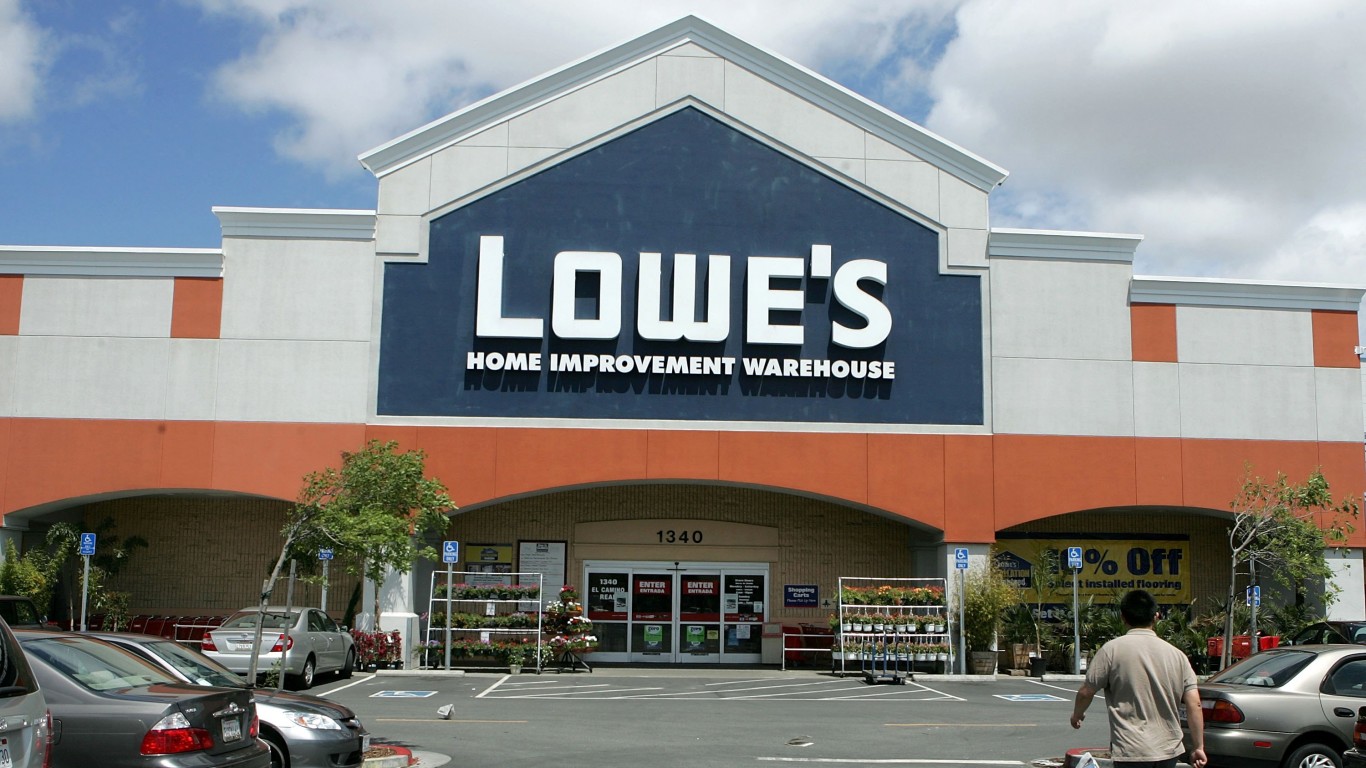
Lowe’s: A Buyback-Heavy Balance Sheet Still Raising the Payout
Lowe’s (NYSE:LOW) raised its quarterly dividend from $1.20 to $1.25 per share at the July ex-date, for an annualized $5. Yield stands at 2.37%, the highest in this group. CFO Brandon Sink referenced “our status as a dividend aristocrat” on the Q2 call.
Coverage read: Q2 FY26 free cash flow was $3.1 billion, dividends paid were $673 million, and return on invested capital was 25.5%. FY2026 guidance calls for adjusted diluted EPS of about $12.25 on sales near $92 billion. The FCF yield reads at 6.87%, which is what funds continued raises.
Bull case: comparable sales were positive in nine of 13 merchandise divisions, appliances put up a seventh consecutive quarter of positive comps, and management believes “there is $20 and $50 billion of pent-up deferred project demand in home improvement.”
Risk: shareholders’ equity is -$7.437B from aggressive buybacks, adjusted debt/EBITDA sits at 3.0 times versus a target of 2.75 times, and shares are down 24.67% over one year on the DIY slowdown.
Emerson Electric: Automation Cash Flow Feeding a Long Dividend Record
Emerson (NYSE:EMR) currently pays a quarterly dividend of $0.555 per share, or $2.22 annualized, for a yield of 1.44%. The most recent raise took the quarterly from 0.5275 to 0.555, and the payment history shows steady annual increases going back through 2010 in the supplied record.
Coverage is deep. Q3 FY26 free cash flow was $1.3 billion, up 36%, with a margin of 27.1%. Full-year FCF guidance is approximately $3.6 billion, and the FY2026 capital return plan is $2.2 billion, split $1.2 billion in dividends and $1 billion of share repurchases. Adjusted segment EBITDA margin expanded 140 basis points to 28.5%.
Bull case: underlying orders grew 7%, growth verticals rose 27%, and the project funnel expanded to $12.4 billion, up 8% year over year. Power, semiconductor, and software exposure gives the dividend a secular tailwind.
Risk: Europe sales declined 1% and China was down 3%, so international cyclicality remains the swing factor.
Bottom Line for Income-Focused Investors
These are dividend growers, and that is the point. Home Depot and Lowe’s fund raises through housing-cycle scale, Chubb through underwriting profitability and record investment income, Cintas through recurring-revenue compounding, and Emerson through an automation and power backlog that keeps cash flow expanding. Pair Chubb, Cintas, and Emerson if you want diversification away from housing turnover, since owning both HD and LOW doubles that single macro exposure. (If you want to go one step further on payout longevity, we ranked ten companies with 50+ years of consecutive raises by valuation in a free report here: 10 Dividend Kings to Buy Now and Hold Forever.)
Contact [email protected] for any questions or corrections.
Joel South covers large-cap stocks, dividend investing, and major market trends, with a focus on earnings analysis, valuation, and turning complex data into actionable insights for investors.
He brings more than 15 years of experience as an investor and financial journalist, including 12 years at The Motley Fool, where he served as an investment analyst, Bureau Chief, and later led the Fool.com investing news desk. He has also co-hosted an investing podcast and appeared across TV and radio discussing market trends.