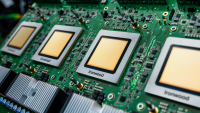
Marvell Smashes the AI ‘Power Wall’ with Industry-First 2nm Optical Chips
Marvell just pulled off a photonic milestone that could rewrite the power economics of AI data centers, and the ripple effects reach all the way to Google, NVIDIA, and the next generation of hyperscale silicon.


Shares of Marvell Technology (NASDAQ:MRVL | MRVL Price Prediction) opened higher Monday, trading at $248 in the first hour, up 1.5% on the session after the company unveiled the industry’s first 2nm optical interconnect demonstrations for AI data centers. The move extends a one-week gain of 5% and a year-to-date advance of 192%.

2nm Optical Breakthrough Targets the AI Power Wall
The catalyst is a technology milestone. Marvell disclosed the industry’s first 2nm optical interconnect demos for AI data centers, including 102.4Tbps co-packaged optics, with the company saying it is “pushing the envelope of what is possible in optical tech” as AI clusters demand more bandwidth at lower power. Co-packaged optics (CPO) place the optical engine on the same substrate as the switch or accelerator silicon, shortening data pathways and cutting energy per bit, a direct answer to the electricity constraints boxing in hyperscale build-outs.
The demonstration also stakes a claim on the roadmap. By showing 2nm optical tech capable of handling 200G and 400G per lane, Marvell effectively steps beyond the current 800G deployments and the ramping 1.6T generation to the coming 3.2T standard. That matters for hyperscalers designing training and inference clusters that link tens of thousands of XPUs across multiple racks, where copper runs out of reach at the speeds required.
Optical Roadmap Lines Up With a Red-Hot Data Center Quarter
Today’s announcement lands on top of a fundamental backdrop that is already firing. Marvell reported record Q2 FY2027 revenue of $2.739 billion, up 37% year over year, with Data Center revenue of $2.17 billion, up 46% year over year and now 79% of total revenue. Non-GAAP EPS came in at $0.94, and Q3 guidance was set at $3.150 billion plus or minus 5%, with EPS of $1.10 plus or minus $0.05. The August 27 filing also raised the fiscal 2027 and fiscal 2028 outlooks.

On the earnings call, CEO Matt Murphy told investors that “the magnitude of our scale-up optics opportunity next year is much larger than we thought just a quarter ago” and that Marvell expects scale-across network bandwidth requirements to be more than 10 times greater than current front-end DCI networks. The 2nm demo puts silicon behind those forecasts. It also validates Marvell’s earlier moves, including the Celestial AI photonic fabric acquisition that closed Feb 2, 2026 and the XConn Technologies chiplet connectivity deal that closed Feb 10, 2026.
Competitive Frame and Custom Silicon Halo
The optical push runs parallel to Marvell’s custom silicon story. Management disclosed an expanded partnership with Google that includes a warrant for Google to acquire up to 7% of Marvell shares tied to revenue milestones, and Murphy said custom revenue is expected to more than double in fiscal 2028. Being first to 2nm optics tightens Marvell’s position versus Broadcom in high-speed networking silicon, and pairs with the expanded NVLink Fusion partnership with NVIDIA for scale-up switching. Marvell now carries a market cap near $217.4 billion, a forward P/E of 58, and an average analyst price target of $289 against 39 buy or strong-buy ratings and five holds.

What to Watch Next
The next scheduled catalyst is Marvell’s Investor Day on October 6, 2026 in New York, where management has said it will detail the long-term custom silicon trajectory, scale-up optics, and the fiscal 2029 revenue envelope. I would keep an eye on whether MRVL can hold above its $216 50-day moving average into that event, and on any hyperscaler design-win commentary tied to the 2nm CPO demonstration.
Contact [email protected] for any questions or corrections.
After two decades of patrolling the dark corners of suburbia as a police officer, Rich Duprey hung up his badge and gun to begin writing full time about stocks and investing. For the past 20 years, he’s been cruising the markets looking for companies to lock up as long-term holdings in a portfolio while writing extensively on the broad sectors of consumer goods, technology, and industrials. Because his experience isn’t from the typical financial analyst track, Rich is able to break down complex topics into understandable and useful action points for the average investor. His writings have appeared on The Motley Fool, InvestorPlace, Yahoo! Finance, Money Morning, and, of course, 24/7 Wall St. He has been featured in both U.S. and international publications, including MarketWatch, Financial Times, Forbes, Fast Company, and USA Today.