IREN’s Energy Pipeline Optionality is Very Appealing So Should You Buy It?
IREN has locked up gigawatts of power, billion-dollar contracts with Microsoft and NVIDIA, and analyst targets well above its current price, yet losses are ballooning and the real revenue test has not arrived. Here is what needs to happen in…


IREN (NASDAQ:IREN) at $47.23 looks compelling. The case rests on a pre-secured power portfolio the company can flex across the most valuable compute workloads on earth. The stock carries a $18.4 billion market cap.
IREN owns the physical layer of AI: more than 5 gigawatts of announced power across Texas, British Columbia, Oklahoma, Spain, and South Australia, anchored by a $9.7 billion AI Cloud contract with Microsoft and a $3.4 billion five-year deal with NVIDIA.
Sold-Out Capacity and $25 Million per Megawatt Pricing
Management says $4 billion of ARR is contracted for 2026 capacity, with $1 billion already operating. Three-year contract pricing is up about 125% since November, with recent deals above $20 million per megawatt of IT load and active talks near $25 million per megawatt. Customer prepayments cover 45% to 55% of GPU capex.
Only less than 10% of the five-gigawatt portfolio is monetized. The remainder can be steered toward whichever workload pays best: hyperscaler training, frontier lab inference, robotics customers, or managed services. Analyst conviction reflects the setup, with 12 Buy and 1 Strong Buy ratings.
Losses Widen as Capex Balloons
IREN posted a $684 million net loss on $137.2 million of Q4 revenue that missed estimates and fell 26.75% year over year. Adjusted EBITDA fell from $59.5 million in Q3 to $19.2 million. FY27 capex is guided at $25 to $30 billion.
Consensus FY27 EPS has fallen from negative $0.94 ninety days ago to negative $3.92. Forward P/E sits at 137, price-to-sales at 26, and beta at 4.29. Key risks include customer concentration in Microsoft and NVIDIA, GPU obsolescence, and potential ERCOT rule changes.
Reasons to Wait for the March Quarter
Patience has a case. Much of the December-quarter capacity comes online late in the period, so revenue lift lands in the March quarter. Horizons 2 through 4 must commission on schedule. The balance sheet carries $11.60 billion of liabilities against $4.19 billion of equity. Waiting one quarter delivers a clean look at whether contracted ARR converts to reported revenue.
Price, Target and Performance Read
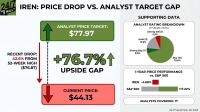
IREN trades at $47.23 against a mean analyst target of $80.21, implying substantial upside. Coverage spans 17 analysts: 1 Strong Buy, 12 Buy, 3 Hold, 0 Sell, and 1 Strong Sell. Shares are up 25.05% year to date and 22.23% over the past year, ahead of the S&P 500 at 13.43% YTD and 16.55% over one year. The 52-week range of $28.93 to $76.87 captures volatility.
Why IREN Stands Out at $47.23
At $47.23, IREN screens as an asymmetric setup for investors researching AI infrastructure exposure.
The path to appreciation runs through capacity conversion. If Horizons 2 through 4 commission on time and December-quarter ARR flows into March-quarter revenue, IREN moves from story stock to cash-generating infrastructure platform inside two quarters. The optionality on the unmonetized 90%-plus of the portfolio is the asymmetric prize: each additional gigawatt allocated at $25 million per megawatt of IT load adds billions in ARR without new grid connections.
The setup skews favorably because the market is discounting execution rather than assets. Shares sit just above the 200-day moving average of $45.54. The thesis breaks if Microsoft or NVIDIA renegotiates terms, GPU financing tightens, or a Horizon deployment slips a full quarter.
Watch three items: Horizon 2 commissioning, March-quarter revenue against the $4 billion contracted ARR figure, and any 2027 capacity announcements at or above the $25 million per megawatt benchmark. IREN owns the scarcest asset in AI, energized power at scale, and is selling it into the tightest compute market on record.
Contact [email protected] for any questions or corrections.
Alex Sirois is a financial writer with experience spanning both retail and institutional investing. He has written for InvestorPlace and held roles at BNY Mellon and Bernstein, giving him a perspective that bridges Main Street portfolios and Wall Street analysis.
Alex holds an MBA from George Washington University and has built his career across multiple industries, including e-commerce, education, and translation — a breadth of experience that informs how he breaks down complex financial topics for everyday investors. His writing is conversational, actionable, and grounded in long-term, buy-and-hold investing principles.
At 247 Wall St., Alex focuses on delivering analysis that is both accessible and useful, with a clear emphasis on helping readers make more informed decisions with their money.