AMD Just Cracked $1 Trillion and One Strategist Says $750 Is Next
A top strategist just structured a trade on AMD that stops paying him the moment his own price target is hit, and that contradiction reveals something important about where this stock actually goes from here.

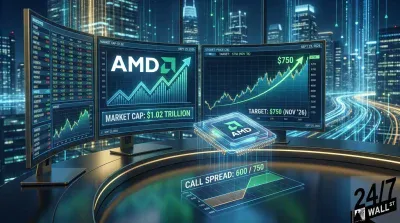
Tony Zhang called for AMD (NASDAQ:AMD | AMD Price Prediction) to reach $750 by November, then structured a trade that stops paying him the moment his own target is hit. That contradiction is the interesting part.
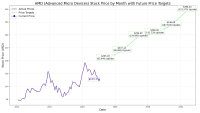
AMD closed Monday at $623.77 after climbing 191.26% year to date and 290.37% over one year, pushing its market value to roughly $1.02 trillion.
Zhang buys the 600 call and sells the 750 call. Above 750, he owns nothing more. His target is also his ceiling.
That is a very specific forecast: a grind into a two-month window. The catalyst is a company-wide price increase of about 10% across AI chips, graphics cards, and chipsets. The debate is whether that pricing action reflects durable leverage over hyperscalers, or a one-time grab into a shortage. Both readings support a higher stock. Only one supports the multiple.
What the 600/750 Call Spread Actually Does
A call spread pays a debit between two strikes, and gains stop at the upper strike.
If AMD prints above 750 at November expiration, both legs finish in the money, and the position pays its maximum. If the stock stalls near 623, both legs decay and the premium evaporates.
Time is a short leg here because the window closes in under two months. A defined-risk trade still loses everything you paid if AMD chops sideways.
Cheaper than a naked call, but the ceiling is the tell. Zhang is forecasting a controlled move to a specific number by a specific date.
Why a 10% Price Hike Matters More Than a Volume Beat
Pricing power in a supply-constrained market flows directly to gross margin because wafer costs are already committed.
AMD reported non-GAAP gross margin of 56% in Q2 2026, up from 43% a year earlier. Data Center revenue rose 107% to $6.72 billion and now represents 58% of the company, per the Q2 8-K.

Layer Zhang’s 10% price hike on top of that mix. If it holds, incremental revenue converts to profit at very high rates.
The question is durability. Hyperscalers may be paying up because MI450 and Helios are scarce, or because their capex windows demand chips this quarter regardless of price.
What Is Already Funded by $623
AMD trades at a trailing P/E of 157x and a forward P/E of 36x. Price-to-sales sits at 24x.
The average analyst target of $616.51 is essentially where the stock closed Monday. Zhang’s 750 sits well above consensus.

Management guided Q3 to about $13 billion in revenue, plus or minus $300 million, up roughly 41% year over year. Lisa Su told analysts the Data Center segment will “more than double year-over-year in 2027” off a much larger base.
The one-year gain has already priced in that acceleration. Zhang’s spread bets that the pricing news adds one more leg before positioning gets crowded.


Bull and Bear Case for AMD Stock
Bull case: a 10% price hike across the product line in a supply-constrained market changes AMD’s leverage. Data Center is compounding at triple digits with gigawatt commitments from OpenAI (6 GW), Meta (6 GW), and Anthropic (2 GW). Helios is tracking ahead of initial forecasts.
If AMD clears $13 billion in Q3, gross margin holds near 56% and Venice ramps as expected, the 2027 doubling is credible, and 750 looks more like a floor.
Bear case: the multiple has done a lot of work already, and a beta of 2.48 leaves no cushion for a hyperscaler capex pause. A handful of frontier customers control the AI accelerator revenue line. Any one qualifying a second source or renegotiating pricing hits the model directly.
Gaming revenue fell 31% year over year, memory costs are rising, and the 10% price increase disappears in a quarter if it isn’t durable.
The variable is hyperscaler order cadence into Q4 and Q1 2027. If order books extend and Helios stays on schedule, Zhang’s 750 looks conservative. If any large customer digests capacity, the multiple compresses first and the spread expires worthless. (We reverse-engineered what the biggest AI chip winners looked like early in a free playbook you can grab here.)
Contact [email protected] for any questions or corrections.
Omor Ibne Ehsan is a writer at 24/7 Wall St. He is a self-taught investor with a focus on growth, cyclical, and dividend equities that have strong fundamentals, value, and long-term potential. He also has an interest in high-risk, high-reward investments such as penny stocks.