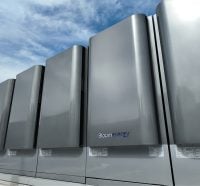
Bloom Energy’s Single Largest Fuel Cell Deployment Is In Trouble
Bloom Energy built its entire bull case on a backlog anchored by one massive data center project, and now a pipeline delay outside its control is forcing investors to ask whether 2027 and 2028 revenue targets were ever as solid…


2.45 Gigawatts of Fuel Cells Suddenly Look Vulnerable
Bloom Energy (NYSE:BE) has spent 2026 selling investors on a story that its solid oxide fuel cells are the standard for onsite AI power. The number that just complicated that story is 2.45 gigawatts. That is the capacity Bloom is contracted to support at Oracle’s Project Jupiter data center in New Mexico, described as one of the largest U.S. data center microgrids and a core piece of the $165 billion Project Jupiter build. Enough power, per the project design, to serve roughly 1.8 million homes at any moment. And it is now the piece of Bloom’s business with the most visible timeline risk.
What 2.45 Gigawatts Means for Bloom
Bloom’s entire bull thesis rests on converting a backlog it pegged at roughly $20 billion into shipped, powered-on Energy Servers. Project Jupiter, at 2.45 GW, is the single largest deployment pipeline attached to that backlog. For context on scale, Bloom disclosed on its Q2 call that it had visibility for 25 gigawatts of deployments across its planning horizon. A single project representing that much of the ramp is anchor exposure.
The mechanical problem is fuel. Bloom’s fuel cells run on natural gas, and a key Energy Transfer LP pipeline meant to feed the project has been delayed from August 2026 to February 2027 due to New Mexico regulatory issues. Without gas at the site, the servers cannot generate power. That turns a manufacturing and delivery story into a fuel-infrastructure story, and Bloom does not control that infrastructure.
Market Reaction
Shares of Bloom Energy are down 8.01% in the current session, trading at $253.16 versus a prior close of $275.19. Over the past week the stock is off 6.24%. The one-year picture is still a gain of 227.16%, which is exactly why any crack in the deployment narrative matters: expectations, and valuation, sit far above the fundamentals.
Bear Case
Start with valuation. Bloom trades at a trailing P/E of 357 and a forward P/E of 57, on a price-to-sales ratio of 26. That multiple is priced for the raised 2026 revenue outlook of $3.9 billion to $4.2 billion and non-GAAP operating income of $800 million to $900 million to convert cleanly into 2027 and beyond. A slip on the largest single project puts that conversion in question.
Then look at what Oracle actually did. Oracle sent a force majeure notice to Project Jupiter’s developer, Blue Owl Capital’s Stack Infrastructure unit, to defer payments if the data center misses its 2028 operational target. Oracle publicly says it remains “fully committed to New Mexico and confident in our path forward.” The legal posture is defensive, meant as a financial safeguard against local permitting delays. But the effect on Bloom is the same either way: if the fuel doesn’t arrive on time, revenue tied to Bloom’s largest deployment pipeline pushes to the right. Lenders are already treating that outcome as plausible, with project debt trading below 90 cents on the dollar.
Bloom’s counter is that its equipment is fungible. Management said on the July 28 call that “to the extent that there are any project delays, the end customer is able to redeploy that equipment to other projects, but ultimately, you know, the financier is on the hook to take delivery of the equipment from Bloom.” Simon Edwards told analysts “the 2026 revenue guidance is not dependent on any single project.” That may protect the current year. It does less to protect the 2027 and 2028 backlog conversion cadence that the current multiple is discounting.

Two other pressure points sit in the filings. Bloom has an active securities class-action process, with third-party notices flagging a lead-plaintiff deadline of September 28, 2026. And the company itself lists lengthy sales and installation cycles and regulatory changes affecting tax credits among its stated risks. The Jupiter fuel-pipeline delay is a live example of both.
Bottom Line
The Q2 earnings report was genuinely strong: revenue of $1.07 billion, up 165.52% year over year, and non-GAAP EPS of $0.78 against a $0.4066 consensus. But at a market capitalization near $81 billion and an analyst target price of $280.24, the stock is priced for the backlog to arrive on schedule. A 2.45 GW project waiting on a pipeline that just slid from August 2026 to February 2027 is the kind of variable long-term holders should track before the next quarterly update. When the largest single deployment in your pipeline depends on infrastructure you don’t own, the risk isn’t hypothetical anymore.
Contact [email protected] for any questions or corrections.
After two decades of patrolling the dark corners of suburbia as a police officer, Rich Duprey hung up his badge and gun to begin writing full time about stocks and investing. For the past 20 years, he’s been cruising the markets looking for companies to lock up as long-term holdings in a portfolio while writing extensively on the broad sectors of consumer goods, technology, and industrials. Because his experience isn’t from the typical financial analyst track, Rich is able to break down complex topics into understandable and useful action points for the average investor. His writings have appeared on The Motley Fool, InvestorPlace, Yahoo! Finance, Money Morning, and, of course, 24/7 Wall St. He has been featured in both U.S. and international publications, including MarketWatch, Financial Times, Forbes, Fast Company, and USA Today.