Should You Buy Bloom Energy Before July 28 Earnings After Its 40% 1-Month Decline?
Bloom Energy just shed 43% in a single month while its contracted backlog and cash position kept climbing. Before the July 28 earnings call, there are a few things retirement investors need to weigh carefully.

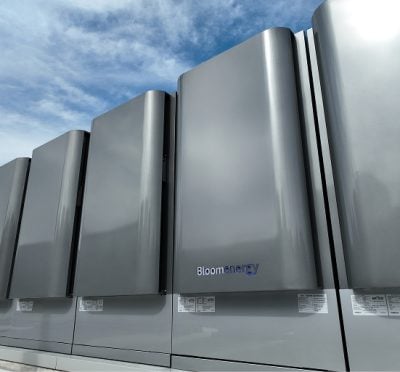
Bloom Energy (NYSE:BE) offers retirement portfolios direct exposure to the AI power buildout through a contracted-revenue model. After a 43% pullback in the past month, Bloom’s contracted growth is available at a steep discount to analysts’ price targets.
Bloom’s $20B Contracted Backlog
Bloom has $20.00 billion in total backlog, including a $14 billion service backlog tied to 10- to 15-year contracts with a 100% attach rate. That is annuity-grade visibility.
Q1 2026 revenue grew 130.37% year over year to $751.054 million, and management raised full-year guidance to $3.40 billion to $3.80 billion, taking growth to 80% at the midpoint from 60% prior.
The 40% Pullback Creates a Fresh Entry Point
Bloom Energy closed at $185.81 on Friday, July 24, meaning the stock is down 43.32% in the past month, giving investors a fresh entry point below analysts’ average price target of $286.20.
Bloom holds $2.491 billion in cash, which is up 213.49% year over year, and is funding a factory ramp from 1GW to 2GW by year-end 2026. Forward guidance implies non-GAAP EPS of $1.85 to $2.25, and adjusted EBITDA of $650 million to $800 million.
Bloom Energy Is Growing 4x Faster Than GE Vernova
The tempting comparison for Bloom is to GE Vernova (NYSE:GEV | GEV Price Prediction), which owns the gas turbine side of the data center power trade. GE Vernova’s Q2 2026 revenue rose 21.83% year over year to $11.10 billion, and its 2026 revenue guide of $45.5 billion to $46.5 billion implies mid-teens growth.
The thing is, Bloom is compounding roughly four times faster off a smaller base, and it does not carry GE Vernova’s approximately $400 million of expected Wind segment EBITDA losses in 2026.
Plug Power (NASDAQ:PLUG) saw Q1 2026 revenue of $163.513 million on an adjusted loss of $0.08 per share, with management not targeting EBITDAS-positive results (EBITDA and Stock-based comp) until Q4 2026. Bloom is already there.
Why an AI Spending Slowdown Would Not Break the Thesis
The obvious pushback for Bloom is AI capex slowing. However, it helps to take a look at the company’s order book. Oracle’s Project Jupiter alone is a 2.45 gigawatt, 100% Bloom power block, and Bloom’s CEO KR Sridhar said, “Well more than half of our current data center backlog comes from other hyperscalers, neo-clouds and colocation providers.” Demand is contractually signed.
Insider selling looks scary at first glance, but the CEO’s May transaction was an 80,000 share RSU conversion executed on a scheduled vesting, and the board acquired shares in coordinated May 21 filings. For retirement investors focused on AI infrastructure exposure, Bloom Energy’s contracted backlog, cash position, and growth trajectory make it a name to research closely.
Contact [email protected] for any questions or corrections.
Thomas Richmond is a financial writer and content strategist with 5+ years of experience covering stocks and financial markets. He has published over 500 articles focused on individual stock analysis, helping investors better understand business fundamentals, stock valuations, and long-term opportunities.
Thomas previously served as a Content Lead at TIKR, a stock research platform, where he helped scale the company’s blog to hundreds of articles per month and contributed to a weekly newsletter reaching more than 100,000 investors.
Outside of work, Thomas enjoys weight lifting and soccer.