Costco Stock Keeps Defying Expectations. Here’s My 2027 Price Prediction
Costco's fundamentals keep compounding while the stock sits well below its recent peak, and a specific combination of catalysts could push shares far beyond where Wall Street's consensus lands by 2027.


Costco (NASDAQ: COST | COST Price Prediction) has been a rare stumble story in an otherwise strong market. Shares are up just 4.36% year-to-date and actually down 4.45% over the past year, trading at $896.01 after slipping 5.46% in the past month. Yet the business keeps compounding.
The membership warehouse operator has beaten EPS estimates in five straight quarters, membership fee income keeps growing double digits, and traffic is still climbing. That disconnect between fundamentals and price sets up a real question.
Let’s walk through how Costco shares could reach $1,150 by September 2027.

Wall Street Sees Roughly 19% Upside From Here
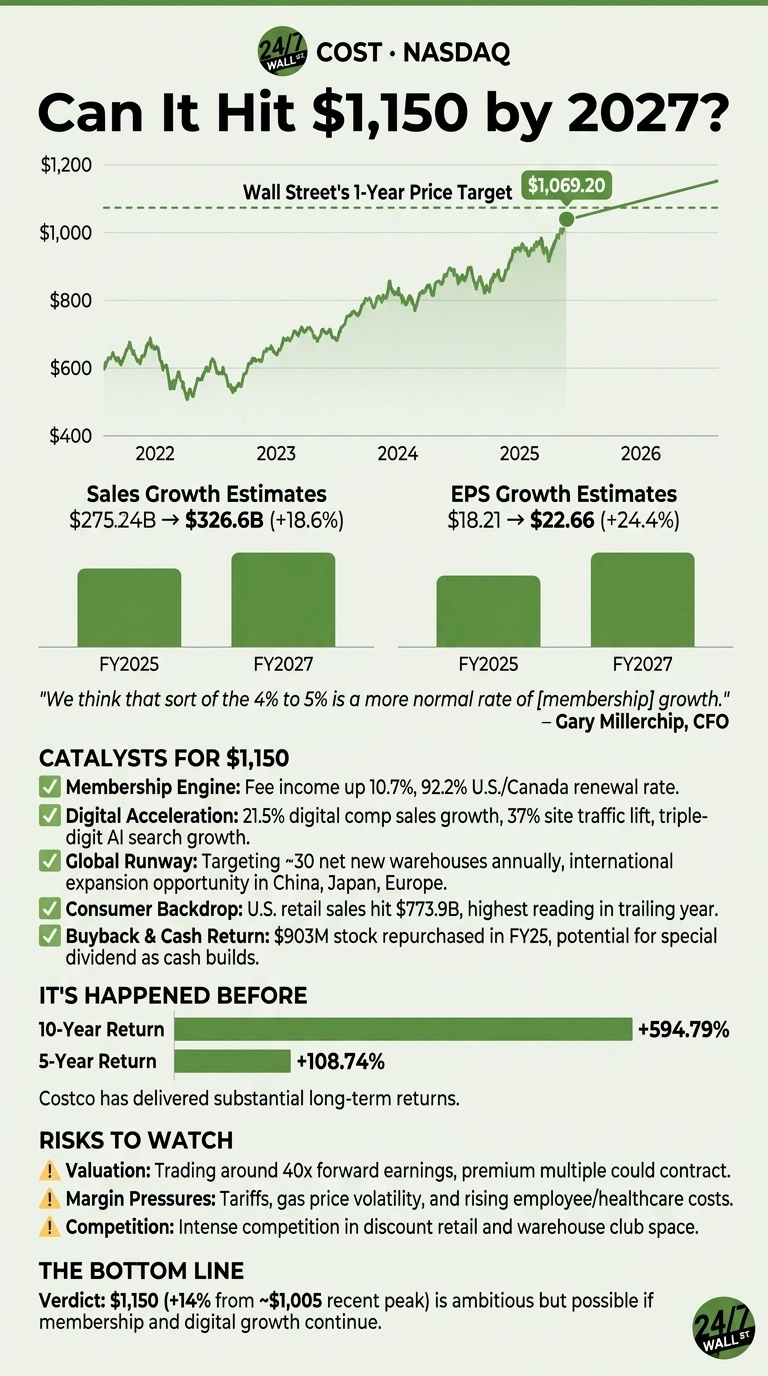
The analyst consensus one-year target sits at $1,069.20, drawn from a panel of 37 analysts with 23 buy-or-better ratings against just two sell ratings. Consensus fiscal 2027 EPS is $22.66, with seven upward revisions over the trailing 30 days.
Revenue is projected to reach $326.6 billion in fiscal 2027, up from $275.2 billion in fiscal 2025. Given a five-quarter beat streak, actual results will likely land above those numbers.
Path to $1,150 Per Share
At $896, Costco trades at roughly 40x forward earnings using consensus fiscal 2027 EPS of $22.66. Hitting $1,150 would put the multiple near 51x, which sounds rich but is close to Costco’s trailing P/E of 45. The market has repeatedly paid a premium for this business, and here is why:
- Membership engine: Fee income hit $1.373 billion in Q3, up 10.7%, with a U.S./Canada renewal rate of 92.2% and 41.2 million executive members (up 9.6%).
- Digital acceleration: Digitally enabled comparable sales rose 21.5% with site and app traffic up 37%. Traffic from AI searches grew at a triple-digit rate and converts at the highest rate on the site.
- Global runway: Management is targeting roughly 30 net new warehouses per year, with international expansion described as a five-to-ten-year opportunity across China, Korea, Japan, France, Spain, and the U.K.
- Consumer backdrop: U.S. retail sales reached $773.9B in August, the highest reading in the trailing year.
- Buyback and cash return: Costco repurchased $903 million of stock in FY25 and management has flagged a potential special dividend as cash builds.

History Says a 28% Move Is Very Achievable
Reaching $1,150 requires roughly a 28% total return over the next year. Costco has done far more. Shares are up 108.74% over five years and 594.79% over ten years.
The stock’s own 52-week high of $1,094.76 is only a short hop from our target, and an internal modeling framework already pegs a bull-case 2027 price of $1,151.26. With a beta of just 0.855, Costco can grind higher simply by reclaiming its recent range.

Bottom Line on $1,150
Getting Costco back to $1,150 asks for roughly 28% upside, above Wall Street’s $1,069.20 consensus.
The bull case rests on durable pillars: a 6% to 7% ex-gas comp trend, high-margin membership fees compounding, an under-tapped international footprint, and a five-quarter earnings beat streak that keeps forcing estimates higher.
The multiple is not cheap, and margin pressure from tariffs and gas is real. Returns like this should not be expected every year, but we’ve laid out the blueprint for how Costco could deliver an outsized 2027.
Contact [email protected] for any questions or corrections.
Vandita Jadeja is a financial publisher with over a decade of experience writing about financial topics, including investment, savings, retirement, insurance and banking. Vandita is a Chartered Accountant who loves to debunk financial concepts for readers.
Her work has appeared on sites that include The Motley Fool, InvestorPlace, and Benzinga. She covers investing and focuses on stock picks and price prediction for 24/7 Wall St.
When not looking for the next stock investment opportunity, she can be found traveling, reading, chasing sunsets and enjoying her iced latte.