Rocket Lab Tumbles 11% as Neutron’s First Flight Moves to 2027; SpaceX and AST SpaceMobile Pull Back
A manufacturing flaw found during production has forced Rocket Lab to push its most ambitious rocket program past a deadline investors were counting on, and now the question is how much longer the cash burn can stretch before something has…

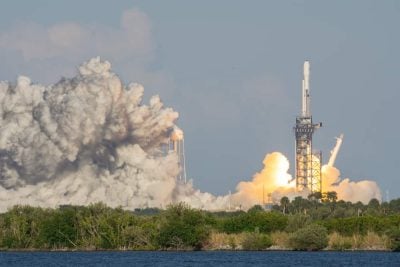
Neutron, the medium-lift reusable rocket at the center of Rocket Lab‘s (NASDAQ:RKLB | RKLB Price Prediction) push into larger launches, is now scheduled to make its first flight in 2027, later than the company had targeted. Rocket Lab stock is at $52.85, down 11% in morning trading, after already declining 8% yesterday to $59.18.
Meanwhile, SpaceX (NASDAQ:SPCX) stock is at $148.65, down 2%, a narrower decline for the launch incumbent Neutron was designed to challenge. Similarly, AST SpaceMobile (NASDAQ:ASTS) stock is at $41.38, down 2%, matching the SpaceX slide.
The Procure Space ETF (NASDAQ:UFO), a space-sector fund that held Rocket Lab, SpaceX and AST SpaceMobile in its latest portfolio filing, is at $39.12, is sliding 2%. The broad-market fund SPDR S&P 500 ETF Trust (NYSEARCA:SPY), meanwhile, is at $767.54, down 0.3%. Those gaps mark the Neutron news as a company-specific repricing.

Composite Dome Flaw Pushes Neutron Into 2027
Rocket Lab said after the close on October 14 that it now expects Neutron’s first launch next year. Chief Executive Officer Peter Beck disclosed that during manufacturing, the company found voids forming within the carbon composite layers of the propellant dome, and according to him the voids would reduce margin and wouldn’t necessarily cause a failure in flight, and the problem is now solved.
Testing is the critical item. Beck said the cryogenic (cryo) and hydrostatic test campaigns won’t finish until Q1 2027. When Rocket Lab last updated the schedule in August, it had targeted delivery of Neutron to the launch pad before the end of this year, with Stage 1 tank production aligned to a Q4 2026 timeline.
Why Neutron Hits Rocket Lab Harder Than Its Rivals
Rocket Lab makes its launch revenue today from the Electron small-lift rocket and the HASTE suborbital vehicle, and it also builds satellites and spacecraft components, while SpaceX flies its own launch fleet and AST SpaceMobile builds a satellite network sold through mobile carriers, so Neutron’s schedule affects Rocket Lab’s future revenue alone.
Beck noted the tension on the August 10 call, when production still lined up with a fourth-quarter pad target. “While the window for an end-of-year launch is narrowing, the work we’re doing now is about risk trading, balancing the timing of our first launch against how quickly and seamlessly we can scale our tenth launch,” he stated.
The bull case rests on Beck’s statement that the dome problem is solved, which frames the delay as a schedule cost with the core design intact. On the August call, Beck called Neutron demand “not a concern.” He said customers were booking the vehicle at full price before its first flight, including a dedicated Space Force launch and a full rocket for Kepler Communications. At the end of Q2 2026, Rocket Lab’s backlog stood at $2.36 billion, up 137% year over year.

Skeptics note Neutron’s debut has slipped before. Chief Financial Officer Adam Spice said in August that cash-flow improvement is tied to Neutron’s first successful test launch, so a later debut pushes that pivot out while cash burn stays elevated.
Testing Window Sets the Next Move
Rocket Lab now faces the question of whether the cryo and hydrostatic campaigns finish inside the Q1 2027 window Beck named. Rocket Lab’s Q3 2026 report will show whether its revenue guidance of $250 million to $265 million holds while Neutron spending stays heavy. Beck put the stakes clearly in August: “Obviously the first flight is extremely important, but what about flight 10?”

Electron and HASTE keep Rocket Lab generating revenue in the meantime, and its GHOST globally deployable launch system was already scheduled for a 2027 operational debut from Alaska. A clean finish to the test campaigns would give the bull case its strongest evidence, while another slip would hand the skeptics fresh support, so investors should keep their Rocket Lab share positions sized for either outcome.
Contact [email protected] for any questions or corrections.
David Moadel is financial writer specializing in stocks, ETFs, options, precious metals, and Bitcoin. David has written well over 1,000 articles for leading online publications, helping investors understand markets, income strategies, and risk.His work has appeared in The Motley Fool, InvestorPlace, U.S. News & World Report, TipRanks, ValueWalk, Benzinga, Market Realist, TalkMarkets, Finmasters, 24/7 Wall St., and others.With a master’s degree in education, David has taught at the elementary, high school, and college levels. That teaching background shapes his writing style: clear, educational, and practical. David has also built a loyal social-media audience by providing trustworthy financial content on YouTube, X/Twitter, and StockTwits.