What Will $5,000 Invested in Palantir Stock Be Worth in 5 Years?
Palantir just posted revenue growth above 90% year-over-year with a Rule of 40 score that has Wall Street rubbing its eyes, yet the five-year model tells a far more complicated story than the bull hype suggests.

This post may contain links from our sponsors and affiliates, and Flywheel Publishing may receive compensation for actions taken through them.

Palantir Technologies (NASDAQ:PLTR | PLTR Price Prediction) has become one of the most closely watched names in enterprise AI, riding a wave of sovereign-AI demand that pushed U.S. commercial revenue up 149% year-over-year in the second quarter of 2026.
At a recent price of $175.91, the question for investors putting a fresh $5,000 to work is simple: what could that stake realistically look like five years out, if the modeled trajectory holds?
Base Case: What $5,000 Could Become by 2031
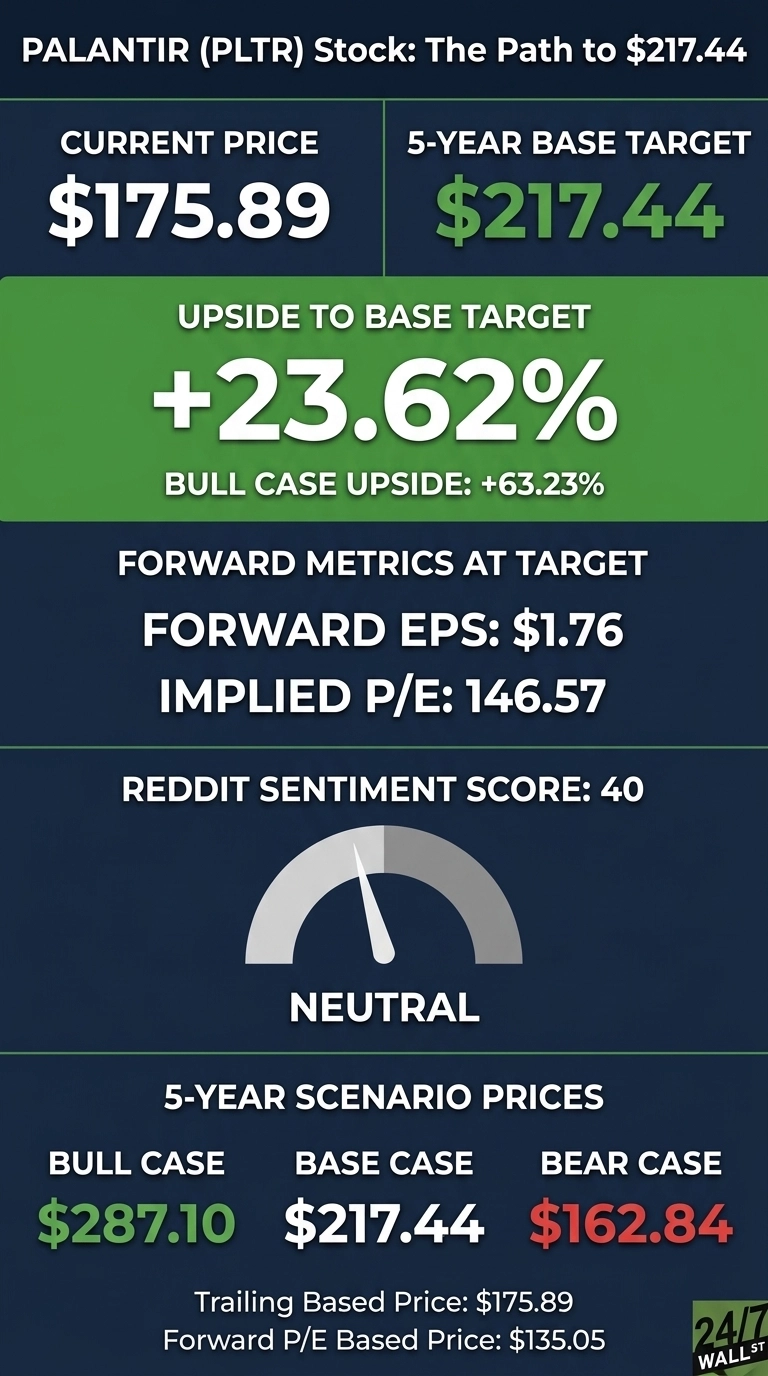
Under the five-year base case, PLTR shares are modeled to reach $217.44, a total return of 23.62% or roughly 4.33% annualized. Plugged into a starting stake, a $5,000 investment could be worth about $6,181 at the five-year mark.
The modeled per-share target sits below the current $196.84 analyst consensus target, reflecting a valuation methodology that blends trailing P/E, forward P/E, and analyst targets with a proprietary factor score. Model confidence on the projection is high at 0.9, and the current recommendation reads hold based on a 3.55% reported upside to fair value.

Bull, Base, and Bear Scenarios Side by Side
Across the modeled scenarios, the range for a $5,000 stake stretches from a modest loss to a solid gain. Every figure below is drawn directly from the five-year prediction data and pipeline calculations.
| Scenario | Target Price (2031) | Total Return | Value of $5,000 Stake |
|---|---|---|---|
| Bull | $287.10 | 63.23% | $8,161.50 |
| Base | $217.44 | 23.62% | $6,181 |
| Bear | $162.84 | -7.42% | $4,629 |
Analyst sentiment currently skews positive, with 66 bullish, 28 neutral, and 6 bearish ratings feeding the model, and a formal breakdown of 1 strong buy, 20 buy, 9 hold, 1 sell, and 1 strong sell.

Why the Bull Thesis Has Teeth
Palantir’s fundamentals are running hot enough to justify the wide upside band. In the second quarter of 2026, Palantir posted revenue of $1.935 billion, up 92.83% year-over-year, with a Rule of 40 score of 155 and adjusted free cash flow of $1.22 billion at a 63% margin.
Total remaining deal value hit $13.1 billion, up 83% year-over-year, and net dollar retention expanded to 157%. Management raised full-year 2026 revenue guidance to $8.150 to $8.158 billion, representing 82% year-over-year growth, and lifted adjusted free cash flow guidance to $4.5 to $4.7 billion.
CEO Alex Karp framed the setup this way: “Demand for AI sovereignty has now been unleashed. And Palantir is the only company that has demonstrated it can transform tokens into actual economic value.”
He also set an internal target of “I am driving the business to grow at a rate equal or above to what we have in U.S. commercial for the next 18 months, which is a very high goal.” If that bar is even partially met, the bull path becomes credible.
Karp’s framing is the kind of early signal that separated past monster tech winners from the pack (we reverse-engineered what those traits looked like before the runs in a free playbook here: The Next Nvidia Playbook).
Risks That Could Push the Stake Toward the Bear Case
Valuation is the loudest risk in the room. Palantir trades at a P/E of roughly 250 and a P/FCF of about 193, with an EV/Revenue of 68 and a forward P/E of 78. At those multiples, any slip in the growth curve, U.S. government budget shifts, or slowdown in AIP monetization can compress the stock quickly.
Other flagged risks include heavy stock-based compensation ($265 million in Q2 2026), long and unpredictable sales cycles, termination-for-convenience contract clauses, and concentration in the U.S. market. Beta of 1.621 flags above-market volatility, and shares are already only about 5% below the 52-week high of $207.52.
Bottom Line for a $5,000 PLTR Stake by 2031
The modeled range for a $5,000 investment in Palantir over five years runs from $4,629 in the bear case to $6,181 in the base case and $8,161.50 in the bull case.
Analyst consensus and the model’s high 0.9 confidence both point to the base case sitting near fair value today. These are scenario projections built from current data, and this article is for informational purposes only.
Contact [email protected] for any questions or corrections.
Vandita Jadeja is a financial publisher with over a decade of experience writing about financial topics, including investment, savings, retirement, insurance and banking. Vandita is a Chartered Accountant who loves to debunk financial concepts for readers.
Her work has appeared on sites that include The Motley Fool, InvestorPlace, and Benzinga. She covers investing and focuses on stock picks and price prediction for 24/7 Wall St.
When not looking for the next stock investment opportunity, she can be found traveling, reading, chasing sunsets and enjoying her iced latte.