Fastenal vs. Applied Industrial Technologies: Which Dividend Grower Is the Better Buy?
Both industrial distributors have rewarded shareholders for years, but one carries a payout ratio that leaves little cushion while the other sits below analyst targets with a cleaner growth story waiting to play out.


Fastenal (NASDAQ:FAST | FAST Price Prediction) or Applied Industrial Technologies (NYSE:AIT): which dividend grower should an investor planning for retirement own right now? Starting yields are low: Fastenal pays 1.81% and Applied pays 0.58%. This contest turns on moat, payout growth, coverage and price. Both stocks have run this year, with Fastenal up 27.73% and Applied up 30.48% year to date. Both slipped over the past month, by 1.41% and 2.64%, respectively.
Business Model: Fastenal’s Embedded Vending Network Wins
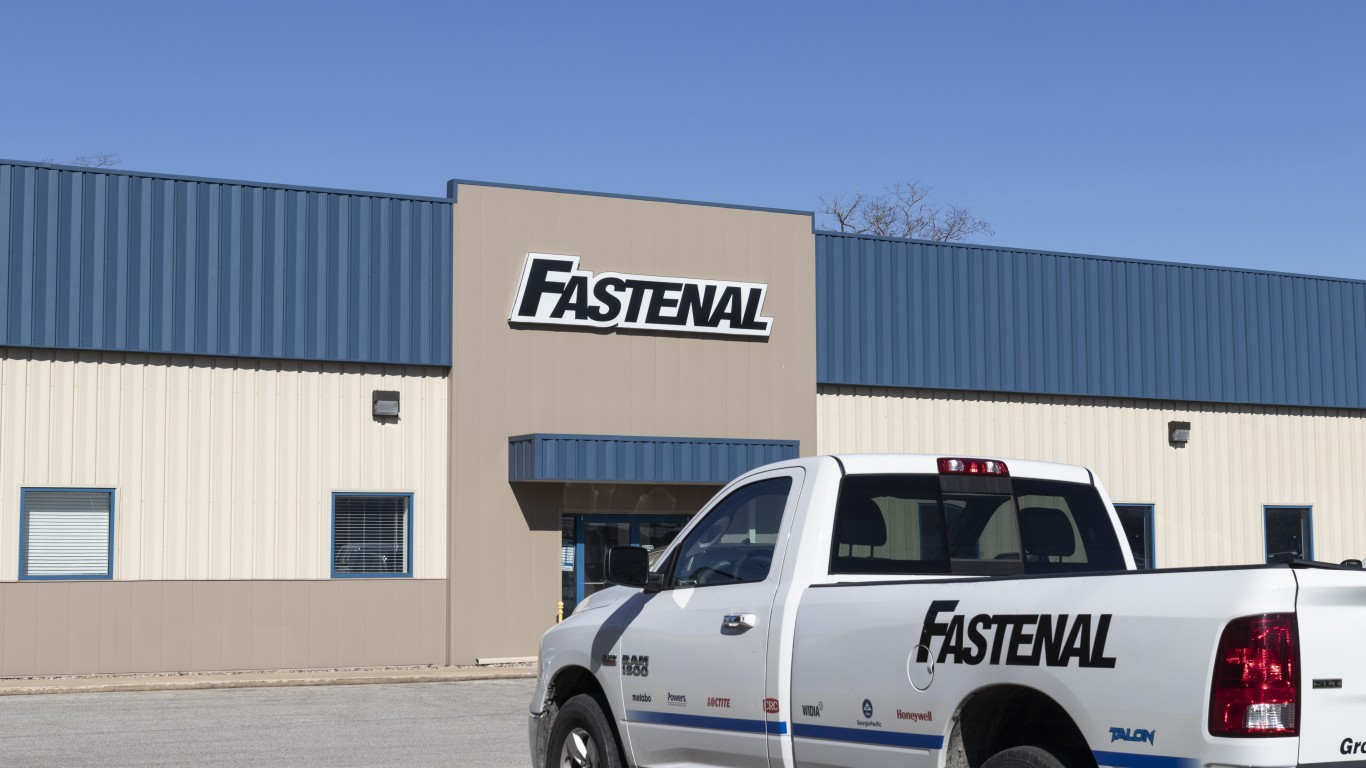
Fastenal runs roughly 3,200 in-market locations and 140,789 FASTBin and FASTVend installations, up 6.5%. Contract customers now make up 75.8% of revenue, and Digital Footprint sales reached 61.6% of net sales. A vending machine bolted to a customer’s plant floor creates switching costs that a branch counter cannot match. Second-quarter revenue rose 14.7% to $2.39B.
Applied wins customers through technical expertise. Automation organic sales rose over 20%, and 27 of the top 30 U.S. service center sectors grew. That edge leans on engineers and acquisitions, with more than 18 transactions since 2018. Fastenal’s physical presence inside customer facilities is harder to replace. One caveat: its gross margin contracted 50 bps to 44.6% in the first quarter as larger accounts grew in the mix.
Dividend Growth and Coverage: Applied Pulls Ahead
Fastenal’s record needs cleaning up. It paid supplemental distributions of $0.40 in December 2020 and $0.38 in December 2023. The drop from $0.44 to $0.22 in 2025 coincides with a two-for-one stock split. The regular payout then rose to $0.24 in January and $0.26 in July. Coverage is thin. The 2025 dividends of $1,004.2M took 79.8% of net income. That came against free cash flow of $1.05B, and 2026 capex guidance jumps to $310M to $330M from $230.6M.
Applied’s history is clean and steady. The quarterly payout climbed from $0.33 in 2021 to $0.51, with no specials. Its latest 11% raise was its 17th increase since 2010. A $2.04 forward dividend stands against fiscal 2026 GAAP EPS of $10.95 and free cash flow of $460.5M. Applied still bought back $317.2M of stock while carrying net leverage of just 0.2 times EBITDA.
Valuation: Applied Is the Cheaper Compounder
Long-run historical multiples are unavailable here, so each stock is measured against its own trading range and growth. Fastenal trades at 43x trailing and 37x forward earnings, with a PEG of 3.39. Its $50.43 price stands above the $48.84 analyst target and near its $52.92 52-week high.

Applied trades at 31x trailing and 28x forward, with a PEG of 2.779. At $333.16, it stands below both its $374.27 high and the $400 target. Management cited five-year EPS growth of 18% and guides fiscal 2027 EPS to $11.65 to $12.15. It also raised its intermediate sales target to $7 billion. CEO Neil Schrimsher said Applied enters the year “with the strongest market position in Applied’s history.”

Verdict: Applied Industrial Wins for Dividend Growers
Applied takes two of three dimensions and wins for the long-term dividend-growth investor, offering faster raises, wide coverage, a strong balance sheet and a lower multiple. Fastenal fits a narrower profile. It suits a retiree who wants a higher starting yield and less volatility, given its beta of 0.713 versus Applied’s 0.834. That investor pays a premium for a payout with little room to grow faster than earnings.
Two developments would flip this call. A large debt-funded acquisition at Applied, or organic growth falling short of its 6% to 8% first-quarter forecast, would weaken its case. Fastenal’s multiple compressing toward Applied’s while its payout ratio eases would strengthen its own. Both companies’ next earnings reports could reveal either shift.
Contact [email protected] for any questions or corrections.
Chris Lange is a financial and geopolitical writer with more than a decade of experience covering a myriad of topics. He has published thousands of articles for 24/7 Wall St., with past coverage focused heavily on stocks, IPOs, healthcare, defense, global affairs, and technology.
His work has been quoted, or referenced by a number of outlets including Business Insider, USA Today, Yahoo Finance, MSN, The Motley Fool, and many other publications. A graduate of Southwestern University, he studied business with a focus on investments and has previous experience in banking and startups.
When not reading or writing the news, he is following his passion for Lacrosse, playing chess, or building solar projects with his dad.